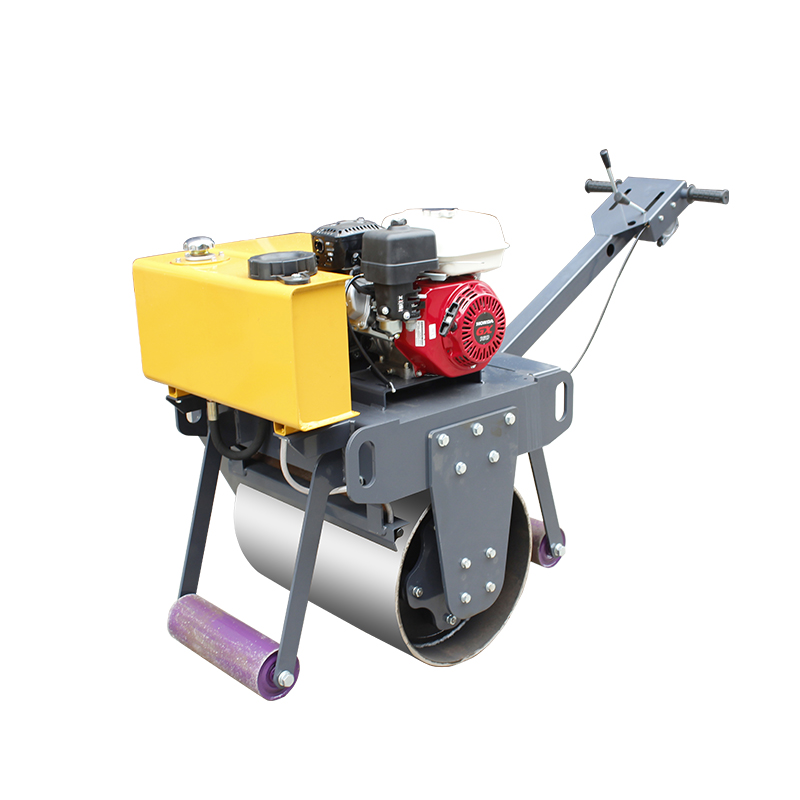
The core contradiction of subgrade compaction in permafrost regions lies in "balancing the frost heave and thaw settlement characteristics of permafrost with compaction stability". Permafrost (including seasonal permafrost and permafrost) is prone to volume deformation under temperature changes. Compaction operations must avoid damaging the permafrost structure and causing subsequent thaw settlement, while ensuring the subgrade meets compaction degree standards. The technical requirements and operation specifications for rollers should focus on four core aspects—"low-temperature adaptability, controllable energy, permafrost protection, and uniform compaction"—to form targeted solutions, as detailed below:
The operating environment in permafrost regions has low temperatures (winter temperatures range from -10℃ to -30℃ in seasonal permafrost areas, and remain ≤0℃ year-round in permafrost areas). Roller power systems must meet low-temperature adaptability requirements:
Engine: Equipped with low-temperature starting devices (e.g., glow plugs, fuel heaters) to ensure a single-start success rate of ≥95% at -30℃. Low-freezing-point fuel (e.g., -35# diesel) and low-temperature viscosity grade engine oil (e.g., 5W-40) must be used to prevent fuel solidification and reduced oil fluidity at low temperatures.
Hydraulic System: Uses low-temperature anti-wear hydraulic oil (viscosity grade HV46). The hydraulic oil tank is equipped with thermal insulation devices to avoid vibration/travel system failure due to hydraulic oil solidification at low temperatures. Hydraulic pipelines are made of low-temperature resistant rubber to prevent freezing, cracking, and leakage.
Battery: High-capacity low-temperature batteries (capacity ≥150Ah) with battery insulation sleeves are used to ensure stable power supply at low temperatures and prevent startup failure.
Permafrost particles are brittle, and their cohesion is significantly affected by temperature (strong cohesion but high brittleness at low temperatures; weak cohesion and prone to "springing" when thawed). Roller compaction systems must precisely control energy output:
Vibration Parameters: Priority is given to the "high-frequency, small-amplitude" combination (frequency: 35–40Hz, amplitude: 0.5–1.0mm) to avoid permafrost particle fragmentation and structural damage caused by large amplitudes (≥1.5mm). For compaction in permafrost areas, vibration must be turned off and static pressure mode adopted to prevent vibration from disturbing the permafrost base and causing thaw settlement.
Tonnage Matching: For seasonal permafrost areas (compaction during thaw periods), 16–20t double-drum/single-drum vibratory rollers (static linear load ≥300N/cm) are selected to balance compaction degree and structural protection. For permafrost areas, 18–22t static rollers (pneumatic tyred/double-drum) are used to achieve compaction through static pressure, avoiding the transmission of vibrational energy to deep permafrost layers.
Drum Design: Rollers are equipped with anti-slip and wear-resistant layers (e.g., hard alloy overlay welding) to prevent freezing and adhesion between the drum and permafrost at low temperatures. The drum width is controlled at 1.8–2.0m to ensure uniform lateral compaction and reduce local pressure concentration. Some models may be equipped with drum heating devices (used during initial startup at low temperatures) to prevent permafrost from freezing to the drum surface.
Control System: The cab is equipped with heating and cooling air conditioning (heating temperature ≥20℃) and anti-frost/defogging devices to ensure clear visibility for operators. Control levers are made of anti-freezing materials with heating functions to prevent operational failure at low temperatures.
Safety Protection: The roller body is equipped with a Roll-Over Protective Structure (ROPS) and Falling Object Protective Structure (FOPS), which undergo low-temperature toughness enhancement treatment to adapt to structural strength requirements at -30℃. Tyres (for pneumatic tyred rollers) are low-temperature crack-resistant tyres (temperature resistance range: -40℃ to 60℃) to prevent low-temperature brittleness and cracking.
Monitoring System: Equipped with a permafrost temperature monitor (for real-time monitoring of subgrade surface/deep temperature) and a real-time compaction degree monitoring system (e.g., integrated nuclear density gauge device), allowing operators to dynamically adjust operation parameters.
Temperature Control Principle: Compaction operations must be conducted within the "stable temperature range" of permafrost. For seasonal permafrost areas, priority is given to the summer thaw period (surface permafrost thaw depth ≥20cm, temperature: 5–10℃) or early winter freezing period (temperature: -5℃ to 0℃, permafrost not fully hardened). For permafrost areas, operations must be carried out during the permafrost’s stable temperature period (-5℃ to -2℃), avoiding compaction during the permafrost freeze-thaw transition period (temperature near 0℃) to prevent subgrade springing and displacement.
Energy Gradation Principle: A gradual transition from static pressure to vibration (in seasonal permafrost areas) is required to avoid direct activation of large-amplitude vibration. The number of rolling passes must be increased by 1–2 compared to conventional areas to ensure compaction degree standards are met without damaging the permafrost structure.
Base Protection Principle: For subgrade compaction in permafrost areas, disturbance to the permafrost base must be avoided. The roller must maintain a stable travel speed, with no sudden braking or sharp turns, to prevent permafrost thaw settlement caused by sudden local pressure changes.
Operation Timing: The surface permafrost thaw depth reaches the compaction layer thickness (20–25cm), and the permafrost moisture content is controlled within ±2% of the optimal moisture content. If moisture content is too high, the soil must be air-dried to meet standards; if too low, a small amount of water must be sprinkled to avoid water freezing at low temperatures.
Roller Selection: 16–20t single-drum vibratory roller (high-frequency, small-amplitude: frequency 35–38Hz, amplitude 0.6–0.8mm) + 18–22t pneumatic tyred roller (static pressure).
Operation Process:
Initial Compaction: The pneumatic tyred roller performs 1–2 static passes (speed: 2–2.5km/h) to stabilize the loose laid layer and prevent permafrost particle displacement.
Secondary Compaction: The vibratory roller performs 3–4 high-frequency, small-amplitude passes (speed: 3–3.5km/h) to gradually improve compaction degree. Compaction degree is tested after each pass (target ≥95%).
Final Compaction: The pneumatic tyred roller performs 2 static passes (speed: 3–4km/h) to eliminate wheel tracks and correct flatness.
Precautions: Permafrost strength is low during the thaw period. Rollers must travel parallel to the subgrade centerline, with an overlap width of rolling strips ≥1/3 of the drum width, to avoid subgrade subsidence due to local overloading. If springing occurs during operation, rolling must be stopped immediately; operations can resume only after air-drying or lime mixing for improvement.
Operation Timing: The permafrost is fully frozen (temperature ≤-5℃), and the subgrade fill is coarse-grained soil (crushed stone soil, sand-gravel). Fine-grained soil (silty soil, clay) compaction during the freezing period must be avoided.
Roller Selection: 20–22t double-drum static roller. Vibratory rollers are prohibited (permafrost particles are highly brittle at low temperatures, and vibration easily causes particle fragmentation and subgrade cracking).
Operation Process: 3–4 static passes (speed: 2.5–3km/h) with an overlap width ≥1/2 of the drum width. Focus on compacting the subgrade edges (prone to looseness during the freezing period). After compaction, the subgrade rebound modulus is tested (target ≥30MPa) to ensure load-bearing stability in the frozen state.
Precautions: Compaction during the freezing period is only applicable to temporary subgrades or subgrade base layers. Compaction degree must be rechecked after spring thaw; if thaw settlement occurs, supplementary compaction or rework is required.
The core of subgrade compaction in permafrost areas is "protecting permafrost from thawing and disturbance" to avoid permafrost base thaw settlement caused by compaction energy. Operation specifications are more stringent:
Operation Timing: Select the stable temperature period of permafrost (winter: -10℃ to -5℃ or cool summer periods). Avoid operations during high-temperature periods (summer midday) to prevent surface permafrost thawing.
Roller Selection: 18–22t double-drum static roller or pneumatic tyred roller. Vibratory rollers are strictly prohibited (vibrational energy transmits to deep permafrost layers, damaging the frozen structure and causing thaw settlement).
Operation Process:
Base Treatment: First, perform 1 static pass on the permafrost base (speed: 2km/h) and test the base bearing capacity (target ≥250kPa). If bearing capacity is insufficient, a sand-gravel cushion (thickness: 10–15cm) must be laid before compaction.
Fill Compaction: The subgrade fill uses coarse-grained soil (crushed stone soil, sand-gravel, with particles ≥20mm accounting for ≥60%). The layered loose laying thickness is ≤20cm (5cm less than in conventional areas), with 3–4 static passes per layer (speed: 2.5–3km/h).
Surface Finishing: Finally, the pneumatic tyred roller performs 2 static passes to ensure the surface flatness IRI ≤2.5m/km.
Precautions: Water sprinkling during subgrade compaction in permafrost areas is prohibited (water infiltration damages the permafrost frozen structure). The fill must remain dry (moisture content ≤5%). The roller’s travel route must be fixed, with no frequent turns or sudden stops, to minimize disturbance to the permafrost base. After compaction, a thermal insulation layer (e.g., polystyrene board) must be laid promptly to prevent permafrost thawing.
Adjustment Measures: Reduce the roller travel speed (≤2.5km/h) and increase the number of rolling passes by 1 to avoid rapid surface cooling and water freezing of permafrost caused by strong winds, which affects compaction results.
Protection Measures: Operators wear cold-proof protective clothing and non-slip shoes. The cab doors and windows are closed, and the heating system is activated. Exposed hydraulic pipelines, tyres, and other components of the roller must be wrapped with thermal insulation sleeves to prevent freezing and cracking.
Adjustment Measures: Adopt a "gradual compaction" method. When transitioning from non-permafrost to permafrost areas, gradually reduce the roller tonnage (from 22t to 18t) and gradually decrease the amplitude of vibratory rollers (from 1.0mm to 0.5mm) to avoid uneven settlement in the transition section due to differences in compaction energy.
Operation Requirements: The overlap width of rolling in the transition section is ≥50cm, with 1 additional supplementary compaction pass to ensure continuous compaction degree in the transition section (coefficient of variation ≤3%).
Adjustment Measures: Use "narrow-width compaction + manual finishing" for subgrade edges. Small static rollers (8–10t, width: 1.5–1.8m) are used for compaction to avoid permafrost collapse at the edges caused by large rollers.
Operation Requirements: After slope compaction, timely finishing is required. The slope ratio is controlled at 1:1.5 to 1:2.0, and the slope is covered with straw bags or thermal insulation cloth to prevent freeze-thaw erosion.
Compaction Degree: ≥95% for subgrades in seasonal permafrost areas (expressways), and ≥96% for subgrades in permafrost areas (using coarse-grained fill).
Moisture Content: During compaction, the moisture content of permafrost fill must be controlled within ±2% of the optimal moisture content. Compaction in overly wet (moisture content ≥ optimal +3%) or overly dry (moisture content ≤ optimal -3%) conditions is prohibited.
Settlement Control: Post-construction settlement of the subgrade after compaction (during the thaw period) ≤5cm; thaw settlement of the permafrost base in permafrost areas ≤3cm.
Flatness: The surface flatness of the subgrade (IRI) ≤2.5m/km, with no obvious wheel tracks (depth ≤2mm).
Prohibition 1: High-intensity compaction using vibratory rollers during the permafrost freeze-thaw transition period (temperature near 0℃), which easily causes subgrade springing and thaw settlement.
Prohibition 2: Water sprinkling or using high-moisture-content fill during subgrade compaction in permafrost areas, which easily damages the permafrost frozen structure.
Prohibition 3: Directly activating the vibration system after long-term roller parking in low-temperature environments (≤-20℃), which easily causes hydraulic system freezing and cracking.
Prohibition 4: Sudden braking or sharp turns of the roller on permafrost subgrades, which easily causes local subgrade collapse or disturbance to the permafrost base.
Daily Maintenance: Before operation, check the low-temperature adaptability of the engine, hydraulic system, and battery, as well as the level and quality of hydraulic oil, engine oil, and fuel. After operation, park the roller in a wind-shielded and warm location, drain water from the water tank (to avoid freezing and cracking), and de-ice and clean the drum and hydraulic pipelines.
Long-Term Storage: After winter shutdown, park the roller in an indoor warehouse. Fill the fuel tank with fuel (to prevent tank rusting), remove the battery for indoor storage (with regular charging), apply anti-rust oil to the drum surface, relieve pressure in the hydraulic system, and replace with low-temperature hydraulic oil.
For subgrade compaction in permafrost regions, the core of the roller’s special technical requirements is "low-temperature adaptability + controllable energy", and the core of operation specifications is "temperature control + permafrost protection". It is necessary to select suitable roller types (vibratory/static) and parameters (amplitude, frequency, tonnage) based on the permafrost type (seasonal/permafrost) and construction stage (thaw/freeze period). Strictly adhere to the principles of "gradual compaction, avoiding disturbance, and strict moisture content control", while implementing low-temperature protection for equipment and quality monitoring. This ensures the subgrade meets compaction standards and maintains long-term stability, preventing subsequent pavement cracking, settlement, and other defects caused by frost heave and thaw settlement.



 Chinese