The distinction between the application scenarios of single-drum and double-drum rollers essentially lies in the "precise matching of compaction requirements and equipment functions" — single-drum rollers, with core advantages of "large tonnage, strong vibration, and deep penetration", focus on "deep compaction of subgrades and interlocking of coarse particles"; double-drum rollers, with core advantages of "rigid drums, high-frequency small-amplitude vibration, and high flatness correction", focus on "uniform compaction and flatness protection of pavement structural layers (base course/surface course)". The scenario boundaries between the two can be clearly divided through four dimensions: "project stage, material type, compaction target, and site conditions", as detailed below:
Structural Features: Equipped with one large-diameter drum (diameter: 1.2–1.6m) + rear pneumatic tyres/crawler tracks, with a tonnage range of 10–30t (mainstream: 18–26t). The vibration system mainly adopts "large amplitude (1.0–2.5mm) and medium frequency (25–35Hz)", featuring high static linear load (≥350N/cm) and deep energy penetration depth (20–40cm).
Core Functions: Break the friction/cohesion between material particles through concentrated vibration energy to achieve deep compaction and interlocking of coarse particles. Suitable for compaction scenarios requiring "thick layers, coarse particles, and low flatness requirements".
Limitations: Only one drum is in contact with the ground, so lateral compaction uniformity is slightly inferior to that of double-drum rollers. Its flatness correction capability is weak, and it tends to leave wheel tracks on the surface.
Structural Features: Equipped with two symmetric drums (diameter: 1.5–1.8m), with a tonnage range of 6–14t (mainstream: 8–12t). The vibration system mainly adopts "small amplitude (0.3–1.0mm) and high frequency (35–40Hz)", featuring uniform static linear load (250–300N/cm) and gentle distribution of ground contact pressure.
Core Functions: Achieve uniform surface compaction and flatness correction through synchronous rolling and high-frequency vibration of the two drums. Suitable for compaction scenarios requiring "thin layers, fine particles/binder-containing materials, and high flatness requirements".
Limitations: Smaller tonnage and shallow vibration energy penetration depth (≤20cm), making it difficult to meet the deep compaction needs of thick-layer fills with coarse particles.
Applicable Equipment: Single-drum rollers (large-amplitude models of 22–26t); impact rollers can be used for rock-filled embankments to enhance compaction.
Basis: Coarse-grained materials have high porosity and strong friction, requiring large-amplitude vibration energy (1.8–2.5mm) to force particles to undergo plastic deformation and interlock. The concentrated pressure of single-drum rollers can penetrate thick-layer fills (30–40cm), avoiding "dense surface with loose interior".
Applicable Equipment:
Deep compaction (layered thickness: 20–25cm): Single-drum rollers (16–20t, amplitude: 0.8–1.2mm) to avoid cohesive structure damage caused by large amplitudes.
Surface compaction (≤15cm): Double-drum rollers (10–12t, high-frequency small-amplitude), supplemented by pneumatic tyred rollers for kneading compaction to improve uniformity.
Applicable Equipment: Double-drum rollers (priority given to static pressure or high-frequency small-amplitude vibration mode).
Basis: The strength of binder-containing materials depends on the aggregate skeleton and binder cohesion. The one-sided concentrated pressure of single-drum rollers tends to cause excessive local pressure and damage the binder structure. The uniform pressure and high-frequency vibration of double-drum rollers can ensure compaction degree (void ratio of asphalt mixtures: 3%–6%) while protecting structural integrity.
Applicable Equipment: Single-drum rollers (large tonnage, large amplitude).
Target Achievement: Reduce post-construction settlement of the subgrade (≤5cm) and improve foundation bearing capacity (≥300kPa) through deep compaction. The vibration energy of single-drum rollers can help material particles form a stable skeleton structure, meeting long-term bearing requirements.
Applicable Equipment: Double-drum rollers (high-frequency small-amplitude, medium tonnage).
Target Achievement: Achieve a coefficient of variation of surface compaction degree ≤3% and flatness IRI ≤1.8m/km through uniform rolling. The synchronous operation of the two drums of double-drum rollers can avoid lateral compaction differences, and high-frequency vibration can eliminate tiny pores, improving surface uniformity.
Applicable Equipment: Single-drum rollers (large-tonnage models of 20–26t).
Target Achievement: The compaction efficiency of single-drum rollers is 30%–50% higher than that of double-drum rollers, with a daily operation volume per machine of over 15,000㎡. They are suitable for large-area extensive compaction scenarios, balancing efficiency and cost.
Applicable Equipment: Single-drum rollers (large tonnage, wide drums).
Basis: Open sites have no space restrictions. The large coverage range (drum width: 1.8–2.1m) and high efficiency of single-drum rollers can maximize construction progress without concerns about turning or passage issues.
Applicable Equipment: Double-drum static rollers (low noise, low vibration).
Basis: The noise level of double-drum rollers in static pressure mode is ≤75dB, much lower than that of single-drum rollers in vibration mode (≥85dB), avoiding vibration and noise impacts on the surrounding environment. If compaction degree needs to be improved, a high-frequency small-amplitude (0.3–0.5mm) vibration mode can be used to control the range of vibration propagation.
Hazards: Insufficient energy penetration depth of double-drum rollers leads to substandard deep compaction degree of the subgrade (≤90%), which is prone to settlement in the later stage.
Avoidance: Use single-drum rollers as the main equipment for subgrade construction. Flatness only needs to meet the requirement of "no obvious potholes", and surface flatness can be corrected through subsequent base course/surface course construction.
Hazards: The concentrated pressure and large amplitude of single-drum rollers easily cause aggregate crushing and binder detachment in asphalt mixtures, resulting in severe surface wheel tracks (depth ≥3mm).
Avoidance: Strictly use double-drum rollers for pavement surface courses (especially the top surface course), adopting the process of "static initial compaction + high-frequency small-amplitude secondary compaction + static final compaction".
Hazards: Large-tonnage single-drum rollers have a large turning radius (≥3m), making them unable to steer flexibly in narrow spaces. They are prone to colliding with slopes/tunnel walls, and corners cannot be properly compacted.
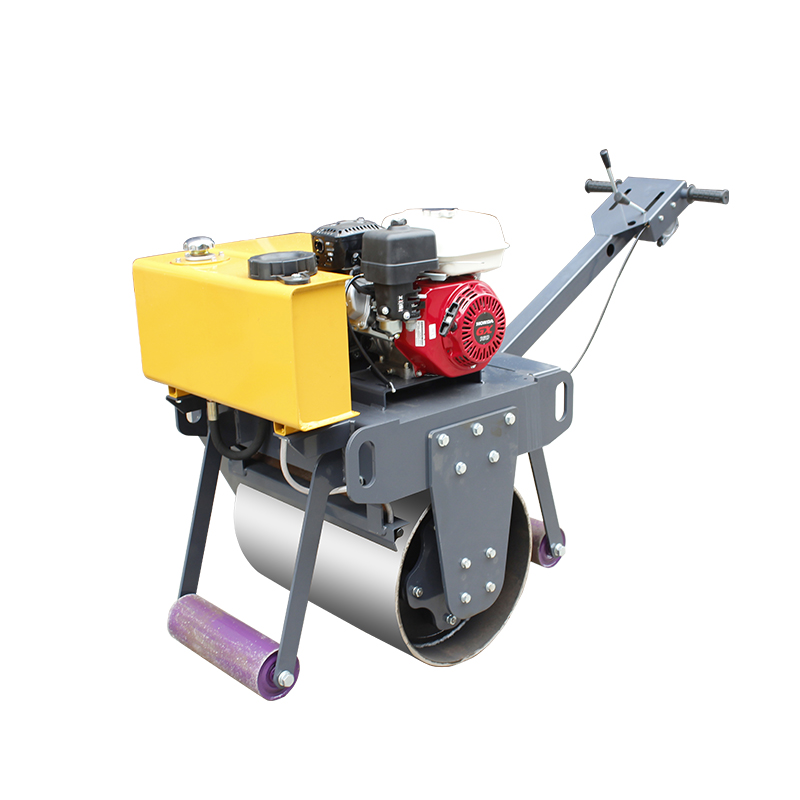
Avoidance: Use small double-drum or small single-drum rollers (tonnage ≤10t) in narrow spaces, supplemented by walk-behind micro-rollers for corner compaction to ensure no compaction blind spots.
Hazards: Insufficient energy of double-drum rollers prevents effective interlocking of coarse particles, resulting in a 5%–8% deficit in compaction degree and forming "false compaction" (surface appears compact but internal structure is loose).
Avoidance: Prioritize single-drum rollers for coarse-grained materials (crushed stone soil, block stone soil); if necessary, use impact rollers to ensure deep compaction.
The core of distinguishing the application scenarios of single-drum and double-drum rollers lies in "using single-drum rollers for subgrades and double-drum rollers for pavements" — single-drum rollers are suitable for subgrade compaction scenarios requiring "thick layers, coarse particles, low flatness requirements, and large areas", with the core goal of deep compaction and bearing capacity; double-drum rollers are suitable for pavement compaction scenarios requiring "thin layers, fine particles/binder-containing materials, high flatness requirements, and narrow/sensitive spaces", with the core goal of uniform compaction and flatness protection. During selection, it is necessary to first clarify the project stage and compaction target, then make fine adjustments based on material type and site conditions, avoiding "functional mismatch" that leads to substandard compaction quality or low efficiency.



 Chinese