The core properties of subgrade fill materials, such as particle gradation, cohesion, and porosity, directly determine the "energy type (static pressure/vibrational energy/impact energy)" and "action mode (uniform pressure application/impact interlocking/kneading compaction)" required for compaction. This in turn dictates the logic for selecting roller types: silty soil is suitable for the combination of "low-amplitude vibration + static pressure", sandy soil for "high-frequency medium-amplitude vibration", and crushed stone soil for "large-amplitude vibration + impact". The specific influence mechanisms and selection schemes are as follows:
Different subgrade fill materials exhibit significant differences in physical and mechanical properties, leading to entirely distinct core challenges in compaction and required energy forms. This serves as the fundamental basis for roller type selection:
Silty soil: Contains ≥30% particles with a diameter ≤0.075mm, featuring moderate cohesion and high porosity. The core challenge in compaction is to "break particle cohesion while avoiding surface hardening and deep-layer looseness". It requires "gentle and uniform vibrational energy + static pressure finishing" to prevent structural damage from excessive energy.
Sandy soil: Contains ≥70% particles with a diameter of 0.075–2mm, characterized by extremely weak cohesion and strong particle fluidity. The key compaction challenge is to "promote particle interlocking and prevent particle slippage". It needs "high-frequency vibrational energy" to drive rapid particle reorganization, without over-reliance on static pressure.
Crushed stone soil: Contains ≥50% particles with a diameter ≥20mm, having extremely high porosity and strong inter-particle friction. The main compaction difficulty is to "overcome friction and achieve deep-layer skeleton interlocking". It requires "large-amplitude vibrational energy or impact energy" to force coarse particles to undergo plastic deformation and form tight interlocking.
Main compaction equipment: 16–20t double-drum/single-drum vibratory roller (amplitude: 0.6–1.0mm, frequency: 35–40Hz).
Auxiliary compaction equipment: 18–22t pneumatic tyred roller (static pressure, tire pressure: 0.6–0.8MPa) or 12–16t double-drum static roller.
Prohibited equipment: Impact rollers (excessive impact energy easily damages the cohesive structure of silty soil, leading to "spring soil"—a phenomenon where soil rebounds like a spring); large-amplitude vibratory rollers (amplitude ≥1.5mm, prone to causing surface looseness).
Low-amplitude vibratory roller: The high-frequency, small-amplitude vibrational energy can gently break the cohesion between silty soil particles, promoting particle rearrangement. At the same time, it avoids surface particle splashing and insufficient deep-layer compaction caused by large amplitudes. The compaction depth can reach 20–25cm (layered compaction), and the compaction degree can be increased to 95%–96%.
Pneumatic tyred/static roller: The static pressure effect can further fill the tiny pores remaining after vibration, achieving uniform surface compaction and avoiding "surface hardening with deep-layer looseness". It also improves subgrade flatness and reduces the risk of long-term settlement.
Operation logic: Initial compaction: Use a static roller for 1–2 static passes (speed: 2–3km/h) to stabilize the loose laid layer. Secondary compaction: Use a low-amplitude vibratory roller for 3–4 passes (speed: 3–4km/h). Final compaction: Use a pneumatic tyred roller for 1–2 kneading passes or a static roller for 2 static passes to eliminate wheel tracks.
High-moisture silty soil (3% above optimal moisture content): Reduce the number of passes of the vibratory roller by 1, and increase the number of passes of the pneumatic tyred roller by 1–2 to prevent "spring soil" caused by vibration.
Modified silty soil subgrade (mixed with lime/cement): Reduce the amplitude of the vibratory roller to 0.5–0.8mm and increase the frequency to 38–40Hz to avoid vibration damaging the binder structure in the modified soil.
Main compaction equipment: 18–22t single-drum vibratory roller (amplitude: 1.0–1.5mm, frequency: 30–35Hz) or 12–16t double-drum vibratory roller.
Auxiliary compaction equipment: Optional 16–18t pneumatic tyred roller (only used for surface flatness correction).
Prohibited equipment: Pure static rollers (without vibrational energy, sandy soil particles cannot interlock effectively, resulting in a compaction degree of only 85%–90%, far below design requirements); low-frequency large-amplitude vibratory rollers (frequency ≤28Hz, slow particle reorganization speed, low efficiency).
High-frequency medium-amplitude vibratory roller: Vibrational energy can quickly drive the resonance of sandy soil particles, breaking their accumulated state, promoting particle interlocking, and forming a stable skeleton structure. Compared with static rolling, vibratory compaction improves efficiency by 30%–50%, with a compaction depth of 25–30cm (layered compaction) and a compaction degree of 96%–97%.
No static roller assistance needed: Sandy soil has weak cohesion, and particles are already fully interlocked after vibration. Static pressure cannot further improve compactness but instead increases operation time. Only when extremely high surface flatness is required (e.g., the upper subgrade layer connecting to the pavement base), a pneumatic tyred roller can be used for 1 kneading pass for correction.
Operation logic: Initial compaction: Use a vibratory roller for 1 static pass (speed: 2.5–3km/h) to stabilize the loose laid layer. Secondary compaction: Use the vibratory roller for 3–4 high-frequency medium-amplitude passes (speed: 3–4.5km/h). Final compaction: If needed, use a pneumatic tyred roller for 1 static pass to eliminate wheel tracks.
Sandy soil with high silt content (20%–30% silt particles): Reduce the amplitude to 0.8–1.2mm and increase the frequency to 35–38Hz to avoid uneven compaction caused by silt particle agglomeration.
Sand-filled subgrade (pure sand fill): Select a 22–26t large-tonnage vibratory roller (amplitude: 1.2–1.5mm). Utilize greater static pressure combined with vibrational energy to improve deep-layer compactness and prevent long-term liquefaction.
Main compaction equipment: 22–26t single-drum vibratory roller (amplitude: 1.8–2.5mm, frequency: 25–30Hz).
Enhanced compaction equipment: 25–30t triangular impact roller (impact energy: 20–30kJ, impact frequency: 12–15 times per minute).
Prohibited equipment: Small vibratory rollers (tonnage ≤16t, insufficient energy to penetrate deep-layer crushed stones); pure static rollers (only capable of compacting the surface layer, with insufficient deep-layer crushed stone interlocking, resulting in an 8%–10% deficit in compaction degree).
Large-amplitude vibratory roller: The strong impact energy provided by the large amplitude can overcome the friction between crushed stone particles, forcing particles to displace, rotate, and interlock. The compaction depth can reach 30–40cm (layered compaction), effectively reducing the porosity of crushed stone soil (from 35%–40% to 20%–25%).
Impact roller: The instantaneous impact energy is similar to "heavy hammer compaction", which can further enhance the interlocking effect of deep-layer crushed stones. It is particularly suitable for rock-filled embankments or subgrade base reinforcement of crushed stone soil, improving foundation bearing capacity by 20%–30% and reducing long-term settlement (≤5cm).
Operation logic: Initial compaction: Use a vibratory roller for 1–2 static passes (speed: 2–3km/h) to prevent crushed stone displacement. Secondary compaction: Use the vibratory roller for 4–5 large-amplitude passes (speed: 3–4km/h), followed by 2–3 passes with an impact roller. Final compaction: Use the vibratory roller for 2 static passes (speed: 3–3.5km/h) to correct flatness.
Crushed stone soil with high block stone content (block stone diameter ≥50cm): Increase the impact energy of the impact roller to 25–30kJ and the amplitude of the vibratory roller to 2.2–2.5mm to extend the particle interlocking time.
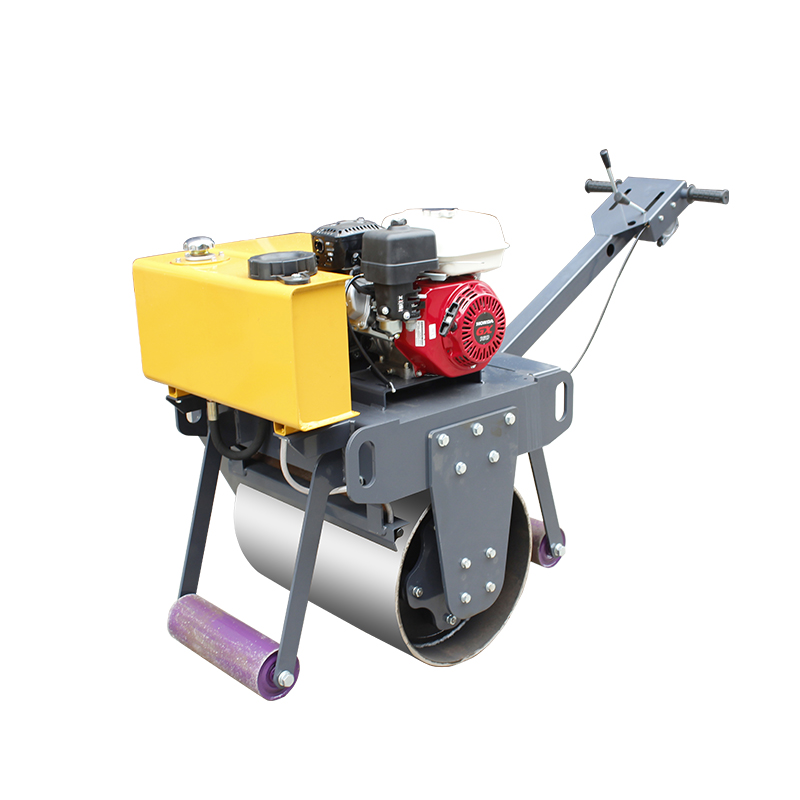
Compaction of crushed stone soil in narrow spaces (e.g., tunnel portals, foundation pit backfilling): Select an 8–12t small large-amplitude vibratory roller (amplitude: 1.5–2.0mm, turning radius ≤2.5m), combined with a 1–3t walk-behind micro vibratory roller (for corner compaction), to replace the impact roller (which is too large to enter the site).
Hazards: Using a large-amplitude vibratory roller for silty soil easily causes surface looseness and "spring soil"; using a small-amplitude vibratory roller for crushed stone soil fails to meet the design compaction degree.
Avoidance: Lock in vibration parameters (amplitude, frequency) based on the particle gradation of the fill material, then match the roller tonnage, rather than uniformly selecting based solely on "subgrade".
Hazards: The kneading effect of pneumatic tyres is ineffective for sandy soil; instead, it causes particle slippage and substandard compaction degree.
Avoidance: Use a high-frequency medium-amplitude vibratory roller as the core equipment for sandy soil subgrades. Pneumatic tyred rollers are only used for surface flatness correction and do not participate in main compaction.
Hazards: For large-diameter crushed stones or deep-layer compaction, vibrational energy is insufficient, leading to inadequate deep-layer particle interlocking and potential long-term settlement.
Avoidance: Rock-filled embankments and crushed stone soil subgrade base reinforcement must be combined with impact rollers. For conventional crushed stone soil subgrades, impact rollers can be used selectively based on compaction depth (≥30cm).
Hazards: Impact energy damages the cohesive structure of silty soil, causing surface hardening and deep-layer looseness, which 反而 reduces compaction quality.
Avoidance: Strictly prohibit the use of impact rollers for silty soil subgrades. Adhere to the combination of "low-amplitude vibration + static pressure" and ensure the compaction degree through a reasonable number of passes.
The influence of subgrade fill materials on roller type selection essentially lies in the "matching degree between fill material properties and compaction energy": silty soil requires "gentle and uniform energy", suitable for the combination of low-amplitude vibration + static pressure; sandy soil needs "energy for efficient reorganization", suitable for high-frequency medium-amplitude vibration; crushed stone soil demands "highly penetrative energy", suitable for the combination of large-amplitude vibration + impact. During selection, it is necessary to first identify the fill material type (particle gradation, cohesion), then lock in the form of compaction energy, and finally match the corresponding roller type and parameters. At the same time, avoid misunderstandings such as "energy mismatch" and "equipment misuse" to ensure that the subgrade compaction quality meets standards (compaction degree ≥95%) and has reliable stability.



 Chinese