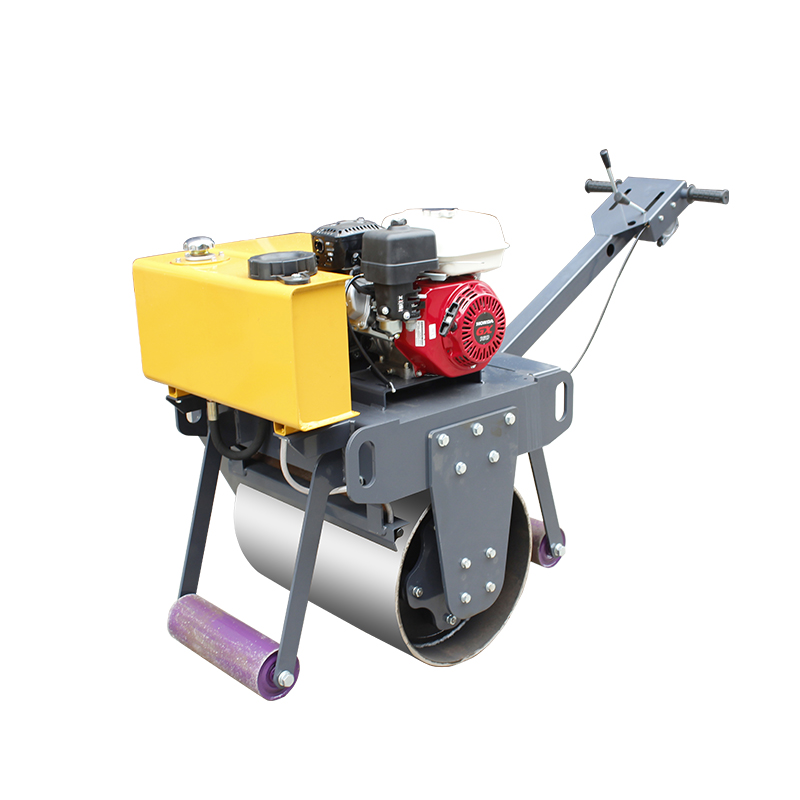
The working width of a road roller refers to the width of the road surface it can cover in a single compaction operation, which directly affects construction efficiency and compaction quality. Its determination needs to comprehensively consider the equipment's own structure, engineering requirements, and construction specifications. The specific analysis can be carried out from the following aspects:
The working width of a road roller is first determined by the width of its compaction wheel (steel wheel or tire), which is the most basic hardware parameter.
Steel wheel rollers: The width of single or double steel wheels is a core indicator. For example, the width of a single wheel of common double-steel-wheel rollers is mostly 1.8-2.1 meters, and the total width of the double wheels during operation is this value (if there is no overlap between the double wheels, the actual working width is equal to the width of a single wheel); the steel wheel width of single-steel-wheel rollers is usually wider (2.1-3.0 meters) to meet the needs of large-area compaction such as roadbeds.
Tire rollers: The working width is determined by the distance between the outer sides of the outermost tires on both sides, considering the number of tires and their arrangement (such as 6-wheel, 8-wheel), with a common width of 2.5-3.5 meters.
Note: The "working width" marked on the equipment nameplate usually refers to the maximum theoretical width of the compaction wheel. In actual construction, it needs to be adjusted in combination with the overlap amount.
To avoid missing compaction and ensure uniform compaction, a certain overlapping width must be retained between adjacent compaction belts. Therefore, the actual effective working width needs to deduct the overlapping part from the theoretical width.
Principles for determining the overlap amount:
Asphalt pavement: To ensure flatness and compactness, the overlap amount is usually 1/3 - 1/2 of the wheel width (for example, when the wheel width is 2 meters, the overlap is 60-100 cm) to avoid local looseness caused by missing compaction.
Gravel subgrade: The overlap amount can be appropriately reduced to 1/4 - 1/3 of the wheel width (for example, when the wheel width is 2.5 meters, the overlap is 60-80 cm). Because gravel materials are not sticky, slight missing compaction can be compensated by subsequent compaction.
Special road sections (such as curves, slopes): The overlap amount needs to be increased to 1/2 of the wheel width to prevent insufficient compaction at the edges.
Example: For a double-steel-wheel roller with a theoretical wheel width of 2 meters, if overlapping by 1/3 of the wheel width, the actual single working width = 2 meters - (2 meters × 1/3) ≈ 1.33 meters.
In actual construction, the working width needs to be flexibly adjusted according to the engineering scenario, mainly affected by the following factors:
Width of the construction section:
If the road surface width is an integer multiple of the theoretical width of the roller (such as a 6-meter-wide road surface using a 2-meter-wide roller), operation can be carried out with the standard overlap amount.
If it is a non-integer multiple (such as a 5-meter-wide road surface), it needs to be adjusted through "edge compaction". The width of the last compaction can be reduced to the remaining width (ensuring that at least 1/3 of the wheel width overlaps with the previous compaction belt).
Thickness of the compaction layer:
Thin-layer compaction (such as asphalt surface layer, thickness ≤ 5 cm): The working width can be implemented according to the theoretical value + standard overlap amount to avoid insufficient compaction due to insufficient pressure at the edge of the compaction wheel.
Thick-layer compaction (such as subgrade filling, thickness ≥ 30 cm): It is necessary to combine the compaction depth of the roller (determined by the amplitude of the vibratory roller). If necessary, reduce the working width to ensure that each compaction can penetrate to the bottom of the layer.
Equipment combination mode:
When multiple rollers work together (such as double steel wheels + rubber wheels in asphalt pavement construction), it is necessary to coordinate the working width of each equipment to avoid excessive overlapping areas leading to reduced efficiency or excessive gaps resulting in missing compaction.
The working width of a road roller is the result of the combined effect of the theoretical wheel width, overlap amount, and engineering requirements:
The theoretical basis is the design width of the equipment's compaction wheel.
The actual effective width needs to deduct the necessary overlap amount (determined according to the pavement type and compaction requirements).
Finally, it needs to be flexibly adjusted according to the width of the construction section, the thickness of the compaction layer, and the equipment combination mode to balance efficiency and compaction quality.
Before construction, the optimal working width is usually determined through a "test section" to ensure that there is no missing compaction and the equipment efficiency can be maximized.



 Chinese