When a road roller is working in confined spaces (such as indoor warehouses, underground garages, roadways, around pipelines, building corners, etc.), due to limited space and many obstacles, it is necessary to adjust the operation method according to the characteristics of the site and the performance of the equipment. The core goal is to avoid collisions and ensure uniform compaction. The specific operation points are as follows:
The premise of construction in confined spaces is to select a suitable road roller to reduce operation difficulty:
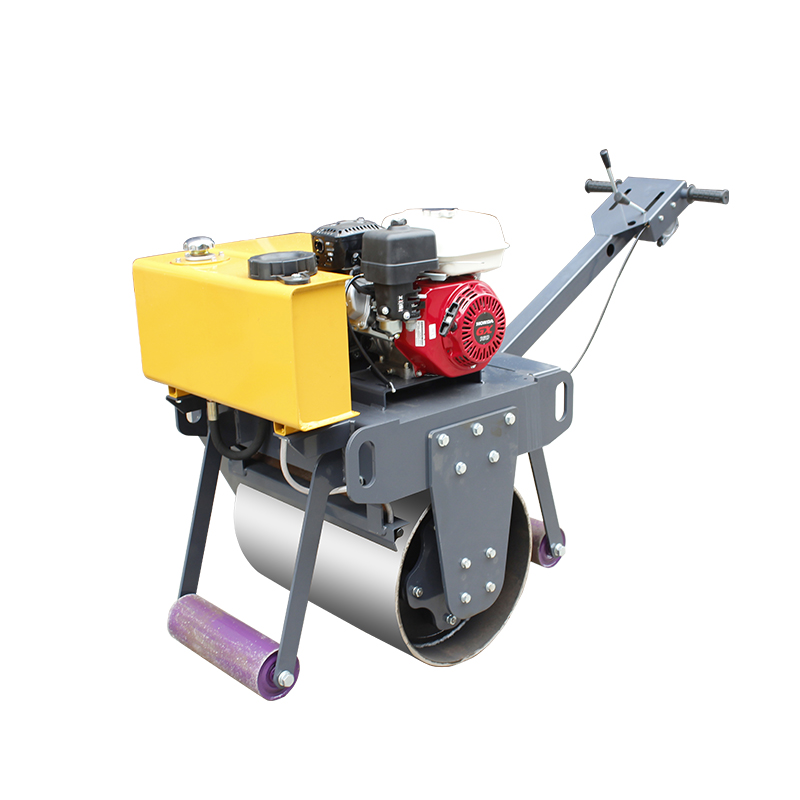
Small road rollers: Preferred are small vibratory road rollers (such as ride-on models of 1-3 tons) or walk-behind road rollers (0.5-1 ton class) with a wheel width of 1.0-1.5 meters and a body length of ≤ 3 meters. They have a small turning radius (usually ≤ 2.5 meters) and can flexibly turn in a space 3-4 meters wide.
Special models: If the site height is limited (such as underground garages with a floor height of ≤ 2.5 meters), choose a road roller with a low body design; if the ground bearing capacity is limited (such as floor slabs), use a rubber-tired road roller (which has a smaller ground contact pressure than a steel wheel roller to avoid cracking the ground).
Avoid using large road rollers (with a wheel width of ≥ 2 meters and a weight of ≥ 10 tons), as they have a large turning radius (usually ≥ 5 meters) and are prone to colliding with walls or equipment.
Before construction, a systematic survey of the confined space is required to reduce operational risks:
Measurement and marking:
Use lime or ink lines to mark the boundaries of the compaction area, the positions of obstacles (such as columns, pipelines), and clarify the rolling route (it is recommended to plan a "one-way circular route" to avoid frequent reversing).
If the site width is only 0.5-1 meter wider than the road roller's wheel width (for example, a 3-meter-wide site using a 2-meter-wide road roller), a "safety distance" (≥ 30 cm on each side of the body) should be reserved to prevent scraping the wall during rolling.
Obstacle clearance:
Remove small debris in the site (such as steel bars, stones). For fixed obstacles (such as columns), anti-collision pads can be wrapped around them. When rolling, keep a distance of at least 50 cm (if the area around the columns needs to be compacted, a walk-behind roller can be used for supplementary compaction later).
Check the flatness of the ground. If there are protrusions (such as concrete blocks), they need to be crushed in advance to avoid the road roller bumpy and causing direction loss.
The key to construction in confined spaces is "small models + slow operation + strong cooperation": adapting to space constraints through small equipment, avoiding collisions with low-speed driving and precise steering, ensuring quality through layered compaction and edge supplementary compaction, and at the same time, doing a good job in site survey and safety protection to balance efficiency and safety.



 Chinese