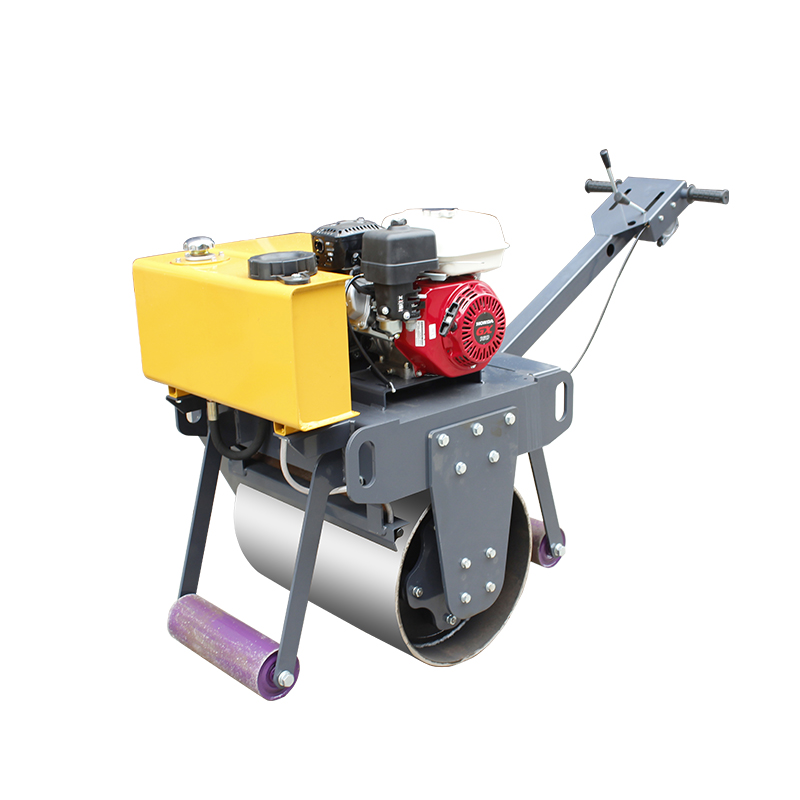
The testing of the compaction degree of a road roller is a crucial step in ensuring the stability of engineering structures such as subgrades and pavements. The testing method should be selected based on the type of material (e.g., soil, sand-gravel, asphalt mixture, etc.) and engineering requirements. Here are systematic testing methods and operational key points:
The essence of compaction degree is the "ratio of measured dry density to maximum dry density" (compaction degree = measured dry density ÷ maximum dry density × 100%). Therefore, the core of testing is to obtain these two key parameters through different methods.
Applicable Materials: Fine-grained soils such as clay and silty clay (excluding gravel and sand particles).
Operational Steps:
Select the testing point, clean the surface loose soil, and vertically press the ring knife (with a volume of 200-500 cm³) into the soil layer to ensure the soil sample is undisturbed.
Take out the ring knife, trim the soil samples at both ends, weigh them (the mass of the ring knife + wet soil), and subtract the mass of the ring knife to get the mass of wet soil.
Take a part of the soil sample and dry it (at 105℃±5℃ for 8-12 hours), then calculate the moisture content (moisture content = (mass of wet soil - mass of dry soil) ÷ mass of dry soil × 100%).
Calculate the dry density (dry density = density of wet soil ÷ (1 + moisture content)), and obtain the compaction degree by combining it with the maximum dry density.
Advantages and Disadvantages: It is simple to operate and low in cost, but it is only applicable to fine-grained soils and has large errors for coarse-grained soils.
Applicable Materials: Soil, sand-gravel, graded gravel, cement-stabilized soil, etc. (except soft clay and high-moisture-content soil).
Core Logic: Replace the volume of the test pit with the volume of standard sand to indirectly measure the density of the soil sample.
Key Steps:
Calibrate the density of standard sand (fill a container of known volume with standard sand, weigh it, and then calculate).
Dig a test pit: The depth is consistent with the thickness of the rolled layer (e.g., if the subgrade rolled layer is 30 cm thick, the test pit is 30 cm deep). Collect all the soil samples in the pit and weigh them.
Fill with sand: Aim the sand filling cylinder at the test pit, fill it with standard sand until stable, record the mass of the filled sand, and convert it to the volume of the test pit (volume = mass of filled sand ÷ density of standard sand).
Dry the soil sample to calculate the moisture content and dry density, and finally obtain the compaction degree.
Note: The test pit must be regular to avoid collapse of the pit wall; the standard sand needs to be sieved in advance (with a particle size of 0.25-0.5 mm).
Applicable Materials: Soils containing large particles such as gravel soil and cobble soil (particle size can be ≥50 mm).
Operational Features:
Cover the testing point with a thin-walled cylinder (with a diameter of 30-50 cm). After digging the test pit, inject water into the cylinder to a fixed scale, and calculate the volume of the test pit by the amount of water injected (excluding the original volume in the cylinder).
The subsequent steps are the same as the sand replacement method (weighing the soil sample, drying and calculating).
Advantages: No need for standard sand, suitable for coarse-grained soils; the disadvantage is that the shape of the test pit must be regular, otherwise the error will be large.
Applicable Materials: Soil, asphalt mixture, cement concrete, etc. (almost all engineering materials).
Principle: Use the rays emitted by radioactive elements (cesium-137 to measure density, americium-241 to measure moisture content) to penetrate the material, and calculate the density through the amount of ray attenuation (the higher the density, the more obvious the ray attenuation).
Operational Key Points:
Before testing, "calibrate" with the ring knife method or sand replacement method (calibrate the instrument's measured value with the actual measured value).
Place the instrument at the testing point, select the "direct transmission" (insert the probe, suitable for thick layers) or "surface scattering" (attach to the surface, suitable for thin layers) mode, and get the result in 1-2 minutes.
Advantages and Disadvantages: It is efficient and fast (each point takes a short time), but it needs regular calibration and has radiation safety requirements (operators must hold a radiation safety certificate).
Applicable Scenarios: Asphalt concrete surface layers and asphalt macadam layers.
Operational Steps:
Use a pavement drilling machine to drill a complete core sample (with a diameter of 100 mm or 150 mm), measure the height (consistent with the pavement thickness) and diameter, and calculate the volume.
Weigh the core sample (for asphalt mixture, use cotton yarn to absorb the surface oil), and calculate the density.
The standard density is the Marshall test density or the maximum theoretical density. The compaction degree = core sample density ÷ standard density × 100%.
Note: The core sample must be free of cracks and defects; otherwise, it needs to be re-sampled. After sampling, the hole must be filled with asphalt mixture of the same grade.
Frequency Requirement: According to the specifications, at least 2-3 points should be tested per 1000㎡, and key parts (such as the top layer of the subgrade and the pavement base) need to be encrypted to 1 point per 500㎡.
Determination of Standard Density:
For soil types: The maximum dry density is determined through compaction tests (light/heavy).
For asphalt mixtures: The maximum theoretical density is measured by the Marshall compaction test or the vacuum method.
Qualified Standards: The subgrade compaction degree is usually ≥93%-96% (according to the depth of the roadbed), the pavement base is ≥96%, and the asphalt surface layer is ≥95% (specifically according to design requirements).
For fine-grained soils: Ring knife method (conventional) + sand replacement method (verification).
For coarse-grained soils/sand-gravel: Sand replacement method or water replacement method.
For asphalt pavements: Core drilling method (mandatory) + nuclear gauge (sampling inspection).
For large-area rapid inspection: Nuclear density gauge (needs to be calibrated in advance).
By scientifically selecting methods and operating strictly, the compaction effect of the road roller can be accurately reflected, and engineering quality problems such as settlement and cracking can be avoided.



 Chinese