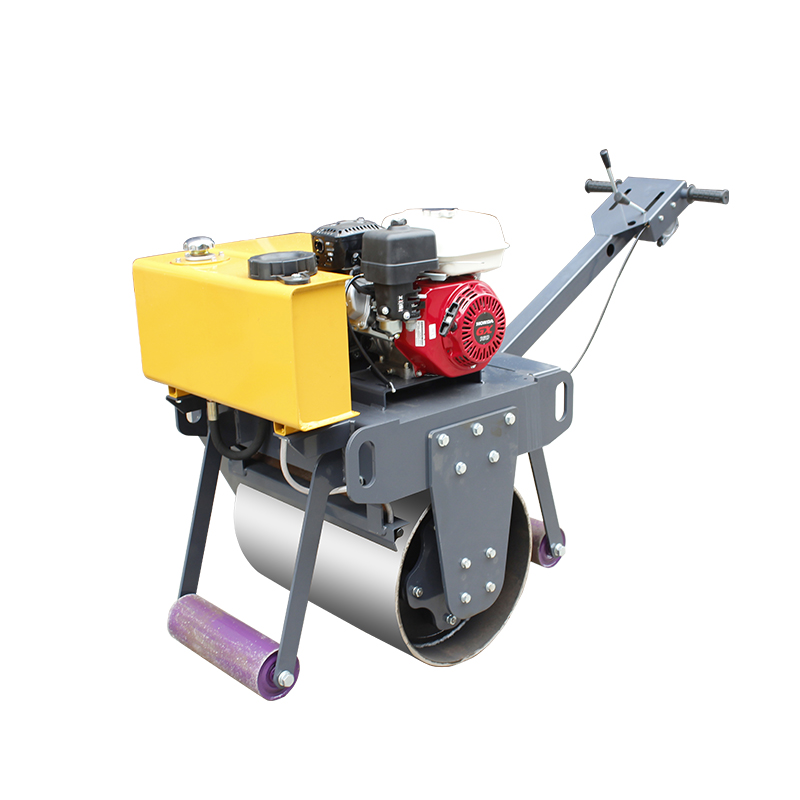
When road rollers compact asphalt pavements and gravel pavements, due to significant differences in material properties (such as viscosity, temperature sensitivity, and particle gradation) and engineering quality requirements (such as flatness, compactness, and deformation resistance), the operation methods need to be adjusted accordingly. The following is a detailed explanation from three aspects: core differences, specific operation points, and precautions:
| Comparison Items | Asphalt Pavement | Gravel Pavement |
|---|
| Material Properties | Thermoplastic mixture (asphalt as binder), with strong temperature sensitivity (easy to shift at high temperatures, easy to crack at low temperatures), and excessive rolling should be avoided to prevent segregation. | Loose granular material (no binder), which relies on particle interlocking for compaction, and vibration is needed to break the friction between particles and promote rearrangement. |
| Compaction Goal | To achieve the specified compactness (usually ≥96%), while ensuring surface flatness and rutting resistance, and avoiding asphalt aging or aggregate crushing. | To achieve the specified compaction degree (according to the subgrade level, usually ≥93%-96%), ensure overall stability, and reduce later settlement. |
| Key Restrictions | Constrained by the temperature window (initial rolling ≥150℃, final rolling ≥80℃), and the rolling timing and speed need to be strictly controlled. | No temperature restrictions, but excessive vibration should be avoided to prevent particle crushing or surface loosening. |
Asphalt pavement:
Priority is given to steel wheel rollers (smooth wheel or double steel wheel with bumps), which compact through static pressure + high-frequency low-amplitude vibration. The "kneading" of tire rollers is avoided to prevent asphalt segregation (only use rubber-tired rollers in special sections, using the sealing effect of tires to squeeze out excess asphalt and enhance aggregate bonding).
Example: Double steel wheel rollers are used for initial and final rolling to control surface flatness; rubber-tired rollers can be used for re-rolling to improve compactness.
Gravel pavement:
Vibration rollers must be used (single steel wheel or double steel wheel, focusing on single steel wheel heavy-duty models), relying on high-amplitude vibration to break the static friction between particles and promote particle interlocking. If the gravel has a high soil content (such as mud-bound macadam), tire rollers can be used for re-rolling to enhance the filling of pores with fine particles through the kneading effect of tires.
Asphalt pavement:
Initial rolling (high-temperature stage, 150-180℃): Use low amplitude (0.3-0.8mm) + high frequency (40-50Hz) to quickly compact with high-frequency vibration, avoiding the pushing and deformation of high-temperature asphalt; high amplitude is prohibited at this time, otherwise it will cause aggregate crushing or surface fuzzing.
Re-rolling (medium-temperature stage, 120-150℃): Maintain low amplitude, and the frequency can be reduced to 35-40Hz, focusing on eliminating small pores after initial rolling.
Final rolling (low-temperature stage, 80-120℃): Vibration can be turned off (zero amplitude), and only static pressure is used for rolling to eliminate wheel marks and ensure flatness.
Gravel pavement:
Initial compaction (loose thick layer): Use high amplitude (1.5-2.5mm) + low frequency (25-30Hz) to penetrate deep layers with large impact force and promote particle rearrangement; if the particles are large (such as block stone filling), the amplitude can be increased to 3mm.
Later compaction (semi-compact state): Switch to medium amplitude (1.0-1.5mm) + medium frequency (30-35Hz) to balance compaction depth and surface flatness, avoiding surface loosening.
High amplitude is prohibited for thin-layer gravel (<10cm), otherwise it will cause the "spring phenomenon" (particles are suspended and cannot be compacted).
Asphalt pavement:
The speed is strictly controlled at 2-4km/h (initial rolling is slow, final rolling can be slightly faster to 5km/h) to avoid insufficient compaction or surface cracking due to excessive speed.
The number of passes depends on the asphalt thickness: ordinary asphalt surface layers (4-6cm) usually require 4-6 passes (1-2 passes for initial rolling, 2-3 passes for re-rolling, 1-2 passes for final rolling), and continuous operation is required to avoid excessive temperature drop due to mid-way stops.
Gravel pavement:
The speed is relatively flexible (3-6km/h). Initial compaction can be slightly slower (3-4km/h) to allow full transmission of vibration; later, it can be increased to 5-6km/h.
The number of passes depends on the looseness of the material: filled gravel usually requires 6-8 passes. If "layered filling" is adopted (each layer is 30-50cm), the number of compaction passes for each layer must be determined through the test section (to meet the specified compaction degree).
Asphalt pavement:
Follow the principle of "from low to high, from edge to center" (for straight sections) or "from inside to outside" (for curved sections) to avoid pushing the asphalt mixture.
The overlap width of steel wheels is 1/3-1/2 of the wheel width to ensure no missed rolling; during final rolling, the overlap width can be increased to 1/2 of the wheel width to eliminate wheel marks.
Repeated rolling at the same position is prohibited (especially at low temperatures), otherwise it will cause asphalt to "over-compact" and crack.
Gravel pavement:
The direction is similar to that of asphalt, but "round-trip staggered rolling" is allowed (i.e., adjacent rolling belts are staggered by 10-20cm) to enhance the compaction effect by superimposing vibration waves.
The overlap width of 1/4-1/3 of the wheel width is sufficient (because gravel has no viscosity, missed rolling areas can be compensated by subsequent rolling), but edge missed rolling must be avoided to prevent collapse.
Asphalt pavement:
The temperature must be monitored in real-time during rolling. If the final rolling is not completed when the temperature is lower than 80℃, the operation must be stopped (otherwise, it cannot be compacted and is easy to crack).
Steel wheels need to be sprinkled with water regularly (or coated with anti-adhesive agents) to prevent asphalt from sticking to the wheels, but the amount of water must be small and uniform to avoid excessive cooling.
Gravel pavement:
"Pre-sprinkling" is required before rolling (especially in dry areas) to make the water content of gravel close to the "optimal moisture content" (determined through tests) to enhance particle bonding; but excessive sprinkling is prohibited to avoid "muddying".
When starting the vibratory roller, vibration should be turned on while moving, and vibration should be turned off before stopping to avoid local settlement caused by vibration in place.
Asphalt pavement: The core is "temperature control, light pressure, and flatness preservation", avoiding high-amplitude, low-temperature rolling, and excessive rolling.
Gravel pavement: The core is "vibration penetration and particle interlocking", which requires initial compaction with high amplitude + later trimming with medium amplitude, while controlling water content.
The operational difference between the two is essentially "different material responses": asphalt relies on temperature and static pressure to achieve cementation and compaction, while gravel relies on vibration to break particle friction to achieve interlocking compaction. In actual construction, parameters need to be dynamically adjusted based on test section data (such as compaction degree and flatness detection) to ensure project quality.



 Chinese