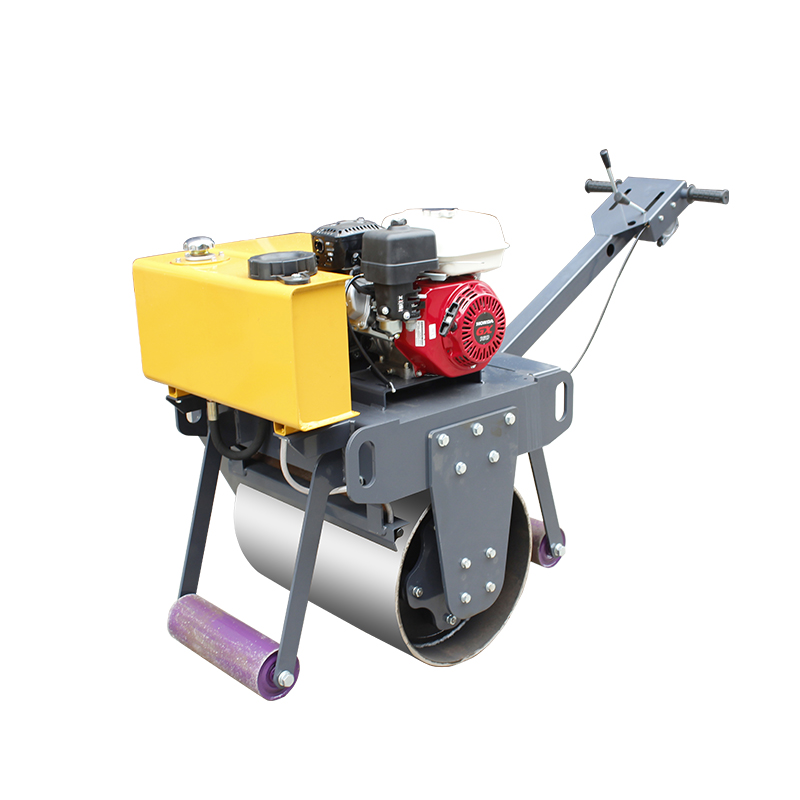
Road rollers are key equipment used in engineering construction to compact materials such as soil, sand and gravel, asphalt, and concrete. Their core function is to reduce the porosity of materials and increase their density through mechanical force, thereby enhancing the bearing capacity and stability of foundations or structural layers. They have a wide range of applications, covering almost all engineering fields that require foundation reinforcement or pavement formation. Specifically, they are suitable for the following types of construction projects:
Road engineering is the main application scenario for road rollers, as compaction work is required for all structural layers from the base course to the surface course:
Subgrade construction: Compacting soil subgrades and sand-gravel subgrades to reduce subsequent settlement. For example, in the subgrade treatment of expressways and municipal roads, road rollers are used for layered compaction (each layer is usually 30-50 cm thick) to ensure that the foundation bearing capacity meets the standards.
Base course and subbase course: Compacting semi-rigid base materials such as cement-stabilized macadam, lime soil, and graded sand and gravel to form a solid load-bearing layer.
Surface course construction:
Asphalt pavement: Asphalt rollers (such as double-drum vibratory rollers) are used to compact hot asphalt mixtures to eliminate voids, improve flatness, and enhance waterproofness.
Cement concrete pavement: Vibratory rollers are used to compact the unset concrete in the early stage, and later, they can work with joint cutters to complete the pavement formation.
Urban roads and squares: Including the compaction of the base and surface courses of urban arterial roads, secondary roads, pedestrian streets, and squares, which requires balancing compaction effect and pavement flatness (such as the foundation compaction before laying square tiles).
Pipeline engineering: Compacting the backfill soil around underground pipelines (such as water pipes and gas pipes) to prevent pipeline settlement or water leakage (small rollers or vibratory rammers are commonly used).
Sewage treatment plants / landfills: Compacting the foundation of treatment pools and the soil under the anti-seepage layer of landfills to enhance structural stability and prevent leakage.
Site leveling and foundation treatment: Compacting the backfilled soil after excavation of construction sites, and compacting the foundation under shallow foundations (such as strip foundations and independent foundations) to avoid building settlement.
Filling engineering: Layered compaction of large-area filled areas in projects such as mountain construction and reclamation (such as treating rock-filled subgrades with heavy rollers).
Parking lots and yards: Compacting the ground base of parking lots and logistics yards to ensure they can bear long-term vehicle loads.
Expressways and national highways: High-grade highways have extremely high requirements for compaction degree (usually ≥96%). Large-tonnage vibratory rollers (over 20 tons) combined with intelligent compaction systems are needed to ensure pavement strength and durability.
Airport engineering: Compacting the foundation and surface course of airport runways and aprons to meet the ultra-high loads of aircraft takeoff and landing (the compaction degree of the runway base needs to reach more than 98%, and heavy rollers are commonly used for multiple rolling).
Ports and wharves: Compacting the foundation of wharf yards and approach bridges, and handling the hardened ground base of container yards.
Dam engineering: The compaction of earth dams and flood control dikes is a key link. Rolling machinery (such as sheep-foot rollers and convex block rollers) are used for layered compaction of materials such as clay and loam to prevent dam leakage or collapse.
Canal engineering: Compacting the slopes and bottoms of irrigation canals and water conveyance canals to reduce collapse caused by water erosion.
Reservoir engineering: Compacting the anti-seepage body (such as clay core wall) of reservoir dams and reinforcing the reservoir bank foundation.
Mine site construction: Compacting the transportation roads and working platforms in mining areas to ensure the safe passage of heavy mining equipment.
Tailings pond engineering: Compacting the filling of tailings pond dams to prevent tailings leakage and environmental pollution.
Farmland water conservancy: Compacting farmland irrigation canals and field roads to reduce water leakage and facilitate the passage of agricultural machinery.
Land consolidation: Compacting the soil after leveling slopes and wastelands to improve cultivated land quality.
Different projects require different types of road rollers due to the differences in compacted materials (soil, sand and gravel, asphalt, concrete, etc.) and compaction requirements:
Earth / sand and gravel: Single-drum vibratory rollers (with a tonnage of 10-30 tons) are commonly used.
Asphalt pavement: Double-drum vibratory rollers (for initial compaction and re-compaction) + rubber-tired rollers (for final compaction to improve density).
Narrow areas (such as around pipelines and next to buildings): Small rollers (with a tonnage of 1-6 tons) or hand-held vibratory rollers.
Special materials (such as clay dams): Sheep-foot rollers and convex block rollers (to enhance the compaction effect on cohesive soil).
In conclusion, as long as a project involves the need to "improve material density", road rollers can play a core role. Their applications almost cover all civil engineering fields and are one of the key equipment to ensure project quality.



 Chinese