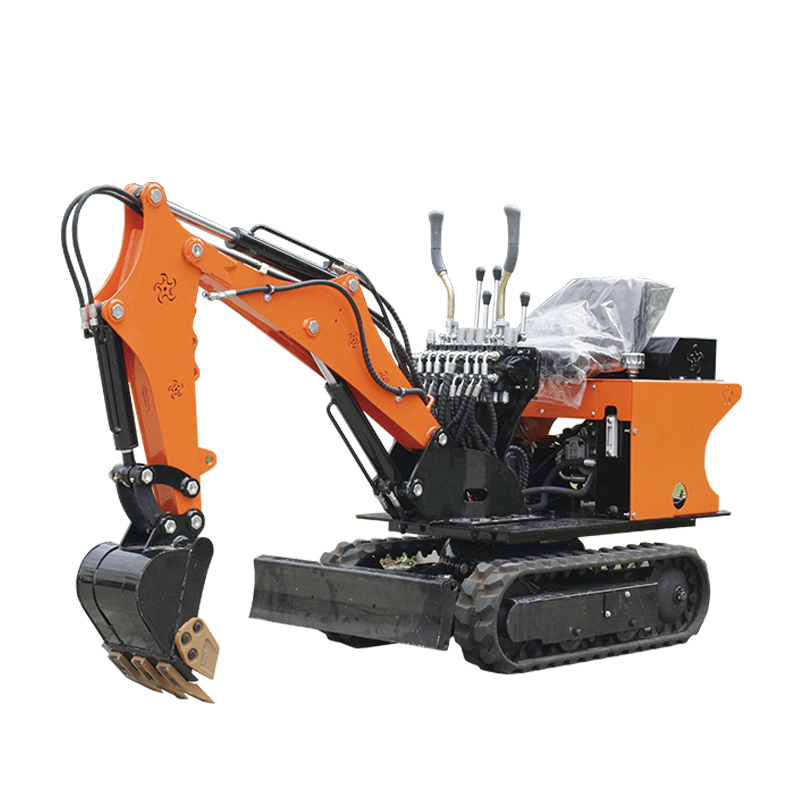
When a crawler excavator operates on soft ground (such as wetlands, marshes, farmland, and soft subgrades), the core risks are track sinking (insufficient ground bearing capacity) and equipment tipping (center of gravity imbalance + uneven ground settlement). The core logic for prevention is "dispersing ground contact pressure + stabilizing the machine's center of gravity + controlling operation intensity", and a closed-loop protection system is formed through four-dimensional measures: "site pre-treatment, equipment adjustment, operation specifications, and emergency support". The details are as follows:
Before operation, assess the ground bearing capacity through "test excavation + settlement observation": Lightly press the ground with the excavator bucket. If the settlement exceeds 10cm and continues to sink, the area is determined as a high-risk zone and requires priority treatment.Divide the site into "operation area, travel area, and slewing area", and only perform operations in pre-treated areas to avoid rolling over untreated soft ground.
Travel Area: Lay plates continuously along the travel route, with an overlap of ≥10cm between adjacent plates to prevent track jamming due to gaps.
Operation Area: Fully lay plates under the excavator's tracks; the slewing area requires an expanded laying range (diameter ≥1.5 times the machine width) to prevent edge ground sinking during slewing.
Note: Steel plates/subgrade plates must be laid flat without voids underneath (gravel can be used for leveling) to avoid plate deformation caused by uneven stress.
Steel plates (thickness 12-16mm, width 800-1200mm, length matching the track's ground contact length)
Subgrade plates (high-molecular polyethylene/wooden, with a bearing capacity ≥5t/m²)
Gravel cushion (particle size 5-10cm, laying thickness 20-30cm)
Replace with widened track shoes (30%-50% wider than standard tracks, e.g., standard 600mm → 800-900mm). After increasing the ground contact area, the ground contact pressure can be reduced by 20%-30%, suitable for long-term soft ground operations.
Temporary measure: Install "anti-slip widened plates" on the outer side of the tracks (fixed by bolts, width 200-300mm), which can quickly increase the ground contact area without modifying the equipment.
If the soft ground has high water content (such as wetlands after rain), first excavate drainage ditches (depth 30-50cm, spacing 5-8m) to drain surface water and reduce soil saturation.For locally extremely soft areas (such as marshes), inject curing agents (cement slurry, lime powder) or lay geogrids to quickly improve soil bearing capacity (bearing capacity ≥0.1MPa after curing).
Track Tension Adjustment: Keep the tracks moderately loose (sag 150-200mm) to avoid reduced ground contact area due to over-tightening, while enhancing the track's adaptability to the ground (the track can disperse pressure through slight deformation on soft ground).
Inspect Travel Mechanism: Ensure the track rollers and top rollers rotate flexibly to avoid local pressure concentration caused by jamming, which may worsen sinking.
Bucket and Work Device Position: Before operation, lower the boom, retract the arm, and place the bucket flat on the ground (height ≤50cm from the ground) to avoid raising the center of gravity due to a lifted boom (for every 10cm reduction in the center of gravity height, the anti-tipping capacity increases by 15%).
Counterweight Adjustment: Remove unnecessary additional counterweights (such as breakers, quick couplers). If retention is necessary, place them as close to the slewing center as possible to reduce center-of-gravity offset. For large excavators, temporary counterweights can be installed on both sides of the tracks (evenly distributed) to enhance lateral stability.
Confirm that the anti-tipping alarm system (if equipped) works normally: When the machine's tilt angle exceeds 15°, the system automatically alarms and restricts dangerous movements.
Inspect the travel brake and parking brake: Ensure reliable braking to prevent accidental sliding of the equipment during operation (the risk of brake failure is higher on soft ground).
Travel Speed: Use low gear (≤2km/h), and prohibit sudden acceleration or braking (inertial force will cause the tracks to compact the soft ground, increasing the sinking depth by 30%).
Steering Method: Prioritize "large-radius steering" and avoid in-place steering (in-place steering generates high shear force on the ground, easily agitating the soil and causing sinking). Reduce the engine speed during steering to decrease the driving force of the single-side track.
Route Selection: Travel along a straight line and avoid frequent direction changes. If position adjustment is needed, use "small-amplitude translation" instead of continuous steering.
Align the tracks with the excavation direction and keep the machine level (left-right tilt ≤3°, front-back tilt ≤5°). If the ground has a slope, position the tracks perpendicular to the slope direction (lateral slope ≤10°, longitudinal slope ≤15°).
Maintain the boom at an angle of 45°-60° with the ground, and extend/retract the arm at a uniform speed to avoid sudden bucket penetration into the ground (impact load will cause local ground settlement).
Reduce the single excavation volume (60%-70% of that for hard ground operations) to avoid center-of-gravity offset caused by full-bucket heavy loads. When excavating hard soil or obstacles, use "layered excavation" and prohibit forced excavation (impact load is likely to cause equipment tipping).
Prohibit lateral excavation: If lateral operation is necessary, the excavation radius shall not exceed 80% of the equipment's rated radius, and the bucket load shall be reduced by 50% to avoid excessive stress on the single-side track leading to sinking.
Reduce the slewing speed to 0.5-0.8r/min (50%-60% of that for hard ground) to avoid machine shaking caused by slewing inertia.
Keep the bucket away from the ground (≥30cm) but not raised too high (≤1.5m) during slewing to prevent center-of-gravity elevation leading to tipping.
Prohibit continuous operation when one side of the track is sinking: If the sinking depth of one track exceeds 10cm, adjust the equipment first (lay steel plates/gravel) and resume operation only after the machine is level.
Prohibit stacking materials on the edge of the slewing platform to avoid center-of-gravity offset caused by additional loads.
Prohibit multiple personnel from getting on/off the equipment or working around the tracks simultaneously to prevent safety accidents when the equipment shakes or sinks.
Slow track sinking, increased machine tilt, and cracks in the ground during excavation.
Immediately stop excavation, place the bucket on the ground (lightly, without applying pressure), and use the bucket's supporting force to prevent further machine sinking.
If sinking is slight (≤10cm): Slowly retract the arm, slightly lift the boom, and at the same time start the travel motor to slowly drive out of the sinking area (travel direction opposite to the sinking direction).
If sinking is severe (>10cm): Prohibit forced travel (which will cause the track to sink deeper), immediately lay steel plates/subgrade plates under the sinking track (assisted by the bucket), and then slowly drive out.
If both tracks are sinking: Use the bucket to excavate hard soil around and fill it under the tracks, while laying steel plates. After the ground contact pressure is dispersed, slowly start the travel motor to drive out.
Machine tilt angle exceeding 10°, track suspension, abnormal increase in hydraulic system pressure, and activation of the anti-tipping alarm.
Immediately stop all movements (excavation, slewing, travel), keep the bucket on the ground for support, and prohibit large-amplitude movements of the control levers.
If tipping to one side: Slowly retract the arm on that side, while slightly lifting the boom to shift the center of gravity toward the machine's center. Prohibit slewing or traveling in the tipping direction.
If the tipping risk intensifies: The operator should immediately evacuate the equipment (jump off from the non-tipping side) and contact rescue equipment (such as cranes, another excavator) for traction. Do not attempt to reset the equipment by yourself (which may easily cause the equipment to roll over).
After operation, clean the track shoes and travel mechanism to remove mud and debris (to avoid corrosion or jamming).
Inspect the wear of track shoes, track links, and pins. If deformation or excessive wear occurs, replace them in a timely manner (soft ground operations cause greater wear to the tracks).
Check for leaks in the hydraulic system (hydraulic system pressure fluctuates greatly during soft ground operations, making seals prone to damage).
After operation, remove the bearing plates/subgrade plates and level the soft ground site (to avoid potholes that may cause subsequent sinking).
For sensitive areas such as farmland and wetlands, restore the soil structure (such as loosening compacted soil and replanting vegetation) to avoid ecological damage.
The essence of risks in soft ground operations is the combination of "insufficient ground bearing capacity" and "machine center-of-gravity imbalance". Prevention measures should focus on "reducing ground contact pressure" (dispersing pressure) and "stabilizing the center of gravity" (controlling movements and loads): Improve bearing capacity through site pre-treatment before operation, avoid center-of-gravity offset through standardized operations during operation, and take timely emergency measures when risk warnings appear. Ultimately, the goal of safe operation with "no sinking and no tipping" is achieved.


 Chinese