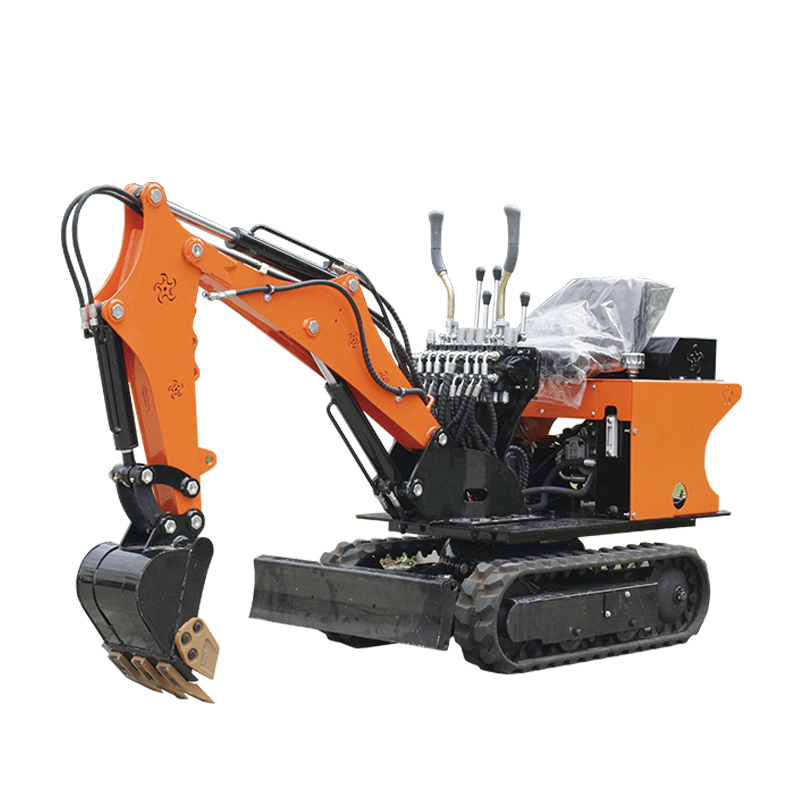
The travel operation taboos of crawler excavators mainly revolve around three core objectives: "avoiding damage to the crawler system, preventing the machine body from instability, and evading safety accidents". Based on the structural characteristics (differential steering, rigid connection, crawler-ground meshing transmission) and mechanical principles of crawler travel, the following are 12 types of core taboos verified by engineering practice, including forbidden behaviors, risk consequences, and underlying logic:
Risk Consequences: The crawler track links and pins bear severe impacts, accelerating wear (service life shortened by over 30%); the drive wheels slip when meshing with the crawler, causing tooth surface wear; the machine's center of gravity shifts, making it prone to sinking or tipping over on soft ground or slopes.
Underlying Logic: The designed maximum travel speed of crawler excavators is only 2-5 km/h (featuring low-speed and high-torque characteristics). When traveling at high speed, the inertial force is excessively large, and the transmission system (travel motor, reduction gearbox) cannot withstand frequent load mutations.
Risk Consequences: The axles and travel frames bear additional loads, easily leading to structural deformation; the crawler's ground contact specific pressure increases, exacerbating sinking on soft ground; the braking system overheats and fails.
Underlying Logic: Under heavy load, the machine's center of gravity shifts forward, and the load on the travel system exceeds the design threshold. High-speed travel will amplify the load impact.
Risk Consequences: The slipping side of the crawler idles rapidly, causing severe wear to the track links and drive wheel tooth surfaces; the hydraulic system pressure rises sharply, easily damaging the travel motor and seals; excessive power on one side causes the machine body to shift sideways, leading to tipping over.
Underlying Logic: When the crawler slips, the ground friction force is zero. Forcibly increasing power cannot improve traction but only aggravates component wear.
Risk Consequences: Severe shear force is generated between the crawler and the ground, causing deformation of the crawler shoes and loosening of the track links; the drive wheels misalign when meshing with the crawler, leading to derailment; the travel frame bears lateral torque, making the welding joints prone to cracking.
Underlying Logic: During in-place steering, the two sides of the crawler rotate in opposite directions, resulting in extremely high friction resistance on hard ground. High-speed steering will amplify this shear force, exceeding the structural strength of the crawler and travel frame.
Risk Consequences: The machine's center of gravity shifts severely, making it easy to tip over during steering; the suspended side of the crawler has no support, causing the drive wheel to bear uneven force and leading to derailment; the travel motor on one side is overloaded and burned out.
Underlying Logic: When one side of the crawler is sunken, the machine body is already in an unstable state. Steering will further destroy the balance of the center of gravity, and at the same time, the travel system bears unbalanced force.
Risk Consequences: The edge of the crawler rubs against the idler and top roller, causing the crawler shoes to curl and the roller bodies to wear; the track link pins bend, resulting in abnormal crawler tension.
Underlying Logic: Crawler steering is achieved through "differential speed". When the angle is too large, the crawler cannot bend smoothly, and forced pulling will cause mechanical interference.
Risk Consequences: The steel crawler shoes are punctured and cut by sharp objects; the rubber crawler shoes are torn, and the embedded steel cord is broken; the roller bushing is squeezed and deformed by gravel, leading to seal failure.
Underlying Logic: Sharp objects are likely to damage the structural integrity of the crawler, and high-speed travel or steering will aggravate this damage.
Risk Consequences: The bearings, pins, and sleeves of the travel system are flooded and rusted, resulting in lubrication failure; the seals of the hydraulic pipeline joints are flooded, causing hydraulic oil emulsification; electrical components (such as travel control sensors) are short-circuited.
Underlying Logic: The seal design of the crawler travel system is only suitable for shallow water environments. Deep water will break through the seal protection, causing rust and hydraulic system failures.
Risk Consequences: The crawler sinking depth increases, and even the entire machine gets stuck; the crawler agitates the soil, leading to a further reduction in ground contact specific pressure and making it impossible to get out of trouble; the travel motor works under high load for a long time, causing overheating and damage.
Underlying Logic: The bearing capacity of soft ground is insufficient, and frequent lane changes will damage the ground structure and increase the risk of sinking.
Risk Consequences: The hydraulic oil has high viscosity and poor fluidity, resulting in insufficient lubrication of the travel motor and reduction gearbox, and accelerated component wear; the seals harden due to low temperature, making them prone to leakage; the steering operation is stiff and the response is slow.
Underlying Logic: In low-temperature environments, the hydraulic oil and grease do not reach the operating temperature and cannot form an effective oil film. Heavy loads at this time will cause dry friction damage.
Risk Consequences: Unable to control the travel speed, easily colliding with obstacles; the machine slips on slopes, causing serious safety accidents; the travel motor has no brake protection and is easily damaged due to inertial idling.
Underlying Logic: The braking system of crawler excavators is the core of safety. After failure, the movement state of the equipment cannot be controlled, and the risk is extremely high.
Risk Consequences: The slewing platform rotates randomly, colliding with surrounding objects or personnel; debris on the platform falls due to jolting, causing safety accidents; the slewing bearing gear ring interferes with the travel system, leading to structural damage.
Underlying Logic: Unlocking the slewing platform during travel is a basic safety requirement. Failure to lock it will damage the overall stability of the equipment and cause collaborative interference risks.
Risk Consequences: One side of the crawler is overloaded, causing uneven wear of the crawler shoes and rollers; the machine's center of gravity shifts, making it easy to tip over toward the slope; the travel frame bears excessive force on one side, leading to fatigue cracking of the welding joints.
Underlying Logic: Unilateral load-bearing will cause unbalanced force on the travel system and machine body structure, and long-term such conditions will lead to structural damage.
Risk Consequences: The machine's center of gravity shifts significantly upward, resulting in extremely poor travel stability and easy tipping over when encountering jolts or steering; the swinging of the bucket hits the machine body, causing deformation of the boom and arm; the hydraulic system has excessive load fluctuations, damaging the cylinder seals.
Underlying Logic: Holding the bucket high or hanging heavy objects changes the center of gravity distribution of the equipment, destroying the balance state during travel.
All taboos for the travel operation of crawler excavators essentially "violate the mechanical transmission logic of crawler travel" or "exceed the equipment's structural strength/protection capacity":
Speed and power taboos: Avoid transmission system overloading caused by load mutations.
Steering taboos: Avoid damage to the crawler and travel frame due to shear force and mechanical interference.
Site adaptation taboos: Avoid crawler damage or center-of-gravity imbalance caused by environmental factors.
Equipment status taboos: Ensure the travel system is in a normal working state, and avoid failures caused by insufficient preheating, brake failure, etc.
Adhering to the principles of "low-speed and smooth travel, gentle steering, site adaptation, and compliance with status requirements" can effectively avoid equipment damage and safety risks caused by the above taboos and extend the service life of the travel system.


 Chinese