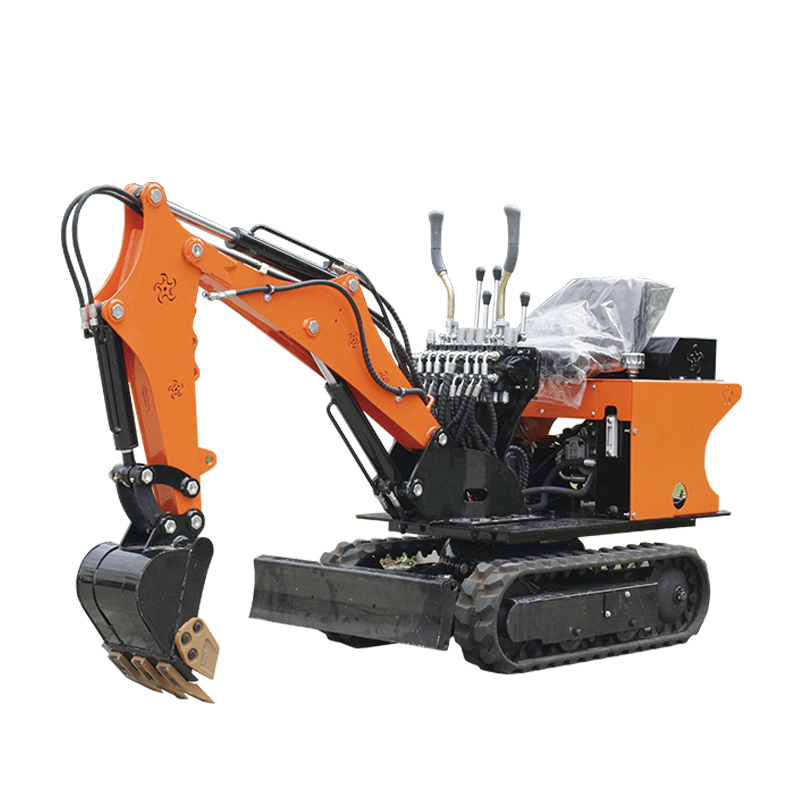
The core of selecting an excavator’s track shoe type lies in the accurate matching of "ground conditions - operating requirements - structural characteristics of track shoes". Different track shoes, through differentiated tread patterns, materials, and structural designs, are suitable for a full range of operating scenarios from urban municipal works to heavy-load mining operations. Below, we systematically break down their structural features, suitable scenarios, and selection logic based on the core types of track shoes:
Material: High-strength manganese steel (Q345/NM400 wear-resistant steel) or alloy steel, processed by stamping/forging + quenching, with a plate thickness of 10-20mm (up to 25mm for heavy-load types).
Surface Characteristics: Equipped with anti-slip protrusions (height 5-15mm) and reinforcing ribs; some have drainage/mud-discharging grooves. Track links and pins undergo carburizing treatment, with a tensile strength of ≥1200MPa.
Weight: Single shoe weight 15-50kg (increasing with excavator tonnage), with a ground pressure of 0.08-0.15MPa.
Mining/Quarry Operations: The ground is covered with sharp gravel and hard rock, requiring track shoes to be puncture-resistant, wear-resistant, and impact-resistant. The metal material of steel track shoes can resist gravel cutting; the thickened structure can withstand hard rock impacts; and the anti-slip protrusions enhance grip to prevent slipping during climbing.
Construction Waste Disposal/Demolition Sites: There are a large number of hard debris such as concrete blocks and steel bars. Steel track shoes are not easily punctured by steel bars; their surface patterns can embed into the gaps of construction waste to improve traction stability, making them suitable for heavy-load excavation and material transfer.
Open-Pit Mining/Earth Stripping: High operation intensity (8-12 working hours per day), hard and uneven ground. The wear resistance of steel track shoes (service life ≥5000 working hours) reduces replacement frequency, and their high-rigidity structure prevents deformation, adapting to continuous heavy-load operations.
Heavy-Load Operations at Ports and Terminals: For handling containers and heavy equipment, steel track shoes have strong load-bearing capacity (single shoe load 3-8 tons) to withstand concentrated loads. Meanwhile, they are resistant to seawater corrosion (some models use anti-rust coatings), adapting to the high-salt-spray environment at ports.
Urban hardened roads, sidewalks, farmland (prone to scratching the ground or compacting soil), and indoor operations requiring low noise.
Material: Composite formula of natural rubber + synthetic rubber (wear index ≥600), embedded with multiple layers of steel cords/fiber fabrics to enhance tensile strength, with anti-derailment flanges on the edges.
Surface Characteristics: Diverse patterns (block/transverse/flat), thickness 20-40mm, strong elastic deformation capacity, and 30%-40% lighter than steel track shoes of the same size.
Ground Pressure: 0.05-0.10MPa (20%-30% lower than steel track shoes), with a larger ground contact area.
Urban Municipal Engineering: Such as road maintenance, pipeline laying, and residential area reconstruction. The operation area is mostly asphalt/cement roads or sidewalks. Rubber track shoes have good elasticity and will not scratch the road surface; their low noise (driving noise ≤75dB, 10-15dB lower than steel track shoes) makes them suitable for operations in residential areas.
Farmland/Orchard Operations: Soft ground requiring soil protection. Rubber track shoes have a large ground contact area and low ground pressure, which can prevent sinking. Meanwhile, their elastic material will not compact the soil structure, making them suitable for farmland water conservancy construction and orchard excavation.
Indoor Warehousing/Workshop Operations: Such as warehouse renovation and workshop equipment installation, requiring low noise and no ground damage. The mute feature and scratch-resistant design of rubber track shoes make them suitable for operations in narrow indoor spaces without damaging the ground floor.
Wetland/Marsh Operations: High ground water content and weak bearing capacity. The elastic deformation of rubber track shoes can further increase the ground contact area to reduce the risk of sinking. Meanwhile, their patterns have good mud-discharging performance to prevent slipping caused by mud adhesion, making them suitable for wetland dredging and marsh operations.
Heritage Protection/Scenic Area Construction: Extremely high requirements for ground damage prevention (e.g., around ancient buildings, scenic trails). The flexible contact of rubber track shoes can completely avoid ground scratches, and their low-vibration feature will not affect surrounding buildings, adapting to high-precision and low-damage operations.
Mining gravel yards, construction waste disposal (prone to puncture and cutting by sharp objects), and continuous heavy-load operations (weak wear resistance, service life about 1500-3000 working hours).
Patterns are independent block protrusions with large gaps (10-20mm) and a protrusion height of 8-15mm, featuring strong grip and good mud-discharging performance.
Steel Block Pattern: Mining, muddy construction sites, climbing operations (patterns embed into the ground/gravel to improve traction).
Rubber Block Pattern: Mixed working conditions in urban-rural fringe areas, post-rain construction sites (good mud-discharging performance to prevent slipping).
Patterns are continuous transverse stripes; grooves are designed as drainage channels, with moderate surface smoothness.
Steel Transverse Pattern: Ports and terminals, wet hard ground (good drainage to prevent slipping caused by accumulated water).
Rubber Transverse Pattern: Urban operations in rainy days, wetland operations (enhance wetland grip and reduce mud adhesion).
No obvious protruding patterns; the surface is flat or has only shallow stripes, with the largest ground contact area and uniform pressure on the ground.
Rubber Flat Pattern: Indoor floors, shopping mall/airport renovation, farmland operations (zero ground damage, avoiding soil compaction).
Steel Flat Pattern: Heavy-load operations on flat ground (e.g., port container stacking, reducing local ground pressure).
Patterns are sharp toothed protrusions with a height of 15-20mm, strong penetration, suitable for extremely soft ground.
Steel Toothed Pattern: Marshes, deep mud, steep slopes in mines (toothed patterns embed into soft soil/rock formations to prevent slipping).
Rubber Toothed Pattern: Soft farmland, wetland dredging (balancing grip and ground protection).
30%-50% wider than standard track shoes (e.g., standard width 600mm, widened to 800-900mm), significantly increasing the ground contact area, with a ground pressure of ≤0.06MPa.
Marshes, deserts, soft soil subgrade operations (minimizing the risk of sinking), such as desert oil exploration and wetland ecological restoration.
The surface of the steel base material is overlay-welded with a wear-resistant alloy layer (thickness 3-5mm); track links adopt an integral forging process; pins are made of hardened alloy steel.
Large-scale mines, continuous heavy-load operations (e.g., open-pit coal mine stripping, gravel yard loading), with a service life 50%-80% longer than ordinary steel track shoes.
Rubber material uses anti-static and flame-retardant formulas; steel components have no sharp protrusions on the surface to avoid spark generation due to friction.
Petrochemical sites, flammable and explosive material warehouses (preventing risks caused by static accumulation or sparks).
Ground Protection Requirements: Whether scratching/compacting is allowed (Yes → Rubber track shoes; No → Steel track shoes).
Operating Environment Hardness: Sharp gravel/hard rock → Steel track shoes; Soft/flat ground → Rubber track shoes.
Operation Intensity: Heavy-load operations with ≥8 working hours per day → Steel track shoes (wear-resistant reinforced type); Light operations → Rubber track shoes.
Urban/Indoor/Farmland → Rubber track shoes (flat/shallow pattern).
Mines/Gravel yards/Construction waste → Steel track shoes (block/toothed pattern).
Wetlands/Marshes → Rubber/steel wide track shoes (transverse/toothed pattern).
Hazardous environments → Explosion-proof track shoes.
Ground Pressure: Soft ground requires ≤0.08MPa → Select wide/rubber track shoes.
Wear Life: Continuous heavy-load operations require ≥5000 hours → Steel wear-resistant reinforced type.
Noise Requirement: Residential areas/indoor spaces require ≤75dB → Rubber track shoes.
The core of excavator track shoe adaptation is "material matching ground hardness, pattern matching grip needs, and structure matching operation intensity":
Steel track shoes focus on "wear resistance, impact resistance, and heavy load", adapting to harsh working conditions.
Rubber track shoes focus on "low damage, low noise, and high adaptability", adapting to refined operations.
Specialized track shoes are enhanced for extreme scenarios (wide type → soft ground, wear-resistant type → heavy load, explosion-proof type → hazardous environments).
A "one-size-fits-all" approach should be avoided during selection. For example, a set of rubber track shoes can be prepared for mixed urban working conditions, and wear-resistant reinforced steel track shoes should be prioritized for mining operations, ensuring maximum operation efficiency and equipment service life.


 Chinese