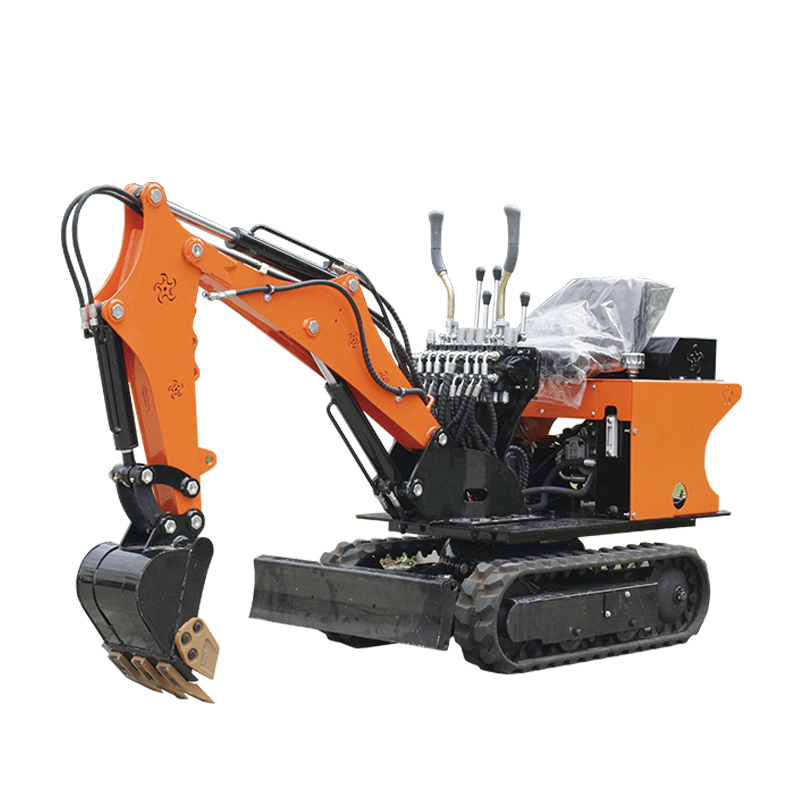
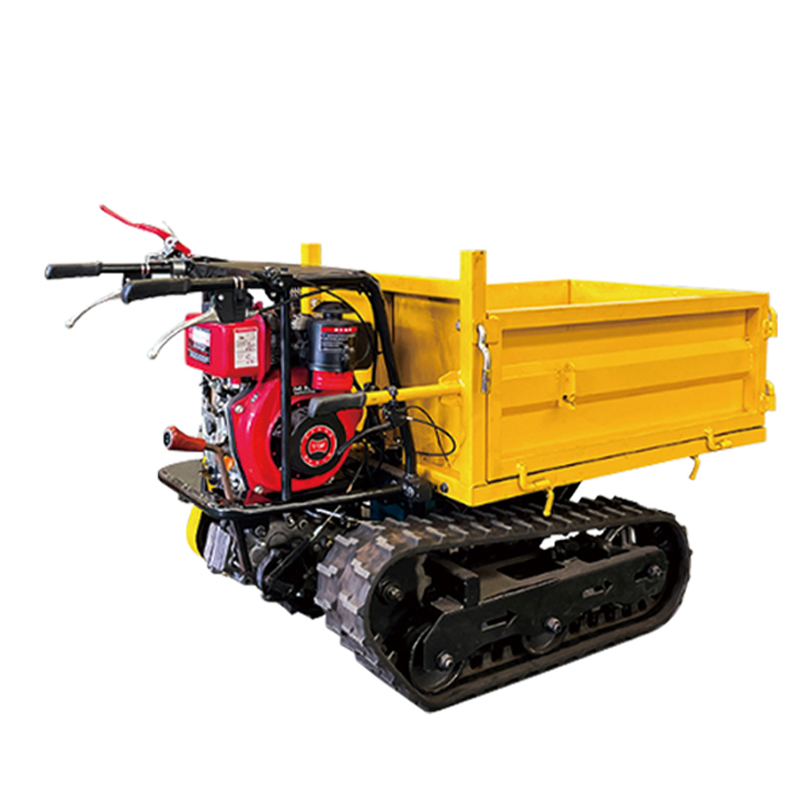
The core differences between the hydraulic systems of crawler and wheeled excavators stem from the fundamental distinctions in their travel methods (crawler vs. wheeled) and operating scenarios (heavy loads on complex terrain vs. mobility on hardened roads). The exclusive optimizations of crawler hydraulic systems revolve around three core goals: "low-speed, high-torque travel, stability on complex terrain, and adaptability to heavy-load operations". Targeted designs are implemented in aspects such as travel drive, load adaptation, anti-pollution protection, and operation coordination. Details are as follows:
Optimization Logic: Crawler excavators do not require high-speed road travel; their core needs are "high-torque starting, climbing capability, and smooth speed regulation". Therefore, a full hydraulic drive path of "engine - hydraulic pump - travel motor - gearbox - drive wheel" is adopted, eliminating the mechanical gearbox and drive shaft of wheeled models.
Exclusive Designs:
Travel Motor: Uniformly adopts low-speed, high-torque axial piston motors (wheeled models mostly use high-speed variable motors). The torque output density is increased by more than 30% (the motor torque of 10-ton models can reach 1500-3000 N·m), and it can directly drive the gearbox without an additional reduction mechanism, adapting to the "low-speed, high-load" travel characteristics of crawlers.
Integrated Gearbox: The travel gearbox is coaxially integrated with the motor (wheeled gearboxes are mostly integrated into the axle). It adopts 2-3 stage planetary gear reduction (reduction ratio 20-50:1, while wheeled models usually have 10-30:1), further amplifying torque to ensure the excavator’s climbing and 脱困 (extrication) capabilities on slopes above 30°, muddy ground, and other scenarios.
Dual-Way Independent Control: The left and right crawlers are respectively driven by independent hydraulic circuits. Differential steering is achieved by adjusting the flow/pressure difference of the motors on both sides (wheeled models rely on articulated frames + steering axles). During in-place steering, the motors on both sides rotate in opposite directions, and the ground contact area remains unchanged during steering, resulting in operational stability far exceeding that of wheeled models.
Exclusive Functions:
Travel Pressure Cut-Off Valve: When the crawler gets stuck in mud or rolls over obstacles, the system automatically triggers pressure cut-off (the set pressure is usually 10%-15% higher than that of wheeled models, reaching 35-40 MPa), preventing motor damage due to overloading while maintaining continuous torque output to improve extrication capability.
Hydraulic Buffer and Make-Up Valve: The crawler frequently starts, stops, and impacts the ground during travel. The system integrates a buffer and make-up valve, which supplements low-pressure oil when the motor decelerates or brakes to prevent motor cavitation. At the same time, it absorbs impact pressure waves to protect hydraulic pipelines and seals (this valve group is simplified or omitted in wheeled models due to their smooth travel).
Optimization Logic: Crawler excavators often face extreme load scenarios such as excavating hard rock and lifting heavy loads. They need to solve the problems of "flow distribution conflicts during multi-action coordination" and "system stability during sudden load changes". Therefore, the LS system is reinforced for heavy loads.
Exclusive Designs:
Main Pump Flow Adjustment Range: Dual/triple variable piston pumps are adopted. The maximum displacement of a single pump is 20%-30% higher than that of wheeled models (e.g., the main pump displacement of 20-ton crawler models can reach 200-250 L/min, while that of wheeled models is mostly 150-200 L/min), ensuring flow supply when excavating, slewing, and traveling actions are performed simultaneously.
Response Speed of LS Valve Group: The spool switching time is shortened to less than 50 ms (usually 80-100 ms for wheeled models). When the excavation load suddenly increases (e.g., the bucket hits hard rock), the main pump can quickly increase pressure and adjust flow to avoid action jams and prevent system overpressure.
Setting of Overload Relief Valve: The overload relief pressure of the excavation circuit and slewing circuit is set to 32-36 MPa (usually 28-32 MPa for wheeled models). Higher system pressure improves excavation force and lifting capacity (the excavation force of 20-ton crawler models can reach 150-180 kN, while that of wheeled models is mostly 120-150 kN).
Exclusive Function: Actions such as boom lowering and arm retraction of crawler excavators need to bear greater loads (e.g., full buckets of ore). Therefore, the regeneration circuit adopts a "two-stage regeneration" design:
First-Stage Regeneration: Directly guides the high-pressure oil discharged from the rodless cavity of the cylinder into the rod cavity to increase action speed.
Second-Stage Regeneration: Recovers load potential energy through a one-way valve group, reducing the oil supply demand of the main pump during heavy-load lowering. This saves energy while avoiding impact caused by excessively fast actions (the regeneration circuit of wheeled models is only for light-load scenarios and has a simpler structure).
Optimization Logic: Crawler excavators mostly operate in harsh environments such as mines, mud, and gravel, where hydraulic oil is easily contaminated with impurities like sand, mud, and metal chips. Therefore, the filtration and sealing systems are more stringent than those of wheeled models.
Exclusive Designs:
Three-Stage Filtration System: On the basis of the "suction filtration + return oil filtration" of wheeled models, a high-pressure side fine filtration (installed at the output end of the main pump, with a filtration precision of 5-10 μm, mostly omitted in wheeled models) is added to protect precision components such as travel motors and main control valves. The return oil filter adopts a "dual-filter element parallel" design, allowing online filter element replacement without stopping the machine (wheeled models mostly use a single filter element).
Upgrade of Sealing Structure: Exposed components such as travel motors and gearboxes adopt a "labyrinth + skeleton oil seal + O-ring" triple seal (wheeled models mostly use double seals) to prevent sand and mud from invading. Hydraulic pipeline joints use flange connections (wheeled models mostly use ferrule-type connections), which improve sealing reliability by 50% under bumpy and impact working conditions.
Exclusive Designs:
Hydraulic Oil Cooler: Adopts "combined air-water cooling" (wheeled models mostly use single air cooling). The cooling area is 30%-40% larger than that of wheeled models. In high-temperature mine environments (ambient temperature above 40°C) or during long-term heavy-load operations, the hydraulic oil temperature can be controlled within 80°C (usually within 85°C for wheeled models).
Intelligent Adjustment of Thermostatic Valve: When the hydraulic oil temperature is lower than 45°C, the thermostatic valve closes the cooling circuit (usually 40°C for wheeled models) to quickly raise the oil temperature to the working range, adapting to operations in low-temperature environments (e.g., mines in winter).
Optimization Logic: The slewing platform of crawler excavators bears a larger load (e.g., the slewing platform of 20-ton models bears more than 15 tons) and requires frequent 360° slewing during operations. Therefore, the slewing hydraulic system focuses on "low-speed stability, braking buffering, and impact resistance".
Exclusive Designs:
Slewing Motor: Adopts an integrated design of low-speed, high-torque piston motor + planetary reducer (wheeled slewing motors are mostly high-speed motors), with large output torque and uniform speed (slewing speed 0.8-1.2 r/min, mostly 1.0-1.5 r/min for wheeled models), avoiding slewing impact.
Slewing Buffer Valve and Brake Valve: Integrates a two-way buffer valve to absorb inertial impact during slewing start and stop; a built-in hydraulic brake valve automatically locks the slewing motor when the operation is stopped to prevent platform rolling (the brake valve structure of wheeled models is simpler due to their stable operating scenarios).
Exclusive Function: Crawler excavators are often equipped with heavy-load auxiliary devices such as breakers and rippers. The hydraulic system reserves exclusive circuits and control modules:
Dedicated Breaker Circuit: Integrates a high-pressure accumulator (volume 1-2 L) to stabilize the breaker’s striking frequency (1000-1500 times/min). At the same time, it is equipped with a relief valve and a throttle valve to adjust striking force and frequency, adapting to breaking scenarios of different hardness (the breaker circuit of wheeled models has no accumulator and weaker striking force).
Independent Control of Multi-Circuits: Adopts a 4-5 section main control valve (wheeled models mostly use 3-4 sections), reserving exclusive valve sections for rippers, quick couplers, etc. It can simultaneously control the actions of excavation, slewing, travel, and auxiliary devices, resulting in higher coordinated operation efficiency.
Exclusive Designs:
Pressure-Loss Automatic Braking: The travel circuit integrates a dual-circuit brake valve. When the hydraulic system pressure is lower than the set value (usually 8-10 MPa), it automatically locks the left and right travel motors to prevent the excavator from rolling during slope operations (wheeled braking relies on axle mechanical braking + hydraulic assistance).
Redundant Design of Parking Brake: In addition to hydraulic parking brake, a mechanical parking brake lever is added (wheeled models mostly use electronic parking). When the hydraulic system fails, the travel motor can be manually locked to improve safety in extreme scenarios.
Exclusive Function: Some medium and large crawler excavators are equipped with load-sensing anti-tipping systems. Sensors detect the machine’s tilt angle (front-rear/left-right) and operating load. When the tilt angle exceeds 15° or the load exceeds 110% of the rated value, the system automatically reduces the excavation speed or cuts off relevant actions to prevent the machine from tipping over (wheeled models rarely have this system due to their lower center of gravity).
In essence, the exclusive optimizations of the hydraulic system of crawler excavators represent a design trade-off of "abandoning road mobility to maximize adaptability to complex terrain and heavy-load operation capabilities". Through higher system pressure, stricter protection, and more precise load control, they meet the scenario needs that wheeled models cannot adapt to, such as mines, mud, and heavy loads, ultimately forming the core performance labels of "low-speed, heavy-load, stable, and durable".


 Chinese