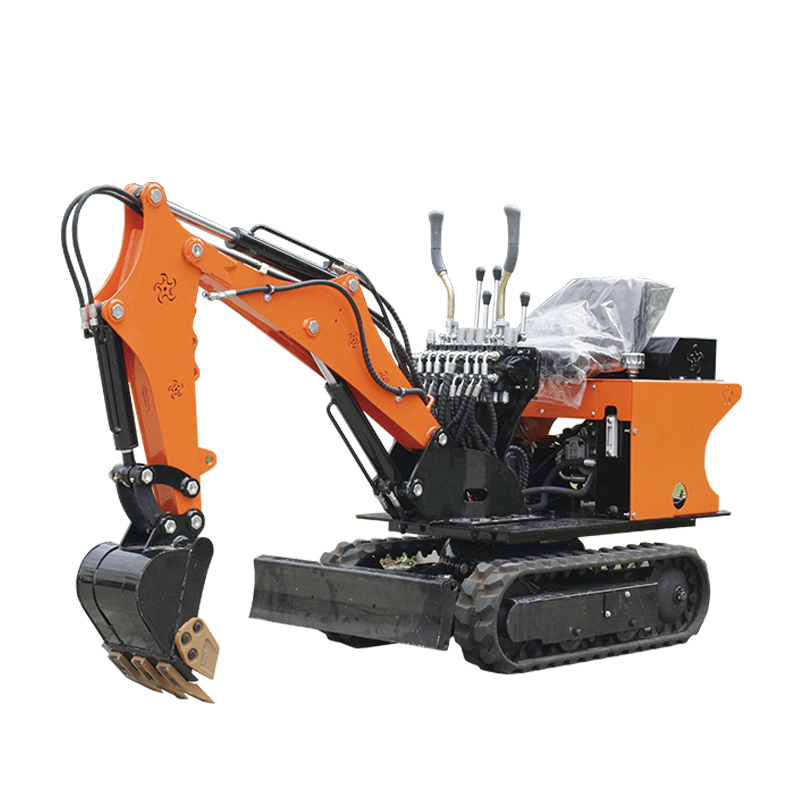
The track travel system of a crawler excavator is a core module that enables movement on complex terrain and stable operation under heavy loads. Its structural design revolves around three core functions: "power transmission - ground adaptation - load-bearing stability". It is composed of five categories of key components that work together: the drive unit, track assembly, wheel system components, travel frame with tensioning and buffering devices, and braking and locking mechanisms. These components form a closed-loop system through rigid connections and meshing transmission. The detailed breakdown is as follows:
The drive unit serves as the "power source" of the track travel system, responsible for receiving power from the hydraulic system and transmitting it to the tracks. Its core components include:
Type: The mainstream type is a low-speed, high-torque axial piston motor (some small excavators use gerotor motors). It can output high torque without an additional reducer (torque range is usually 1000-10000 N·m, suitable for excavators with a self-weight of 10-50 tons).
Core Function: Driven by high-pressure oil input from the hydraulic pump, the rotor rotates to convert hydraulic energy into mechanical energy, which directly or via a reduction mechanism drives the tracks to rotate. It has a bidirectional rotation function (enabling forward/backward movement) and achieves stepless speed regulation by adjusting the displacement of hydraulic oil.
Key Design: Integrates a pressure compensation valve and an overload relief valve to prevent damage from overloading. Some high-end models are equipped with electro-hydraulic proportional control motors to improve speed regulation accuracy and operational smoothness.
Structural Form: Mostly planetary gear reducers (1-3 stages of reduction), integrated inside the drive wheel (coaxially connected to the motor).
Core Function: Converts the high-speed, low-torque output of the travel motor into low-speed, high-torque (reduction ratio is usually 20-50:1) to meet the torque requirements of the excavator for heavy-load starting, climbing, and driving on complex terrain. It transmits power through gear meshing with high transmission efficiency (≥90%).
Key Design: Gears are made of high-strength alloy steel and undergo quenching treatment, with a hardened layer thickness of ≥2 mm on the tooth surface to improve wear resistance. A forced lubrication channel is built-in, and gears and bearings are lubricated through hydraulic oil circulation to prevent high-temperature wear.
Installation Position: Rear end of the inner side of the track assembly (rigidly connected to the output shaft of the gearbox).
Structural Features: The wheel rim is equipped with evenly distributed "drive teeth" (8-12 teeth, matching the track pitch), and the tooth profile adopts an involute design, which fits closely with the meshing surface of the track link.
Core Function: Through the meshing of drive teeth and track links, it transmits the torque output by the gearbox to the tracks, driving the tracks to move cyclically. The drive wheel hub is made of cast steel, and the surface of the drive teeth is overlay-welded with wear-resistant alloy to extend service life.
The track assembly is a key component for the tracks to contact the ground, directly affecting passability, grip, and ground adaptability. Its core components include:
Type: Classified by material into steel track shoes (for mining/heavy-load scenarios) and rubber track shoes (for urban/soft ground scenarios); classified by pattern into "block patterns" (strong grip), "transverse patterns" (good water drainage), and "flat track shoes" (low ground damage).
Structural Features: Steel track shoes are stamped from high-strength manganese steel (Q345 or NM400 wear-resistant steel), with a thickness of 10-20 mm and anti-slip protrusions (height 5-15 mm) on the surface. Rubber track shoes use wear-resistant rubber as the base material, with multiple layers of steel cord embedded to enhance tensile strength and anti-derailment flanges on the edges.
Core Function: Increases the ground contact area (ground pressure 0.05-0.15 MPa) to disperse the machine's self-weight and prevent sinking on soft ground. It provides grip through friction between the pattern and the ground to enable travel and steering.
Structural Form: Divided into left/right track links, connected to track shoes via pins and bolts to form a closed track loop (30-50 track links per side, matching the excavator's tonnage).
Material and Process: Track links are forged from 40Cr alloy steel and undergo quenching and tempering (hardness HRC35-40). Pins undergo carburizing treatment (carburized layer thickness 0.8-1.2 mm) to ensure a tensile strength of ≥1200 MPa.
Core Function: Connects track shoes and pins to form the rigid framework of the track. The pin holes of the track links match with the pins to enable flexible bending of the track (adapting to uneven terrain). Adjacent track links can rotate around the pins with a rotation angle range of ±5° to ensure smooth cyclic movement of the track.
Installation Position: Inside the pin holes of the track links, forming a hinged structure of "track link - bushing - pin".
Structural Features: Pins are cylindrical with chamfers at both ends (for easy installation). Bushings are sleeved on the outside of the pins, forming an interference fit with the pin holes of the track links, and their surfaces undergo nitriding treatment (hardness HV800-1000).
Core Function: Enables flexible connection of track links and reduces friction when the track bends. Sliding friction exists between bushings and pins, so grease must be regularly added (or a maintenance-free design with built-in solid lubricant is adopted) to reduce wear.
Installation Position: Inner side of the track loop, connected to the tensioning device.
Core Function: Adjusts the tension of the track (standard tension: track sag 100-200 mm, which can sink 50-100 mm when pressed in the middle of the track) to prevent derailment caused by loose tracks. It buffers the impact during track travel and protects track links and pins.
Installed under the travel frame, the wheel system components are responsible for supporting the machine's self-weight, guiding track movement, and reducing track wear. Their core components include:
Installation Position: Under the travel frame, evenly distributed (6-10 per side, spacing 200-300 mm), directly in contact with the inner side of the track.
Structural Features: The roller body adopts a double-rim design (to prevent track deviation), made of cast steel or forged steel, with the roller surface undergoing quenching treatment (hardness HRC50-55). It has built-in double-row tapered roller bearings and a dual-seal structure of "labyrinth + O-ring".
Core Function: Supports the entire self-weight of the excavator (single roller load-bearing capacity 3-8 tons) and transmits the weight to the track. It rolls along with the track to reduce friction between the track and the travel frame, ensuring stable cyclic movement of the track. The roller surface is arc-shaped, fitting the inner side of the track to guide the track's movement direction.
Installation Position: Above the travel frame, on the inner side of the track (2-3 per side), between the drive wheel and the idler wheel.
Structural Features: The roller body has a single rim, made of the same material as the track rollers, with a smooth roller surface (to reduce track wear). It has built-in deep groove ball bearings and the same seal structure as the track rollers.
Core Function: Supports the weight of the upper part of the track, preventing poor meshing between the track and the drive wheel/idler wheel due to sagging of the upper track. It guides the movement of the upper track, avoids lateral deviation of the track, and reduces wear on track links.
Installation Position: Front end of the inner side of the track assembly (connected to the travel frame via a tensioning device).
Structural Features: The roller body has a double rim with a smooth arc-shaped surface (to guide the track into the track rollers). The wheel hub has built-in sliding bearings or rolling bearings, and a dust cover on the outer ring.
Core Function: Guides the movement direction of the track to ensure correct meshing between the track and the track rollers, top rollers, and drive wheel. It adjusts the position of the idler wheel via the tensioning device to realize track tension adjustment. The inner side of the rim has a chamfer to avoid scratching the track links.
Structural Form: Divided into "integral travel frames" (for small and medium excavators, compact structure) and "split travel frames" (for large excavators, easy maintenance). It is made of high-strength steel plates through welding (main beam thickness 15-30 mm).
Core Function: Serves as the installation base for the wheel system components, drive unit, and tensioning device, and bears the impact of the excavator's self-weight and operating load. Track roller axle seats and top roller brackets are welded under the travel frame; idler wheel mounting seats are welded at the front end; and the drive wheel gearbox is connected at the rear end, forming a rigid frame structure.
Key Design: The main beam adopts a box-section design (high bending resistance). Welded joints are reinforced with groove welding + fillet welding to avoid stress concentration. The surface is sprayed with anti-rust primer + topcoat to improve corrosion resistance.
Component Composition: Mainly includes a tensioning cylinder, tensioning spring, push rod, guide sleeve, etc.
Installation Position: Front end of the travel frame, connected to the idler wheel.
Core Function: High-pressure oil is injected into the tensioning cylinder (working pressure 10-15 MPa) to push the push rod and drive the idler wheel to move forward, tensioning the track. The tensioning spring plays a buffering role, absorbing the impact during track travel (such as rolling over stones and uneven roads) to avoid track damage caused by sudden changes in tension. Some models are equipped with a manual tensioning mechanism (for emergency adjustment).
Key Design: The tensioning cylinder has a built-in one-way valve to prevent track slack caused by hydraulic oil leakage. The tensioning spring is made of high-quality alloy spring steel with a stable elastic coefficient and a service life of ≥5000 working hours.
Type: Includes rubber buffer blocks (installed between the track roller axle seats and the travel frame) and spring washers (used for fixing wheel system components).
Core Function: Absorbs ground impact and vibration, reducing rigid collisions between the wheel system components and the travel frame. It reduces machine vibration during operation and travel, protecting the hydraulic system and electrical components.
Installation Position: Inside the main control valve of the hydraulic system, connected in series with the oil circuit of the travel motor.
Core Function: Implements service braking (when the driver operates the brake pedal, it cuts off the oil supply to the travel motor and locks the motor rotor via hydraulic pressure). It has a "pressure-loss automatic braking" function (if the hydraulic system pressure is insufficient, the brake valve automatically locks to prevent the excavator from rolling).
Type: Divided into hydraulic parking brakes (controlling the locking of the brake cylinder via a solenoid valve) and mechanical parking brakes (controlling the locking of the brake pads via a pull rope or handle).
Core Function: When the excavator stops moving or operates on a slope, it locks the travel motor or drive wheel to prevent accidental movement. The mechanical parking brake is an emergency braking method that can still effectively lock when the hydraulic system fails.
Installation Position: Between the travel frame and the slewing platform (though not a direct component of track travel, it affects the safety of coordinated travel and operation).
Core Function: When the excavator travels, it locks the slewing platform to prevent accidental rotation of the slewing platform, which could cause collisions. It uses a hydraulic cylinder to drive a locking pin into the slewing bearing gear ring to achieve rigid locking.
The travel motor receives power from the hydraulic pump, and after speed reduction and torque increase via the gearbox, it drives the drive wheel to rotate. The drive wheel drives the tracks to move cyclically through the meshing of drive teeth and track links. Friction between the track shoes and the ground generates traction to push the excavator forward/backward. Track rollers support the machine's self-weight and guide the track to roll stably; top rollers prevent the upper track from sagging; idler wheels ensure correct track meshing. The tensioning device adjusts track tension, and the buffering device absorbs impact. The braking and locking mechanisms ensure travel and parking safety. Ultimately, the crawler excavator achieves stable movement and operation on complex terrain.


 Chinese