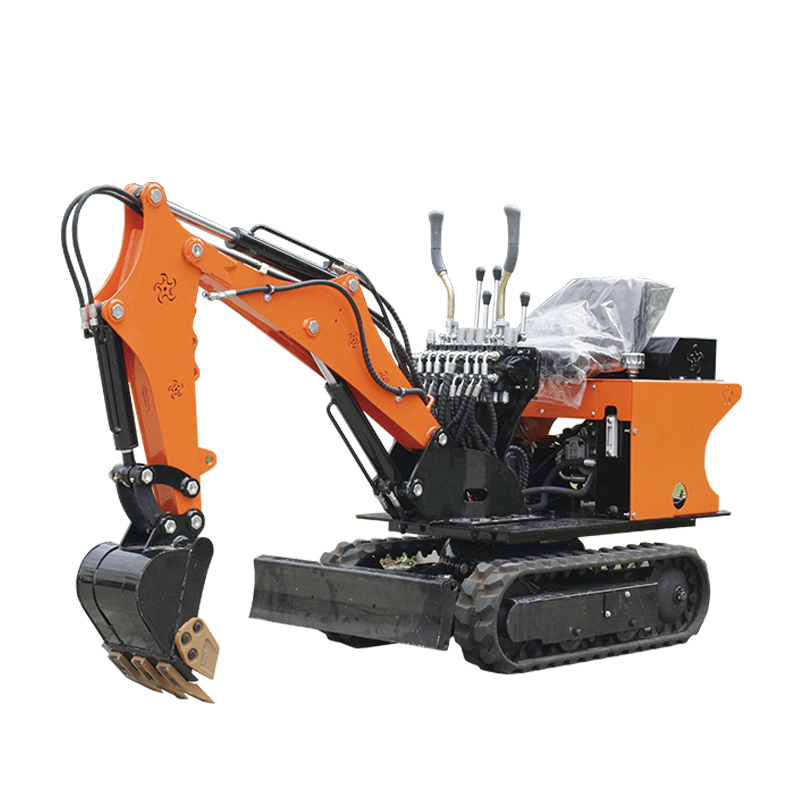
The fuel consumption of an excavator is closely related to its operating conditions. Different operating intensities, load sizes, and equipment action modes directly affect the rate of fuel consumption. The following analysis explores the relationship between the two from specific operational dimensions and summarizes the key influencing factors:
Heavy - duty operation (high load)
Typical scenarios: Crushing hard rocks, excavating dense clay, hoisting heavy components (such as steel, concrete blocks), etc.
Fuel consumption characteristics: At this time, the engine needs to output high power to drive the hydraulic system to overcome resistance, and the speed is usually maintained in the medium - high range (such as 70% - 100% of the rated speed). The fuel burns fully, but the consumption is extremely large. For example, a 20 - ton excavator can consume 15 - 25 liters of fuel per hour during crushing operations, which is more than 50% higher than that of light - duty operations.
Medium - duty operation
Typical scenarios: Excavating ordinary soil, loading loose materials (such as sand and gravel), leveling the site, etc.
Fuel consumption characteristics: The load is moderate, the engine speed is mostly 50% - 70% of the rated speed, the pressure of the hydraulic system is stable, and the fuel consumption is at a medium level. A 20 - ton excavator usually consumes 10 - 15 liters of fuel per hour under such working conditions.
Light - duty or no - load operation
Typical scenarios: Idling of the equipment, short - distance movement, cleaning the surface floating soil, etc.
Fuel consumption characteristics: The engine load is small, the speed is low (such as idle speed or 30% - 50% of the rated speed), and the fuel consumption is the least. For example, when an excavator is idling and waiting, the fuel consumption is only 3 - 5 liters per hour, which is about 1/5 - 1/3 of that of heavy - duty operations.
Compound actions (multi - mechanism linkage)
Typical scenarios: Simultaneously operating the lifting and lowering of the boom, the expansion and contraction of the stick, the flipping of the bucket (such as "lifting the arm + retracting the bucket" during excavation), rotating the body, etc.
Fuel consumption characteristics: Compound actions require multiple hydraulic components (cylinders, motors) to work at the same time, which leads to a sharp increase in the flow and pressure requirements of the hydraulic system. The engine needs to continuously output high power, resulting in a significant increase in fuel consumption. For example, the compound action of excavator rotation + unloading consumes 20% - 30% more fuel than 单独 rotation.
Single action
Typical scenarios: Only lifting and lowering the boom, only opening and closing the bucket, etc.
Fuel consumption characteristics: A single hydraulic component works, the system load is small, the engine power demand is low, and the fuel consumption is relatively small.
Rugged / sloping sites
Typical scenarios: Mountain operations, slope excavation (slope > 15°), muddy or soft ground.
Fuel consumption characteristics: The equipment needs to overcome gravity or ground resistance (such as track slipping, tire trapping). The engine needs to output additional power to maintain the stability of the body or drive the walking, so the fuel consumption is 10% - 40% higher than that of flat - ground operations. For example, when excavating on a 20° slope, the fuel consumption may increase by more than 30%.
Flat and hard sites
Typical scenarios: Operations on hardened roads, solid land.
Fuel consumption characteristics: The resistance to walking and operation of the equipment is small, the power loss is small, and the fuel consumption is more stable and lower.
Typical scenarios: Waiting for material transport vehicles, on - site coordination pauses, not turning off the engine during operation intervals, etc.
Fuel consumption characteristics: When idling, the engine does not participate in effective operations, but still needs to maintain basic operation (such as the hydraulic system on standby, air conditioning use). The fuel consumption per hour is about 3 - 6 liters (depending on the model). If the cumulative idle time per day reaches 2 - 3 hours, the additional fuel consumption can reach 6 - 18 liters, accounting for 10% - 20% of the total fuel consumption.
| Operating condition factors | Scenarios associated with high fuel consumption | Scenarios associated with low fuel consumption | Fuel consumption difference range |
|---|
| Load intensity | Crushing, heavy - duty excavation | No - load, light - duty cleaning | Up to 3 - 5 times |
| Action type | Multi - mechanism compound actions (rotation + arm lifting + bucket retracting) | Single action (such as 单独 bucket opening) | 10% - 30% higher |
| Site conditions | Slopes, muddy ground | Flat and hard ground | 10% - 40% higher |
| Idle time | Long waiting time (> 1 hour) | Continuous operation, no pauses | Account for 10% - 20% of total fuel consumption |
Extension: How to reduce fuel consumption by optimizing operating conditions?
Avoid "using a large horse to pull a small cart": Select a matching model according to the operating load (such as 10 - ton class for light loads, more than 20 - ton class for heavy loads) to avoid overloading of small equipment or low - load operation of large equipment.
Reduce invalid actions: Plan the route before operation to avoid frequent rotation and empty driving; Try to complete simple operations with a single action to reduce the number of compound actions.
Control idle speed: Turn off the engine during long waiting times (such as more than 5 minutes), and reduce the speed to the idle range during short waiting times.
By reasonably matching operating conditions and operating methods, fuel consumption can be effectively reduced, and the service life of the equipment can be prolonged at the same time.



 Chinese