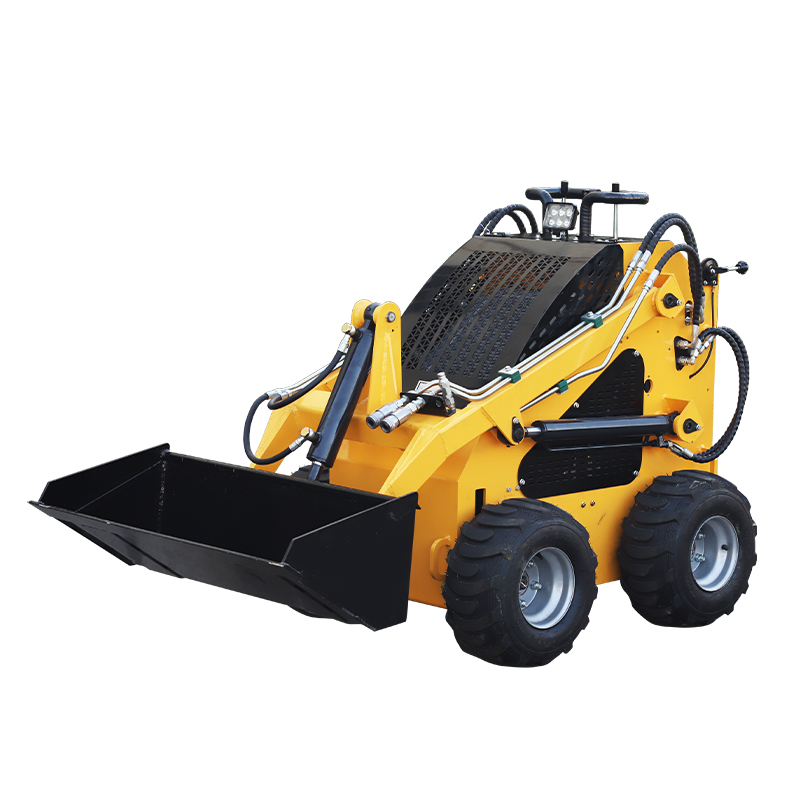
The operational points of loaders in earthwork operations (such as shoveling, transporting, unloading, leveling, etc.) should be carried out around four core dimensions: safety protection, equipment status, operation efficiency, and equipment protection. It is necessary not only to avoid safety accidents but also to reduce equipment wear and improve operation quality. The following is a detailed classification and explanation of the operational points:
The preparation work before operation directly determines the safety and stability of subsequent operations, and all items must be checked and confirmed without omission:
Core Systems: Before starting, check whether the oil levels of engine oil, coolant, hydraulic oil, and fuel are within the standard range. Inspect hydraulic pipelines and joints for leakage (hydraulic system failure is a common problem in earthwork operations).
Operating Components: Test whether the steering wheel, control levers (for bucket and boom control), brakes, and clutch (if it is a manual transmission) are flexible, and whether the gear shifting is smooth to avoid "jamming" or "loss of control" during operation.
Travel and Tires: Check if the tire pressure is normal (most earthwork operations are on soft ground, and the tire pressure needs to be adjusted according to the ground hardness; the tire pressure can be appropriately reduced on soft ground to increase the contact area). Inspect if there are stones or debris stuck in the tire tread and if the wheel hub bolts are tight.
Safety Devices: Confirm that the cab seat belt, rearview mirrors, reverse alarm, work lights (for night or low-visibility operations), and fire extinguisher are in good condition. If there are personnel in the operation area, check in advance whether the "acoustic and optical alarm" function is normal.
Site Evaluation: Observe the ground hardness of the operation area (to prevent the vehicle from sinking), check for hidden ditches, potholes, and obstacles (such as stones, pipelines, trees). Mark dangerous areas (such as slopes, waterlogged pits) in advance and set up warning signs if necessary.
Weather and Visibility: When operating in rainy or foggy days, reduce the driving speed and be cautious of ground slipping. In high temperatures in summer, check the heat dissipation of the engine to avoid overheating caused by long-term overloaded operation.
Personnel Communication: If there are other equipment (such as excavators, dump trucks) or construction personnel on-site, clarify the operation process (such as unloading location, avoidance route) in advance to avoid cross-operation conflicts.
Earthwork operations include four core links: "shoveling → transporting → unloading → leveling". The operational points vary greatly in different links and need to be controlled in a targeted manner:
Shoveling is the core function of a loader. Improper operation may lead to "bucket overloading", "tire slipping", or "boom damage". The key points are as follows:
Bucket Angle and Position: Before shoveling, place the bucket flat (bucket teeth touching the ground) and drive slowly towards the material pile. When the bucket teeth are 30-50 cm away from the material pile, adjust the bucket angle (slightly tilt the bucket teeth downward by about 5-10°) to avoid excessive resistance caused by the bucket teeth "digging too deep" into the pile.
Uniform Propulsion and Shoveling Force: Drive the loader at a medium-low uniform speed to allow the bucket teeth to cut into the earth naturally. If hard soil or stones are encountered, do not rush forward forcefully (which may cause bucket deformation or engine stalling). Instead, adjust the direction slightly or use the bucket teeth to "crush" the obstacle before shoveling.
Avoid Overloading and Maintain Center of Gravity Balance: During shoveling, observe the amount of earth in the bucket and do not exceed 80%-90% of the bucket's rated capacity (soft earth is prone to collapse, and overloading will cause the vehicle's center of gravity to shift backward, leading to "nose-up" during driving). After filling the bucket, first lift the bucket slightly (by about 10-15 cm), then retract the bucket (with the bucket teeth facing upward) to prevent the earth from spilling during driving.
The transport link requires attention to driving stability, especially when operating on curves, slopes, and soft ground:
Driving Speed: The loader can drive at a medium speed when unloaded, but must drive at a low speed (≤5 km/h) when loaded. Avoid sudden acceleration and sudden braking (which may cause the earth to shift and even the vehicle to skid).
Bucket Height Control: When driving with a load, keep the bottom of the bucket 30-50 cm above the ground (excessively high height will raise the vehicle's center of gravity and increase the risk of rollover; excessively low height may scratch the ground). When encountering obstacles, the bucket can be lifted slightly temporarily and lowered immediately after passing.
Operation on Slopes and Curves:
Uphill: Shift to a low gear in advance and drive at a uniform speed. Avoid shifting gears midway (which may cause power interruption and backward sliding). If the slope is greater than 15°, it is forbidden to go uphill with a load (the vehicle's climbing capacity needs to be evaluated).
Downhill: Engage a low gear and use the engine for "braking". Step on the brake gently (do not step hard) and avoid coasting in neutral (which may lead to loss of control). When turning, slow down in advance, keep the turning radius as large as possible, and prohibit "sharp turns + sudden braking" (which is prone to rollover).
Handling Soft Ground: If the ground is muddy or soft, first test the ground bearing capacity (drive empty to observe whether the vehicle sinks). If there is slight sinking, reduce the tire pressure and drive straight at a uniform speed. Avoid frequent steering or stopping (which will aggravate sinking).
Unloading is mainly for discharging materials into containers such as dump trucks and silos, and it is necessary to control the "alignment accuracy" and "unloading speed":
Alignment Skills: Drive slowly towards the unloading point, observe the position of the bucket and the unloading container through the rearview mirror, and ensure that the center of the bucket is aligned with the center of the container (with a deviation of ≤10 cm). After parking, pull the handbrake tightly to prevent the vehicle from moving during unloading.
Control of Unloading Actions: First, slowly lift the boom to the unloading height (the bottom of the bucket is 10-20 cm higher than the edge of the container; do not raise it too high to avoid excessive impact when the earth falls). Then, slowly turn the bucket to unload. Do not push the control lever violently during unloading (which may cause hydraulic impact and damage the boom cylinder). If there is residual earth, gently shake the bucket (swing back and forth slightly) instead of using the bucket to "hit" the container (which may damage the bucket teeth and the container).
Reset After Unloading: After unloading, first turn the bucket back to the "horizontal position", then slowly lower the boom (do not lower the boom too fast to avoid "smashing the ground" and damaging the bucket). After confirming the height of the bucket from the ground, release the handbrake and drive away from the unloading point.
Some earthwork operations require loaders to assist in leveling the ground (such as site leveling). The operational points are as follows:
Bucket Angle Adjustment: Place the bucket flat (bucket teeth touching the ground) and adjust the bucket tilt angle (about 2-3°, with the bucket teeth slightly higher than the bucket bottom) to form a "leveling" state.
Driving and Operation Rhythm: Drive at a low uniform speed, keep the boom at a fixed height (the bucket slightly touches the ground), and adjust the bucket angle slightly through the control lever to scrape the raised earth to the low-lying areas. Avoid "scraping too deep at one time" (which may cause uneven ground). If hard soil clods are encountered, first shovel and remove them instead of scraping forcefully (which may damage the bucket teeth).
Maintenance and cleaning after operation are crucial for reducing equipment failures and ensuring the next operation:
Remove the residual earth and debris in the bucket (high-pressure water can be used for flushing to avoid affecting the next shoveling after drying and hardening). Clean the stones and soil in the tire tread (to prevent uneven tire wear).
Wipe the cab glass and rearview mirrors. Check the vehicle body for scratches and deformation, and record the appearance damage of the equipment.
After stopping the machine, wait for the engine to cool down (for about 10-15 minutes), check the oil levels of engine oil and hydraulic oil, and replenish them to the standard range. Inspect hydraulic pipelines and joints for leakage; if leakage is found, report for repair in time.
Lubricate key parts: According to the equipment manual, add lubricating grease to the hinge points such as boom pins, bucket pins, and steering tie rods (earthwork operations generate a lot of dust, and insufficient lubrication will accelerate component wear).
Battery maintenance: If it is a lead-acid battery, check the electrolyte level and add distilled water if the level is too low. Clean the oxides on the battery terminals to prevent poor contact.
Park the loader on a flat and hard ground (avoid parking on slopes, soft ground, or low-lying waterlogged areas). Pull the handbrake tightly, put it in neutral, turn off the engine, and pull out the key.
Clean up the scattered earth and debris in the operation area, check for any missing tools, and complete the on-site safety handover.
Prohibition of Illegal Operations: It is strictly forbidden to use the loader bucket to "lift personnel" (such as for repairing high-altitude equipment), to use the bucket to hit or drag other equipment or objects, and to operate with an overload (the rated load capacity of the loader must be clearly known, and it cannot be judged by experience).
Personnel Safety Distance: During operation, ensure that there are no personnel within the rotating radius of the bucket (maintain a safety distance of at least 5 meters). If personnel are required to cooperate in command, standard hand gestures or walkie-talkies should be used for communication to avoid collisions caused by blind spots.
Emergency Handling: If faults such as hydraulic system leakage, abnormal engine noise, or brake failure occur during operation, stop the operation immediately, park the loader in a safe area, cut off the power supply, and contact maintenance personnel. Do not operate with "faults".
In summary, the core of loader earthwork operations is "stable operation, careful inspection, and risk prevention". Operators need to be familiar with the equipment performance and flexibly adjust the operation methods according to the operation scenario, so as to ensure safety, improve operation efficiency, and prolong the service life of the equipment.



 Chinese