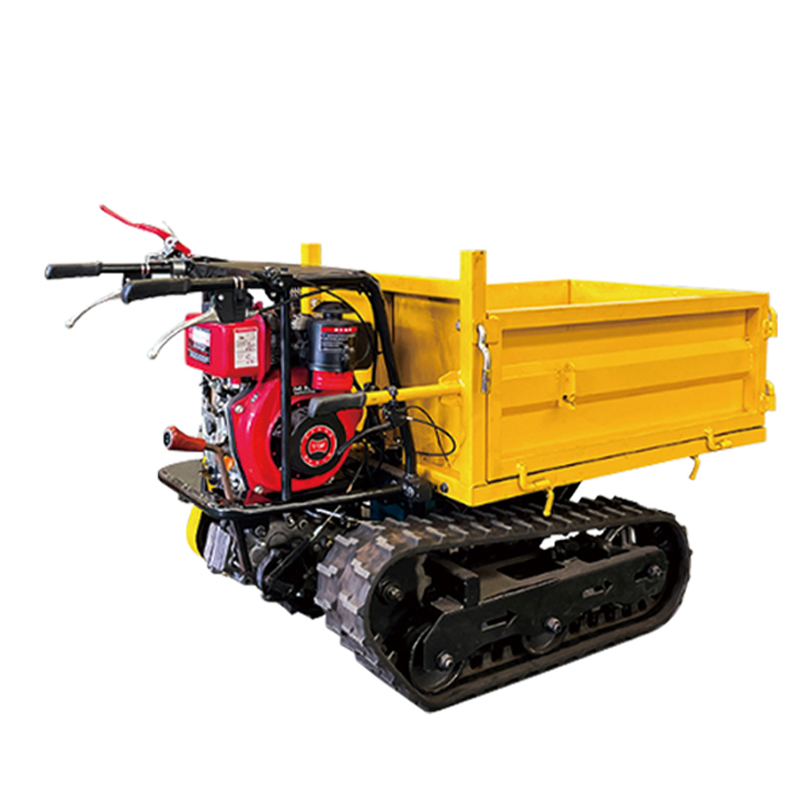
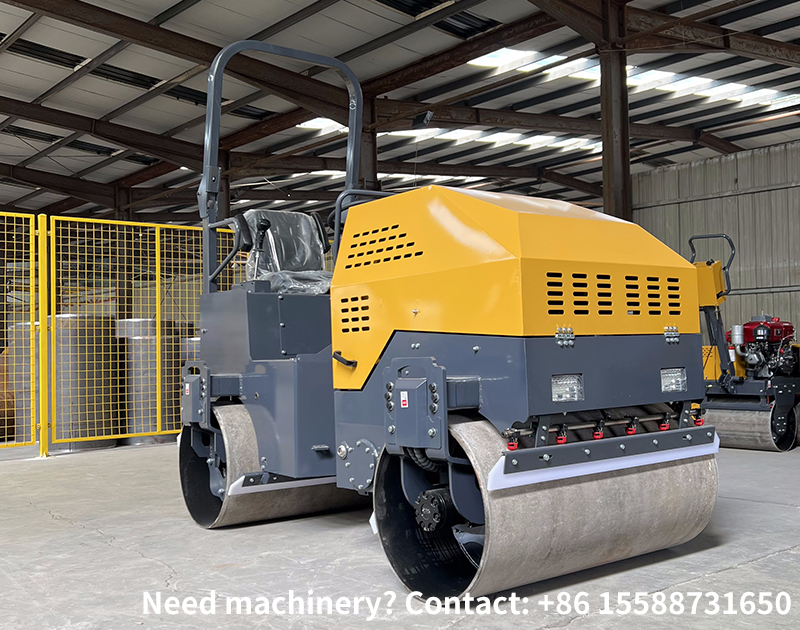
Road rollers can be divided into multiple categories according to compaction principles, structural forms, and uses. The most commonly used types in engineering include: static road rollers (smooth-wheel static, tire static), vibratory road rollers (single-drum vibratory, double-drum vibratory), impact road rollers, and walk-behind road rollers (small static/vibratory) adapted for narrow scenarios.
Static road rollers compact materials by static pressure generated by their own weight, without vibration or impact. They are mainly divided into two types: smooth-wheel static and tire static:
Smooth-wheel static road rollers (also called "static compactors"): The working device is a steel smooth roller (single-wheel, double-wheel, or three-wheel). It uses the overall weight (adjustable by adding counterweights) to make the roller exert uniform static pressure on the ground, squeezing material particles to arrange them closely and reduce gaps. Principle features: uniform pressure, no disturbance; suitable for operations requiring high surface flatness (e.g., final compaction of asphalt pavements) or scenarios where vibration is not allowed (e.g., old pavement renovation, backfill compaction near buildings).
Tire road rollers (also called "rubber-tyred rollers"): The working device consists of multiple inflated rubber tires (usually arranged as 3 front and 4 rear, or 4 front and 5 rear). It compacts materials by the "kneading and pressing effect" generated by the overall weight and tire elasticity. The contact between tires and the ground is flexible; in addition to static pressure, tire deformation can knead and squeeze materials, making particles interlock. Principle features: compacted surface is dense with certain elasticity, not prone to cracks; especially suitable for final compaction of asphalt mixtures (can eliminate wheel tracks and improve pavement flatness), and also applicable for compaction of cement-stabilized soil and crushed stone bases.
Vibratory road rollers add periodic excitation force generated by vibration devices on the basis of static pressure, making material particles resonate and slide against each other to achieve compaction. They are currently the main equipment for subgrade and base compaction:
Single-drum vibratory road rollers: One side is a large-diameter steel vibratory drum (with built-in vibration motor and eccentric block), and the other side is a rubber driving wheel. During operation, the eccentric block rotates at high speed to generate vertical excitation force (up to tens or even hundreds of tons), which acts on the ground together with static pressure, making soil/crushed stone particles rearrange under vibration and fill gaps. Principle features: large excitation force, deep compaction depth (up to 1-1.5 meters); suitable for subgrade filling (sand, clay, crushed stone soil) and base (cement-stabilized soil, graded crushed stone) compaction. It has two working modes: "high frequency and low amplitude" (surface compaction, e.g., asphalt surface course) and "low frequency and high amplitude" (deep compaction, e.g., subgrade bottom layer).
Double-drum vibratory road rollers: Both front and rear are steel vibratory drums (can vibrate single drum or double drums), with higher excitation frequency (usually 40-60Hz) and smaller amplitude. The surface of the vibratory drum is smooth, and some are equipped with sprinkler devices to prevent adhesion of asphalt mixtures. Principle features: high compaction precision and good flatness; mainly used for initial and re-compaction of asphalt pavements (initial compaction stabilizes mixtures, re-compaction improves density), and also for compaction of thin-layer cement-stabilized bases.
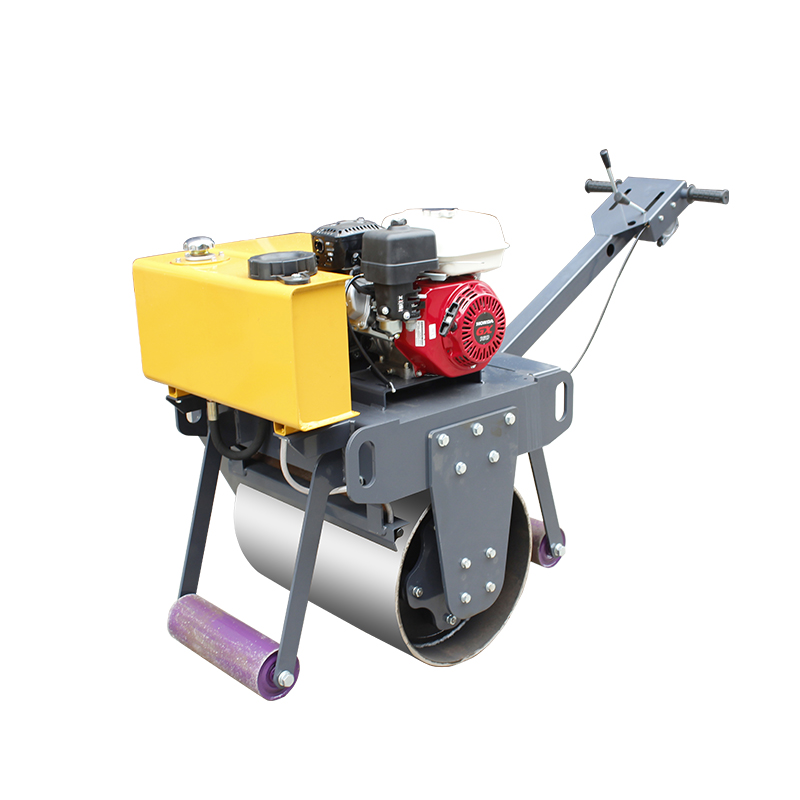
Walk-behind vibratory road rollers (small-sized): Light weight (usually 0.5-3 tons), equipped with small vibratory drums, driven by electric motors or diesel engines to power vibration devices, with relatively small excitation force (several tons to more than ten tons). Principle features: flexible operation; suitable for compaction in narrow spaces (e.g., courtyard pavements, pipeline trench backfill, sidewalk paving) or corner areas inaccessible to large road rollers.
Impact road rollers (also called "impact compactors") have a polygonal (hexagonal/octagonal) impact wheel as the main body. The impact wheel is dragged by a tractor to roll, and uses the gravity of the impact wheel and kinetic energy during rolling to produce a composite effect of "impact + rolling" on the ground. Working principle: When the impact wheel rolls to the vertex, gravitational potential energy is converted into kinetic energy; when it falls, it generates instantaneous impact load on the ground (up to hundreds of tons), forcing material particles to displace and compact, and shock waves can transmit to deep soil (compaction depth up to 3-5 meters). Principle features: large compaction energy, deep influence depth; suitable for high-fill subgrades (e.g., airports, dams, highway subgrades) and soft ground treatment (eliminating soil pores and improving bearing capacity), but poor flatness, requiring cooperation with smooth-wheel road rollers for surface finishing.
Oscillating road rollers: Eccentric blocks in the vibratory drum rotate in pairs in opposite directions to generate horizontal oscillating force, making material particles vibrate and slide horizontally instead of vertical impact. Principle features: no obvious vibration impact, little influence on surrounding buildings; suitable for urban roads, old pavement reconstruction (sections near buildings), or precision compaction scenarios requiring extremely high flatness.
Sheep-foot rollers (protruded-block rollers): The steel wheel surface is covered with protruded blocks (sheep-foot-shaped). During compaction, the protruded blocks penetrate the soil; in addition to static pressure, they can break soil clods through extrusion and kneading to increase density. Principle features: suitable for compaction of cohesive soil subgrades (e.g., clay, silty clay); protruded blocks can break the agglomerated structure of soil clods, making the soil more uniformly dense.


 Chinese