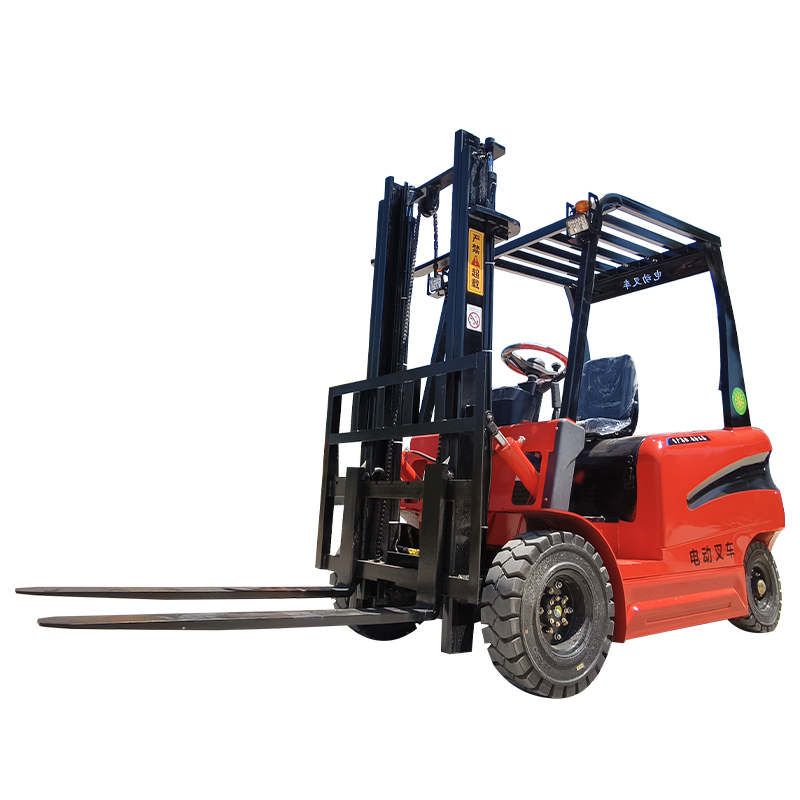
The battery capacity of an electric forklift is the core factor determining its driving range. The two are positively correlated but not absolutely linear, with the specific logic as follows:
The unit of battery capacity is ampere-hour (Ah), which refers to the duration a battery can discharge continuously at a specified current (e.g., a 200Ah battery can discharge continuously for 20 hours at a current of 10A). The driving range depends on the total electrical energy output by the battery (electrical energy = capacity × voltage, unit: watt-hour (Wh)) and the energy consumption rate of the forklift during operation.
Basic Rule: Under the same operating conditions, the larger the battery capacity (the more total electrical energy), the longer the driving range. For example: A forklift with a 150Ah/48V battery (total electrical energy 7200Wh) has a driving range of approximately 6–8 hours; the same model of forklift equipped with a 300Ah/48V battery (total electrical energy 14400Wh) can achieve a driving range of 12–16 hours under ideal working conditions.
Reason for Non-Absolute Linearity: The driving range is also affected by the actual operating load. When handling full loads, frequently lifting and lowering forks, or driving on ramps, the motor power consumption increases significantly, accelerating battery energy consumption. As a result, the driving range will be reduced by 30%–50% compared with no-load or light-load operations. Conversely, the driving range will be closer to the theoretical value during light-load operations on flat roads.
In addition to capacity, the following factors will further amplify or reduce the impact of capacity on driving range:
Battery Type: The energy density (Wh/kg) of lithium batteries is 2–3 times that of lead-acid batteries. Under the same capacity, the actual driving range of lithium batteries is 10%–20% longer than that of lead-acid batteries (lithium batteries have a higher discharge efficiency of over 95%, while lead-acid batteries have a discharge efficiency of about 80%).
Operating Environment: Low temperatures (≤0℃) can cause a 30%–50% reduction in the capacity of lead-acid batteries and a 10%–20% reduction in that of lithium batteries, with driving range shortening as temperature drops.
Forklift Configuration: High-power motors and heavy-duty hydraulic systems will increase energy consumption. For batteries of the same capacity, the driving range can vary by up to 20% when used with forklifts of different configurations.
Operating Habits: Frequent sudden acceleration, sudden braking, and long-term high-speed operation will double the instantaneous power consumption of the motor and accelerate power consumption.
The core of extending the driving range is reducing energy loss + optimizing battery usage + improving electrical energy utilization rate, which can be implemented through the following aspects:
Prioritize Lithium Batteries: Lithium batteries feature high discharge efficiency, no memory effect (can be charged and used at any time), and a long cycle life. Their driving range stability is far superior to that of lead-acid batteries during long-term use. If lead-acid batteries are retained, select large-capacity, high-discharge-rate models (e.g., power-type lead-acid batteries with a discharge rate ≥5C).
Maintain Batteries Regularly:
Lead-acid Batteries: Check the electrolyte level weekly (replenish with distilled water when insufficient; tap water or electrolyte is prohibited). Keep the battery surface clean and dry to prevent short circuits and leakage. Perform equalizing charging once a month to eliminate the voltage difference between cells and restore capacity.
Lithium Batteries: Maintenance-free, but regularly check whether the Battery Management System (BMS) is functioning properly to avoid overcharging/over-discharging, which can damage the battery cells and lead to capacity degradation.
Avoid Battery Aging: The service life of lead-acid batteries is about 2–3 years, and that of lithium batteries is about 5–8 years. Replace the battery in a timely manner when its capacity drops to 70% of the rated value. Even if the marked capacity of an aged battery remains unchanged, its actual driving range will be significantly shortened.
Drive Smoothly: Avoid sudden acceleration and sudden braking. Electric forklifts adopt stepless speed change; slowly pushing the handle or stepping on the pedal can reduce the instantaneous current of the motor (the current during sudden acceleration can be 3 times that during stable driving). Maintain a constant speed during long-distance travel and reduce frequent acceleration and deceleration.
Control Load and Movements Reasonably:
Avoid overloading operations (overloading will increase motor power consumption by more than 50%) and strictly carry goods according to the rated load capacity of the forklift.
Reduce unnecessary fork lifting and lowering: Plan the operation path in advance, complete stacking/handling at the same height in a centralized manner, and avoid repeated lifting and lowering. When driving with no load, lower the forks to 10–15 cm above the ground (raising the forks high will increase wind resistance and motor load).
Optimize Ramp Operations: Decelerate in advance before ascending a ramp and drive straight up at low speed (avoid accelerating on ramps). When descending a ramp, use the brake to control speed and never coast in neutral (the motor of an electric forklift can recover part of the electrical energy when descending; coasting will waste the recovery opportunity).
Address Temperature Effects:
Low-temperature Environment (e.g., Cold Storage): Select low-temperature-resistant batteries (lithium batteries can withstand -20℃; gel batteries are an option for lead-acid batteries). Preheat the battery in advance before operation (some lithium batteries have a built-in preheating function).
High-temperature Environment: Avoid exposing the battery to direct sunlight. Park the forklift in a cool place during operation intervals (high temperatures will accelerate battery self-discharge and reduce capacity).
Adjust Equipment Parameters: The motor power output of some electric forklifts can be adjusted through the electronic control system (e.g., energy-saving mode). Switch to energy-saving mode during non-heavy-load operations to reduce motor power consumption and extend the driving range by approximately 15%–20%.
Charging Lead-acid Batteries: Avoid overcharging (charging time exceeding 12 hours) or undercharging (using the battery before it is fully charged). Overcharging will cause water loss and capacity degradation of the battery, while undercharging will lead to sulfation (scaling on the plates, reducing discharge efficiency). It is recommended to charge the battery as needed and replenish power during operation intervals (e.g., charging for 2 hours during lunch break).
Charging Lithium Batteries: Support fast charging (80% charged in 1–2 hours). Fast charging can be used to replenish power during operation intervals without waiting for full discharge. Avoid storing the battery in a fully charged state for a long time (storing it fully charged for more than 7 days will accelerate cell aging).
Equip with Backup Batteries: For high-frequency operation scenarios (e.g., 24-hour operations in e-commerce warehouses), configure backup batteries. Replace the battery quickly (completed in 5–10 minutes) when the power runs out to avoid interrupting operations and prevent deep battery discharge (deep discharge will damage the battery and shorten the driving range).
Check Tire Pressure: Insufficient tire pressure will increase driving resistance and motor power consumption. Check the tire pressure weekly (for solid tires, check for wear; for pneumatic tires, maintain the rated tire pressure).
Lubricate Transmission Components: Regularly lubricate wheel bearings and steering systems to reduce mechanical friction loss (increased friction will also increase energy consumption).
Calibrate the Hydraulic System: Hydraulic system leakage or excessive pressure will increase energy consumption. Check the hydraulic pipelines for leakage monthly and calibrate the hydraulic pressure to the rated range.


 Chinese