Comparison of Operational Advantages between Single-Drum Rollers and Double-Drum RollersDue to differences in structural design and compaction principles, single-drum rollers and double-drum rollers are respectively adapted to different engineering scenarios, with their operational advantages focusing on dimensions such as compaction depth, flatness, and material adaptability, as detailed below:
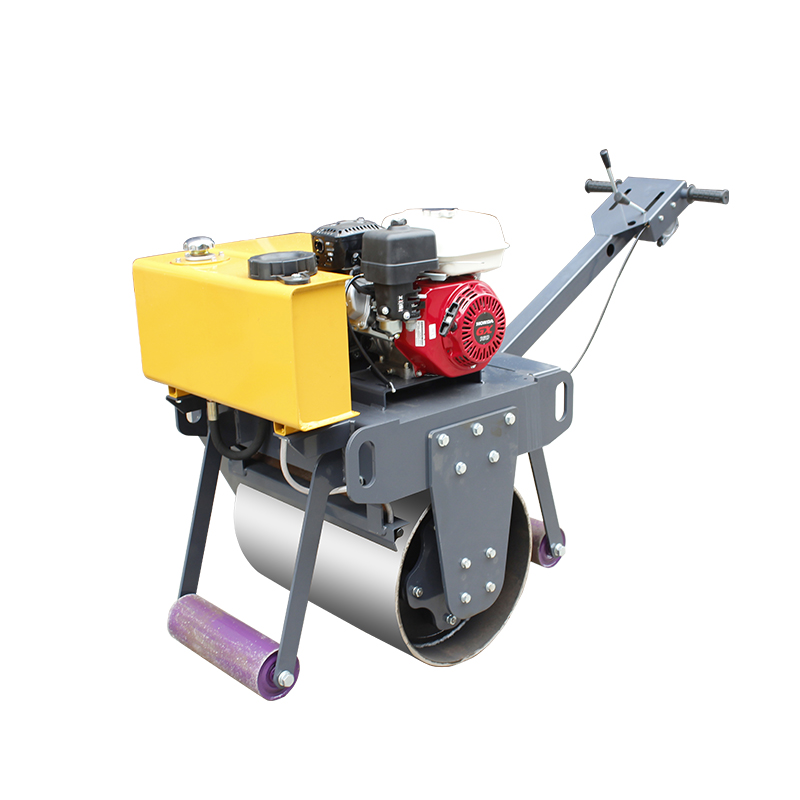
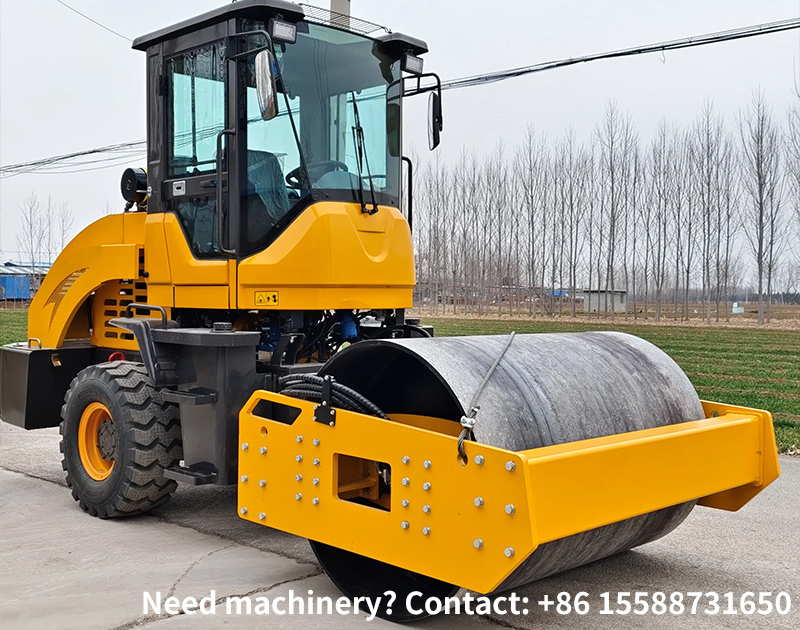
Single-drum rollers (mostly vibratory type, with a large-diameter steel vibratory drum on one side and a rubber driving wheel on the other) have core advantages concentrated in deep compaction capability and adaptability to complex materials, making them particularly suitable for compaction of subgrade, base course and other underlying structures:
Outstanding deep compaction effect: The vibratory drum of a single-drum roller is heavy (the overall machine weight can reach 10-30 tons), with strong excitation force (up to 100-500kN), and most support the "low-frequency and high-amplitude" vibration mode (frequency 20-30Hz, amplitude 1.5-2.5mm). During operation, the excitation force can penetrate deep into the soil (1-1.5 meters), causing deep soil and crushed stone particles to resonate and slide, effectively eliminating subgrade pores and improving foundation bearing capacity. Compared with double-drum rollers, its compaction depth can reach 2-3 times that of the latter, making it the core equipment for high-fill subgrades and soft ground treatment.
Adaptable to various coarse-grained materials: It can efficiently compact coarse-grained or semi-rigid base materials such as sand, crushed stone soil, cement-stabilized soil, and graded crushed stone. For fill subgrades containing large stone blocks (e.g., mountain road subgrades), the heavy vibratory drum of the single-drum roller can break the agglomerated structure of stone blocks, making the stones interlock more tightly; for cohesive soil subgrades, single-drum rollers equipped with protruded block (sheep-foot roller) devices can also penetrate the soil through the protruded blocks, knead and break soil clods, and improve the compaction uniformity of cohesive soil.
High operational efficiency and adaptability to complex working conditions: The machine has high power (engine power can reach 100-200kW), fast traveling speed (up to 10-15km/h), and the rubber driving wheel has strong grip, enabling it to adapt to uneven subgrade working surfaces (e.g., unleveled fill areas). In large-area subgrade construction, single-drum rollers can quickly complete multiple passes of rolling, cooperating with bulldozers and graders, with efficiency far higher than double-drum rollers.
Strong operational flexibility (small single-drum rollers): Small single-drum rollers (weight 3-8 tons) are small in size and have a small turning radius, allowing them to enter narrow areas (e.g., pipeline trench backfill, small-site subgrade compaction), making up for the operational blind spots of large rollers, and are particularly suitable for small-scale projects such as municipal pipe network renovation and courtyard construction.
Double-drum rollers (with steel vibratory drums at both front and rear, mostly smooth-faced design) have core advantages focused on surface flatness and fine compaction capability, mainly adapted to compaction of asphalt pavements, thin-layer base courses and other surface structures:
Extremely high compaction flatness: Double-drum rollers adopt synchronous rolling with smooth-faced vibratory drums at front and rear, with uniform overlapping of wheel tracks during operation, and the vibration mode is mostly "high-frequency and low-amplitude" (frequency 40-60Hz, amplitude 0.3-0.8mm). In this mode, material particles only produce slight vibration on the surface without deep disturbance, which can effectively ensure the flatness of the pavement surface (flatness error can be controlled within 2mm/3m). Especially in the final compaction stage of asphalt pavements, double-drum rollers can eliminate wheel tracks and make the pavement smooth, meeting the requirements of driving comfort.
Adaptable to fine compaction of asphalt mixtures: Asphalt mixtures (especially modified asphalt and SMA mixtures) are sensitive to compaction temperature and force. The high-frequency and low-amplitude vibration of double-drum rollers can fully interlock asphalt particles without damaging the gradation structure of the mixture; at the same time, their equipped sprinkler devices can prevent asphalt from adhering to the wheel surface, ensuring no defects on the compacted pavement. Compared with single-drum rollers, double-drum rollers are more suitable for the entire process of initial compaction (stabilizing the mixture), re-compaction (improving density) and final compaction (finishing flatness) of asphalt pavements.
Excellent thin-layer compaction effect: For thin-layer structures such as thin-layer cement-stabilized bases (thickness ≤15cm), colored asphalt pavements, and sidewalk paving, the light-load vibration mode (adjustable excitation force) of double-drum rollers can avoid surface cracking caused by over-compaction, while ensuring the bonding strength between the thin-layer material and the underlying layer, preventing problems such as delamination and pushing.
Good operational stability and strong controllability: The symmetrical layout of front and rear double drums ensures stable center of gravity during driving and no obvious rollover during turning, allowing precise control of rolling tracks; some high-end models are equipped with automatic leveling and constant-speed rolling functions, which can strictly operate according to preset speed and number of rolling passes, making them particularly suitable for scenarios with high construction precision requirements such as urban trunk roads and expressways.
Low noise and low vibration, adaptable to urban operations: Under the high-frequency and low-amplitude vibration mode, the noise (≤75 decibels) and ground vibration transmission of double-drum rollers are much lower than those of single-drum rollers, and they can be used in road construction near urban residential areas and commercial areas, reducing interference to the surrounding environment.
Single-drum rollers: Strong deep compaction, adaptability to coarse-grained materials, and high operational efficiency, making them the "main equipment" for subgrade and base course compaction;
Double-drum rollers: High flatness, fine compaction, and low interference, making them the "specialized equipment" for asphalt pavement and surface structure compaction.
In engineering, the combination of "single-drum roller for subgrade compaction → double-drum roller for pavement compaction" is usually adopted to balance the bearing capacity of the underlying layer and the flatness of the surface layer.


 Chinese