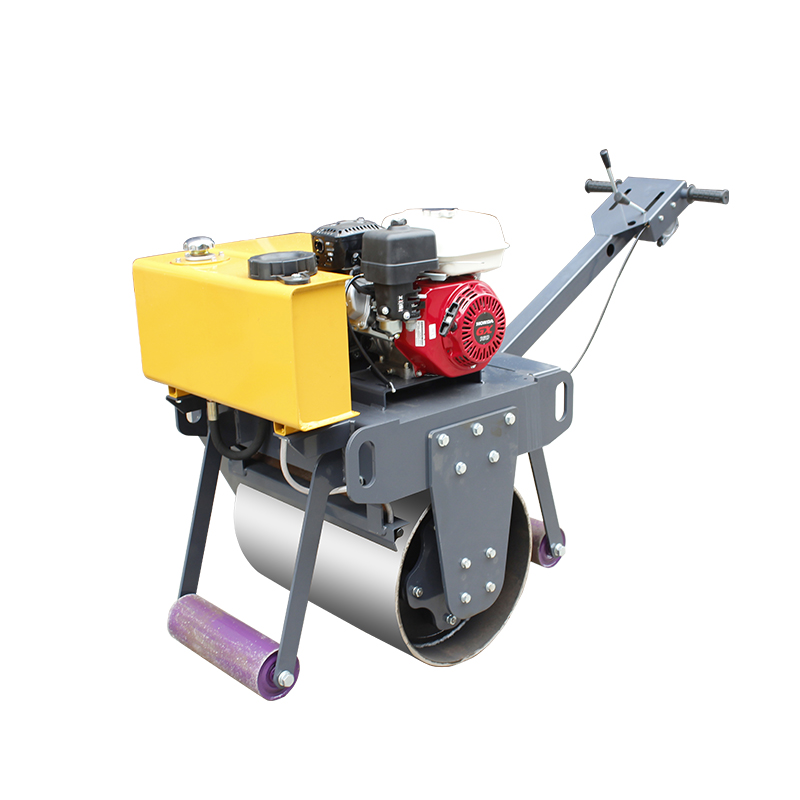
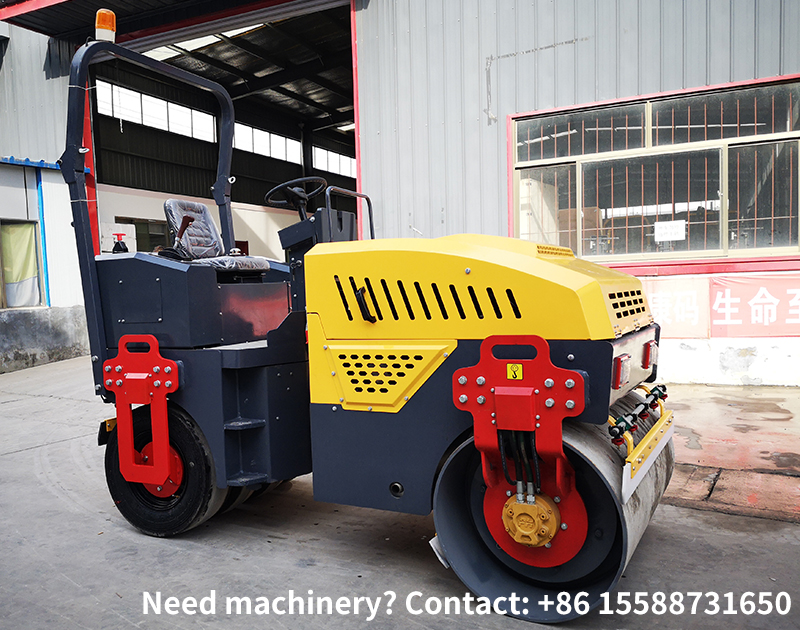
A static road roller, also commonly known as a static compactor, is the most basic and traditional type in the roller family. Its core working principle is very straightforward: it exerts pressure on the material being compacted entirely through its own weight (static pressure), squeezing out air and moisture between the material particles to achieve a dense effect.
Simply put, it is like a huge, rolling "iron weight" that compacts loose materials more tightly through gravity.
Compaction Principle: The core is static pressure, with no vibration or oscillation device.
Working Method: Applies continuous, slow pressure to the material through the weight of the rollers.
Compaction Effect: The compaction depth is relatively shallow, mainly acting on the surface layer of the material.
Applicable Range: Has strong adaptability to materials, especially good at handling cohesive materials.
Equipment Characteristics: Simple structure, easy operation, low cost, and very little impact on the surrounding environment in terms of vibration and noise.
Static road rollers are mainly divided into two types according to the different rollers, each suitable for different working conditions:
Appearance: The roller is a smooth metal cylinder.
Working Characteristics: Mainly relies on linear pressure for compaction, resulting in a flat compacted surface.
Applicable Working Conditions:
Initial compaction of subgrade and pavement base: In large-scale earthwork projects, used for initial leveling and compaction of soil, sand, gravel, etc.
Final compaction (finish rolling) of asphalt pavement: After asphalt pavement paving, used for final precision leveling and compaction to eliminate wheel tracks and obtain a smooth and flat road surface. At this time, smooth drum rollers with larger tonnage are usually used.
Renovation and maintenance of old road surfaces: Used for flattening old road surfaces.
Appearance: The roller consists of multiple pneumatic tires.
Working Characteristics: The tires are elastic, and during compaction, they not only exert vertical pressure but also a certain amount of horizontal kneading force.
Applicable Working Conditions:
Compaction of asphalt pavement: This is the main application scenario of pneumatic tire rollers. Their kneading effect can make the particles of the asphalt mixture interlock more tightly, improving the density, flatness, and water damage resistance of the road surface. Usually, it is used for finish rolling or as part of the intermediate rolling after the initial and intermediate rolling by vibratory rollers.
Compaction of cohesive soil: For cohesive soil with high viscosity, the kneading effect of tires is more effective than that of smooth drum rollers.
Compaction of backfill soil: Also used in some backfill projects where the compaction degree requirement is not extremely high.
Finish rolling of asphalt pavement: Both smooth drum and pneumatic tire rollers are key equipment for the final shaping of asphalt pavement, ensuring the flatness and surface quality of the road surface.
Compaction of cohesive soil: Their gentle compaction method is suitable for handling cohesive soil with high viscosity.
Initial compaction and leveling: In large-scale projects, used for preliminary rough compaction and leveling work.
Compaction in vibration-sensitive areas: In areas near buildings, bridges, underground pipelines, etc., where there are strict restrictions on vibration, static road rollers are the first choice.
In general, although the compaction efficiency of static road rollers is not as high as that of vibratory rollers, they play an irreplaceable role in the final shaping of road surfaces and the compaction of environmentally sensitive areas.


 Chinese