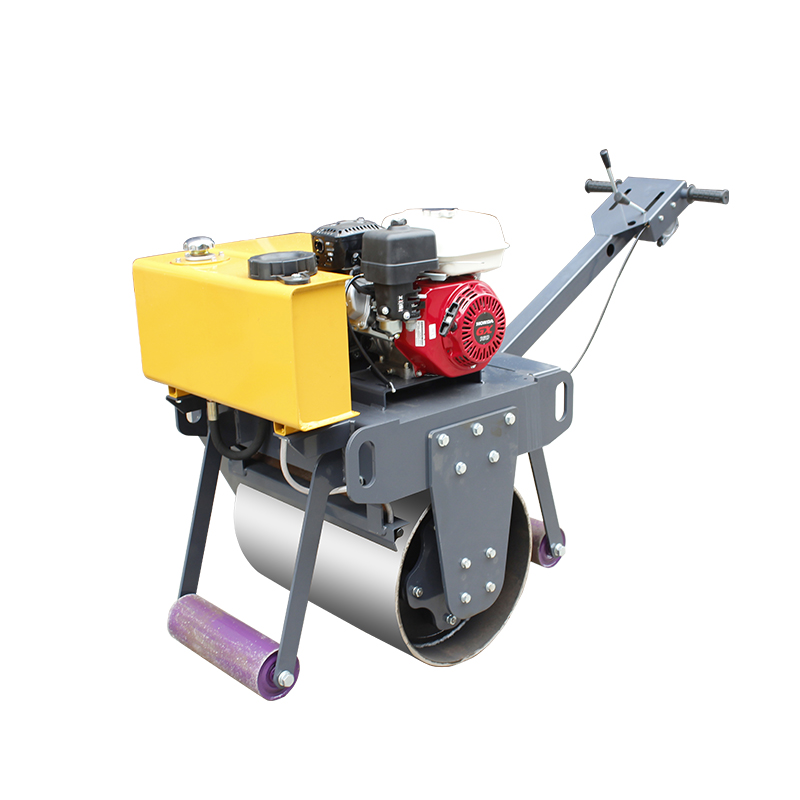
A vibratory road roller is a type of construction machinery that performs compaction work by combining static pressure with high-frequency vibration.
Unlike static road rollers, its core feature is the vibratory drum. Inside the drum, a high-speed rotating eccentric weight (also known as a vibrator) is installed. As the eccentric weight rotates, it generates a periodically changing centrifugal force, which causes the entire drum to vibrate at high frequency and low amplitude.
The vibratory system of a vibratory road roller consists of several key components, and its working process can be summarized as follows:
Power Input: The engine's power is transmitted to the vibratory pump through the transmission system.
Hydraulic Drive: The vibratory pump converts mechanical energy into hydraulic energy, driving the vibratory motor to rotate at high speed.
Eccentric Weight Rotation: The vibratory motor drives the eccentric weights (usually one or more pairs) installed inside the drum to rotate at high speed.
Exciting Force Generation: Since the center of mass of the eccentric weights is not on the axis of rotation, their high-speed rotation generates a centrifugal force that continuously changes in magnitude and direction. This force is the exciting force.
Drum Vibration: The exciting force acts on the drum, causing it to vibrate up and down at high frequency.
Material Resonance and Compaction: When the vibration frequency of the drum approaches or matches the natural frequency of the particles in the material being compacted, it triggers resonance in the material. This allows the material particles to overcome friction and cohesion, undergo relative displacement, and rearrange themselves, thereby squeezing out air and moisture between the particles to achieve deep and efficient compaction.
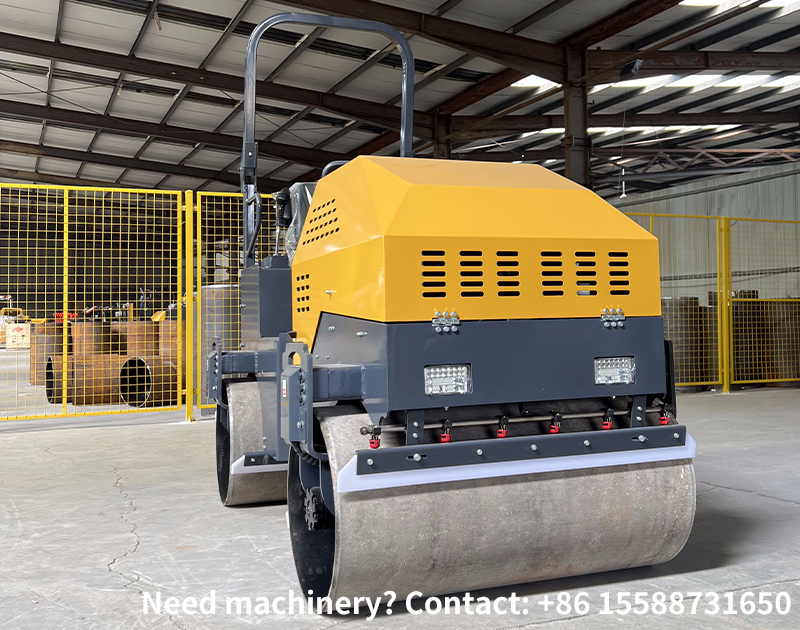
Simply put, a vibratory road roller is like a large "jumping" iron wheel that "vibrates" the material into place through the dual action of its own weight and high-frequency vibration, rather than just "pressing" it.
High Compaction Efficiency: The vibration effect allows material particles to rearrange quickly, making the compaction speed much faster than that of static road rollers.
Deep Compaction Depth: Vibration waves can penetrate deep into the material, achieving deep compaction.
Wide Range of Applications: Particularly suitable for compacting non-cohesive or low-cohesive materials such as sand, gravel, crushed stone, and asphalt mixtures.
Higher Requirements for Operators: Requires adjusting vibration frequency and amplitude according to material type and thickness.
Subgrade Engineering: This is the primary application area for vibratory road rollers, used for compacting various types of subgrade soils and fill materials.
Pavement Base and Subbase: Compacting base materials such as cement-stabilized soil, lime-stabilized soil, and graded crushed stone.
Asphalt Pavement: Used for the initial and intermediate compaction of asphalt mixtures, laying a solid foundation for the final precision leveling and compaction.
Earthwork and stonework compaction in large-scale projects such as dams, airport runways, and squares.
Vibratory road rollers are currently one of the most widely used and core compaction equipment in road construction and earthwork projects.


 Chinese