
 Chinese
- HOME >> NEWS >> Industry news
NEWS
Latest Product
Contact Us
How Does the Vibration System of a Road Roller Work?
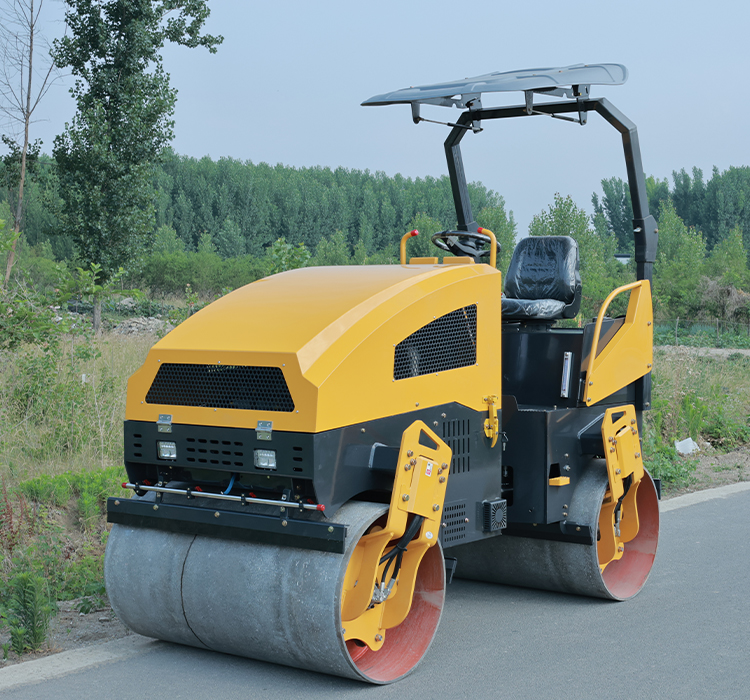
2025-05-29The vibration system is the core mechanism that enables road rollers to achieve efficient compaction, using high-frequency mechanical impacts to rearrange particles in soil, asphalt, and other materials for densification. Below is a detailed breakdown of its components, working principles, and control mechanisms.
I. Core Components of the Vibration System
Eccentric Weights (Vibration Mechanism)
Made of asymmetrical metal blocks that generate centrifugal force when rotated.
Static eccentric moment = mass × offset distance (determines amplitude, e.g., 1.7 mm/0.8 mm).
Vibration Shaft
Connects eccentric weights to the hydraulic motor, transmitting rotational force.
Hydraulic Drive System
Hydraulic pump → Hydraulic motor → Rotates eccentric weights (typically 1,500–3,000 RPM).
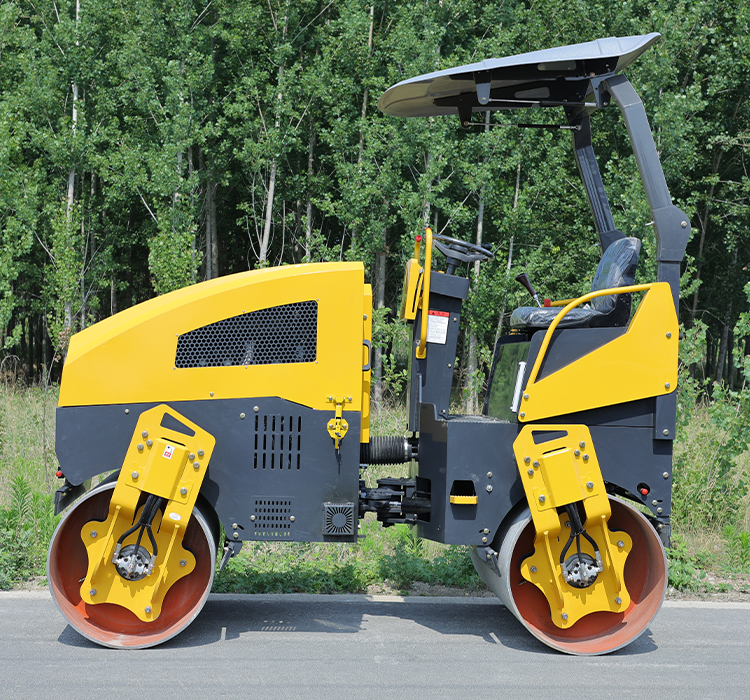
Damping System
Rubber dampers or springs isolate vibrations from the chassis, ensuring operator comfort.
II. Working Principles
Centrifugal Force Generation
: Mass of eccentric weights
: Offset distance (e.g., 0.02 m)
: Angular velocity (proportional to RPM)
The hydraulic motor spins eccentric weights, creating periodic centrifugal force (F):
Vibration Wave Transmission
Heat particles through friction, reducing cohesion.
Rearrange particles, minimizing voids and increasing density.
Centrifugal force transfers to the drum, generating vertical impact waves that:
Key Adjustable Parameters
Parameter Role Typical Range Frequency (Hz) Vibrations per second; affects depth 30–50 Hz (1,800–3,000 RPM) Amplitude (mm) Impact intensity 0.3–2.0 mm Linear Load (N/cm) Pressure per drum length 200–600 N/cm High frequency + low amplitude (50 Hz/0.3 mm): Ideal for asphalt surface compaction.
Low frequency + high amplitude (30 Hz/1.8 mm): Best for subgrade deep compaction.
III. Vibration Modes
Fixed-Direction Vibration (Single Amplitude)
Eccentric weights rotate at a fixed angle, producing unidirectional force (e.g., vertical-only).
Applications: Standard soil or asphalt compaction.
Variable Amplitude Vibration (Dual Amplitude)
High amplitude: Weights aligned additively (e.g., 1.8 mm).
Low amplitude: Weights offset to cancel force partially (e.g., 0.8 mm).
Hydraulically adjusts eccentric weights to switch between:
Advantage: One machine adapts to multiple materials without equipment changes.
IV. Operational Workflow
Startup: Operator activates vibration switch; hydraulic pump supplies oil to the motor.
Rotation: Motor spins eccentric weights at high speed, generating centrifugal force.
Compaction: Force converts to vertical impacts via the drum, densifying materials.
Shutdown: Vibration stops; damping system absorbs residual vibrations.
V. Common Failures & Solutions
| Symptom | Possible Cause | Solution |
|---|---|---|
| Weak vibration | Low/contaminated hydraulic oil | Replace oil, clean filters |
| Abnormal noise | Damaged eccentric bearings | Replace bearings; lubricate |
| Drum bouncing | Excessive amplitude/uneven ground | Reduce amplitude; level surface |
| System won’t start | Electrical/hydraulic failure | Check fuses, pressure sensors |
VI. Vibration vs. Static Compaction
| Aspect | Vibration | Static |
|---|---|---|
| Principle | Dynamic impact | Static weight |
| Efficiency | High (3–5× faster) | Low |
| Materials | Gravel, asphalt, clay | Sensitive materials (e.g., wet clay) |
| Energy Use | Higher | Lower |
VII. Technology Trends
Smart variable-frequency vibration: Auto-adjusts frequency/amplitude via compaction sensors.
Electric-drive vibration: Replaces hydraulics with direct motor-driven eccentrics (e.g., BOMAG e-Vibration).
Multi-directional vibration: Combines vertical + horizontal vibrations for specialized foundations.
Summary
The vibration system’s core physics: eccentric rotation → centrifugal force → impact waves. Optimizing frequency, amplitude, and rolling speed maximizes compaction, while regular maintenance of hydraulic/mechanical parts ensures reliability.