

 Chinese
- HOME >> NEWS >> Company news
NEWS
Latest Product
Contact Us
Key Operational Differences in Compaction of Subgrade and Pavement Surface by Road Rollers
2026-01-29The core differences in road roller compaction operations for subgrades and pavement surfaces stem from the varying functional requirements, material characteristics and quality standards of different construction layers: subgrade compaction pursues deep densification, integral consolidation and settlement resistance, suitable for high-tonnage, high-power compaction methods with low requirements for the flatness of the working surface; pavement surface compaction aims for surface flatness, uniform densification, water damage resistance and no wheel tracks, adapted to refined, flexible/controllable vibration compaction methods with extremely high requirements for compaction precision and operational standardization. The two have distinct practical differences in model selection, compaction parameters, operational processes and quality control, which are professionally disassembled below according to core operational dimensions, in line with the practical specifications of road construction.
I. Differences in Core Compaction Objectives and Material Characteristics (Underlying Basis for Operational Point Design)
Subgrade Compaction
Core Objective: Achieve deep densification (compaction depth up to 30-80cm) and integral consolidation of subgrade soil layers/fillers, improve the bearing capacity and settlement resistance of the subgrade, and prevent cracking and settlement of the subsequent pavement due to subgrade settlement. As the compaction of the foundation load-bearing layer in road engineering, the core control indicators are density and compaction degree, with flatness only as an auxiliary requirement.
Material Characteristics: Subgrade fillers are mainly plain soil, clay, sand, gravel and cement-stabilized soil, with coarse material particles and large differences in cohesiveness (both cohesive and non-cohesive). Some high-fill subgrades use layered backfill materials that are prone to interlayer separation and require high-force compaction to achieve interlayer bonding.
Pavement Surface Compaction
Core Objective: Achieve uniform densification, surface flatness, no gaps and no wheel tracks of pavement surface materials, improve the pavement's resistance to water damage, abrasion and shoving, and ensure driving comfort and pavement service life. As the compaction of the apparent functional layer in road engineering, the core control indicators include flatness, density and surface finish. No wheel tracks, cracks, shoving and other defects are allowed after compaction.
Material Characteristics: Surface materials are mainly hot mix asphalt mixture and modified asphalt mixture (cement concrete pavement is cast and vibrated without road roller compaction process). The materials have thermoplasticity and cohesiveness, and are highly temperature-sensitive (prone to shoving at high temperatures and cracking at low temperatures), with fine gradation of particles. Compaction must be completed within a specific temperature range, and the compaction force must be uniform to avoid aggregate crushing and mixture segregation.
II. Differences in Core Compaction Model Selection
Subgrade Compaction: Focus on high-tonnage, high-power models to meet deep compaction needs
Main Compaction Models: Large-tonnage single-drum vibratory road rollers (above 20t) are the core, using self-weight + high-frequency and high excitation force to achieve deep subgrade compaction, serving as the main model for subgrade construction and adapting to most subgrade fillers such as sand, gravel and cement-stabilized soil; for clay subgrades, sheep-foot static road rollers are preferred, which realize deep extrusion and consolidation of clay by concentrating pressure through protrusions.
Auxiliary/Reinforcing Models: Impact rollers are suitable for high-fill subgrades and soft soil foundations, using high-energy impact compaction to complete 1-5m deep consolidation and make up for the insufficient deep compaction of single-drum vibratory road rollers; rubber-tired road rollers can be selected for the final compaction of subgrade surface layers, achieving tight interlayer bonding through kneading compaction to prevent interlayer slip.
Forbidden Models: Double-drum vibratory road rollers and small walk-behind rollers are prohibited (insufficient force to achieve deep compaction); rubber-tired road rollers are prohibited as the main compaction equipment for cohesive subgrades (prone to material adhesion and insufficient compaction depth).
Pavement Surface Compaction: Focus on refined, adaptive models to balance densification and flatness
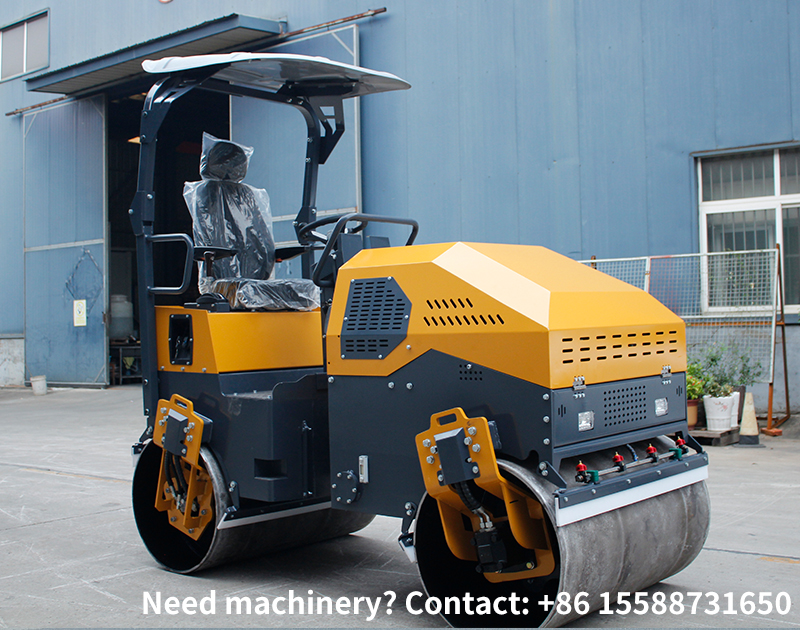
Main Compaction Models: Medium double-drum vibratory road rollers (8-14t) are the core, operating in two steps of initial compaction and re-compaction. They realize uniform densification of asphalt mixture by adjustable frequency vibration, and synchronous rolling of double steel wheels ensures basic flatness of the working surface, serving as the main model for surface compaction; small double-drum vibratory road rollers are adapted to refined compaction in narrow areas such as curves, intersections and sidewalks.
Specialized Final Compaction Model: Rubber-tired road rollers (20-30t) are essential, adopting vibration-free flexible kneading compaction to eliminate wheel tracks caused by double-drum compaction, knead asphalt mixture to make aggregates and binders combine closely, and improve surface density and water resistance. As the core model for asphalt surface finishing, it forms a golden combination of "vibration compaction + kneading finishing" with double-drum vibratory road rollers.
Forbidden Models: Single-drum vibratory road rollers are prohibited (wide steel wheels and high excitation force are prone to pavement shoving and cracking, and leave obvious wheel tracks); impact rollers and sheep-foot rollers are prohibited (high impact/protrusions will directly damage the surface structure); large-tonnage heavy rollers can only be used for light compaction of the lower asphalt layer and are strictly prohibited for the upper layer.
III. Differences in Core Compaction Parameter Control
Subgrade Compaction: Large parameters, wide range, adjusted based on deep densification as the core
Compaction Speed: Controlled at 2-4km/h. Low speed and high force ensure compaction depth and avoid insufficient compaction caused by excessive speed; for high-fill subgrades and soft soil foundations, the speed must be reduced to 1-2km/h for layered slow compaction.
Compaction Passes: Determined according to filler type and compaction degree requirements. Conventional subgrades are compacted in layers for 6-10 passes (2 initial compaction passes + 3-6 re-compaction passes + 1 final compaction pass); high-fill subgrades and clay subgrades need to be increased to 10-15 passes, and impact rollers are compacted for 15-20 passes until the compaction degree meets the design standard (the compaction degree of highway subgrades is generally ≥93%-96%).
Compaction Thickness: Layered compaction is adopted, with the thickness of each compacted layer controlled at 30-50cm (30-40cm for plain soil/clay which is suitable for thin layers; 40-50cm for sand/gravel/cement-stabilized soil which is suitable for thick layers). Over-thick compaction is strictly prohibited, otherwise the problem of "dense surface, loose deep layer" will occur.
Special Parameters: Single-drum vibratory road rollers are set to high excitation force and medium-high frequency (excitation force 200-500kN, frequency 25-35Hz); sheep-foot rollers adopt "low speed, heavy rolling" to achieve deep soil extrusion through protrusions penetrating the soil layer; impact rollers control the impact energy at 15-40kJ, adjusted according to subgrade depth.
Pavement Surface Compaction: Small parameters, precise control, adjusted based on material temperature + apparent quality as the core
Compaction Speed: Strictly controlled according to compaction stages: 1.5-2km/h for initial compaction, 2-3km/h for re-compaction, 3-4km/h for final compaction. The whole process is low-speed and stable to avoid shoving and segregation of asphalt mixture caused by excessive speed. Sudden acceleration, sudden braking and sharp turning are strictly prohibited.
Compaction Passes: Far fewer than that of subgrades. Conventional asphalt surface compaction is 4-6 passes (1-2 initial compaction passes + 2-3 re-compaction passes + 1 final compaction pass), and 1-2 more passes can be added in narrow areas. Excessive compaction passes are strictly prohibited (prone to pavement bleeding and aggregate crushing).
Temperature Control: A core key parameter. Compaction must be carried out within the optimal compaction temperature range of asphalt mixture (initial compaction temperature of hot mix asphalt mixture 130-150℃, re-compaction 110-130℃, final compaction 80-100℃). Excessively high temperature leads to shoving and bleeding, while excessively low temperature fails to achieve densification and is prone to cracking. For low-temperature construction, the factory temperature of the mixture must be increased and the transportation and paving time shortened.
Special Parameters: Double-drum vibratory road rollers use weak vibration/static rolling for initial compaction (to prevent mixture shoving), and strong vibration, high frequency and low amplitude for re-compaction (excitation force 50-150kN, frequency 35-45Hz) to achieve uniform densification; final compaction rubber-tired road rollers adopt full tire pressure and flexible kneading compaction, with tire pressure controlled at 0.6-0.8MPa, realizing all-round kneading by tire elasticity to eliminate wheel tracks.
IV. Differences in Core Operational Processes and Key Operation Points
Subgrade Compaction: Layered and segmented compaction, high-pressure advancement, no strict operational sequence requirements
Operation Mode: Adopt layered filling and layered compaction, compact one layer after filling, and fill the next layer after passing the test. High-fill subgrades must be constructed in accordance with the principle of "thin-layer filling, repeated compaction"; large-area subgrades are compacted in segments, with overlapping compaction of 50-100cm between segments to avoid loose joints.
Rolling Route: Follow the principles of straight forward and backward movement, compaction from sides to center, and light compaction first then heavy compaction. Roll the two sides of the subgrade first (50cm from the edge), then advance to the center to prevent slip of edge soil; first use small-tonnage rollers for light compaction and leveling, then large-tonnage rollers for heavy compaction and densification, and finally use rubber-tired road rollers for kneading and finishing.
Key Operation Points: The road roller travels in a straight line, with overlapping rolling tracks of 1/3-1/2 the wheel width to ensure no compaction blind spots; single-drum vibratory road rollers can be used with water sprinkling to prevent material adhesion to steel wheels; drainage measures must be taken in a timely manner after clay subgrade compaction to avoid subgrade softening caused by rainwater immersion.
Special Treatment: At the junction of subgrades with different fillers, stepped lapping is adopted with a lapping length ≥1m, and layered compaction is carried out to achieve interlayer bonding; at the junction of subgrades and structures, small walk-behind rollers are used for supplementary compaction to avoid compaction blind spots caused by the inaccessibility of large road rollers.
Pavement Surface Compaction: Temperature-controlled continuous compaction, refined rolling, strict adherence to phased and sequential operation
Operation Mode: Compaction is carried out closely following paving and continuously. Road rollers are organized to compact immediately after paver paving to shorten the cooling time of the mixture and ensure compaction is completed within the optimal temperature range. Paving followed by long-term storage before compaction is strictly prohibited; pavement surface compaction is divided into three stages: initial compaction, re-compaction and final compaction, with seamless connection between stages and no mid-operation pause allowed.
Rolling Route: Follow the principles of compaction from sides to center, static rolling first then vibration rolling, and slow speed first then fast speed. Forward and backward rolling is adopted for straight sections, and arc rolling for curves/intersections (advancing from the inner side to the outer side). The overlapping of rolling tracks is 1/3 the wheel width (double-drum) / 1/2 the tire width (rubber-tired) to avoid compaction joints; the rolling overlap of adjacent paving sections is ≥100cm to eliminate joint height difference.
Key Operation Points: Keep the road roller running stably throughout the process, strictly prohibit sudden acceleration, sudden braking, sharp turning and in-situ rotation to prevent mixture shoving and cracking; steel wheel road rollers need continuous water sprinkling (mist water) to prevent high-temperature mixture adhesion to steel wheels, with the sprinkling amount just enough to prevent adhesion, and a large amount of water sprinkling is strictly prohibited (causing a sudden drop in mixture temperature); rubber-tired road rollers are prohibited from water sprinkling, and release agents (such as a mixture of diesel oil and water) can be applied to tires to prevent adhesion.
Special Treatment: For narrow areas such as surface edges and around inspection wells, small double-drum vibratory road rollers/walk-behind rollers are used for supplementary compaction, with smooth connection to the main compaction area maintained during supplementary compaction; if defects such as wheel tracks and shoving are found after compaction, repair them immediately by kneading with rubber-tired road rollers when the temperature is up to standard. Forced repair at low temperatures is strictly prohibited (prone to pavement damage).
V. Differences in Quality Control and Acceptance Key Points
Subgrade Compaction: Take deep density as the core acceptance index, with flatness only as an auxiliary
Core Testing: Use the ring knife method, sand replacement method and nuclear density gauge to test subgrade compaction degree and dry density, with point testing arranged according to design requirements (4 points per 200m). The compaction degree must meet the code standards, with deep layer (≥50cm) density as the testing focus. Supplementary compaction must be carried out immediately if insufficient density is found.
Auxiliary Testing: Test the subgrade bearing capacity (CBR value) using the bearing plate method to ensure the subgrade bearing capacity meets the road design load requirements; flatness is only inspected visually, with no obvious potholes and heaves required, and no professional instrument testing needed.
Quality Problem Treatment: If subgrade settlement, looseness and interlayer separation are found, excavate the unqualified fillers immediately and re-fill and compact in layers; settlement observation must be carried out for high-fill subgrades, and subsequent construction can only be carried out after the settlement is stable.
Pavement Surface Compaction: Take flatness and surface density as the core acceptance indicators, with apparent quality as a mandatory requirement
Core Testing: Use a continuous flatness meter to test pavement flatness (standard deviation ≤1.2mm), and use the core drilling method to test surface density (density of asphalt mixture surface ≥96%); at the same time, test pavement thickness and cross slope, all of which must meet the design requirements.
Apparent Quality Acceptance: The compacted pavement shall have no wheel tracks, no cracks, no shoving, no bleeding, no segregation, smooth and flat surface, smooth joints with no height difference, and no settlement or damage around inspection wells. Apparent defects are directly judged as unqualified and must be rectified immediately.
Quality Problem Treatment: Wheel tracks and shoving found when the temperature is up to standard are repaired by kneading with rubber-tired road rollers; small cracks appearing at low temperatures are treated by crack sealing; serious defects such as shoving, segregation and bleeding require excavation of unqualified sections and re-paving and compaction.
VI. Differences in Core Operational Taboos
Core Taboos for Subgrade Compaction
Over-thick filling and over-thick compaction are strictly prohibited; mixed filling of different fillers followed by one-time compaction is strictly prohibited.
Compaction on muddy and waterlogged subgrades is strictly prohibited; drainage and air-drying to the optimal moisture content must be carried out before construction.
Replacing large-tonnage road rollers with small rollers for deep compaction is strictly prohibited to avoid subsequent settlement caused by insufficient compaction.
Impact rollers are strictly prohibited from operating within 5m of structures to prevent damage to the structure foundation caused by high impact.
Core Taboos for Pavement Surface Compaction
Forced compaction when the temperature of asphalt mixture is lower than 80℃ is strictly prohibited; paving followed by long-term storage before compaction is strictly prohibited.
Random U-turn and in-situ rotation of road rollers on the compacted surface are strictly prohibited; parking construction machinery and stacking materials on the surface are strictly prohibited.
A large amount of water sprinkling for steel wheel road rollers is strictly prohibited; rubber-tired road rollers are strictly prohibited from staying on the high-temperature surface for a long time (prone to tire marks).
Single-drum vibratory road rollers and large heavy road rollers are strictly prohibited from operating on the upper asphalt layer; using vibration mode for initial surface compaction is strictly prohibited.