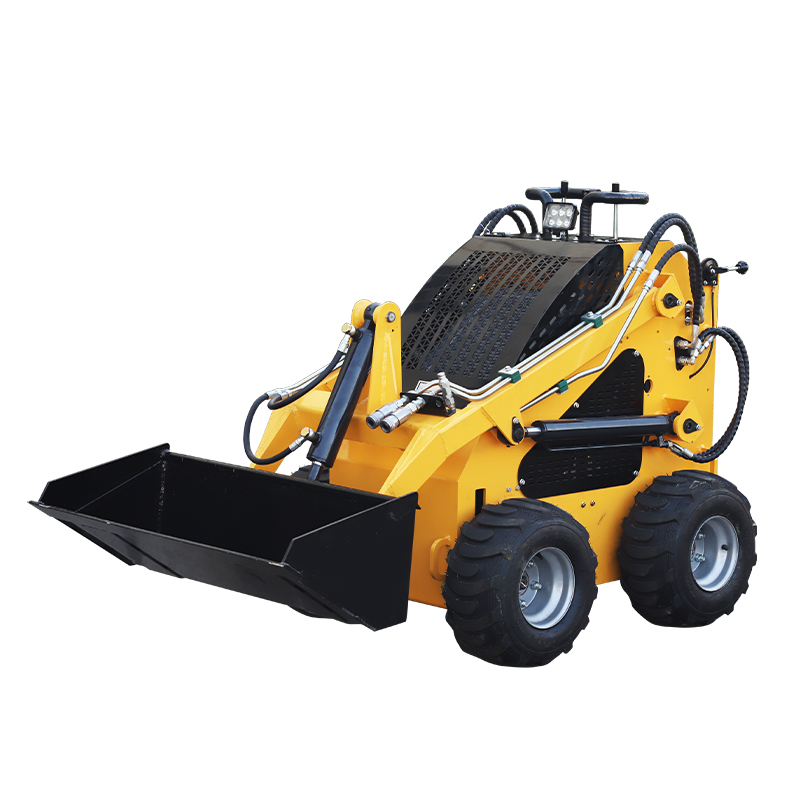
The core causes of slow bucket lifting in loaders mainly fall into three categories: abnormal hydraulic system, insufficient power system, or mechanical structure jamming. Among these, hydraulic system failures (such as oil issues and component wear) are the most common triggers, and troubleshooting should follow the principle of "starting with simple checks before complex ones".
The hydraulic system is the core that drives bucket lifting; abnormalities in any link will directly slow down the lifting speed. Specific issues are divided into 4 types:
Insufficient Oil Level: If the hydraulic oil level in the tank is below the standard scale (usually marked with "MIN" and "MAX" on the side of the tank), the hydraulic pump cannot draw enough oil. This leads to insufficient pressure during lifting, resulting in slow speed.
Oil Deterioration/Contamination: After long-term use (replacement is generally recommended every 2,000-3,000 hours), hydraulic oil oxidizes and thickens, or becomes contaminated with impurities (such as metal shavings and dust). This reduces oil fluidity, accelerates wear of hydraulic components, and increases resistance during lifting.
Incorrect Oil Type: Adding hydraulic oil of incorrect viscosity (e.g., using high-temperature viscosity oil in a low-temperature environment) slows down the oil flow in the pipeline. Especially in low temperatures, this may cause "jerky and slow lifting".
The hydraulic pump is the "power source" responsible for converting mechanical energy into hydraulic energy. Common problems include:
Internal Wear: After long-term use, the gears, plungers, or vanes of the hydraulic pump wear out, reducing the pump’s "volumetric efficiency" (i.e., the amount of oil output by the pump decreases). Insufficient oil supply during lifting leads to slow speed.
Air Inhalation: Loose oil suction pipelines of the hydraulic pump or aging seals (e.g., damaged O-rings at the inlet hose joints) can cause air inhalation, forming "air pockets". This results in unstable pressure in the hydraulic system and "intermittent and slow lifting".
Problems with key valves controlling bucket lifting (such as the lift cylinder control valve, safety valve, and flow control valve):
Spool Jamming: Impurities in the hydraulic oil get stuck between the spool and valve sleeve, preventing the spool from fully opening. This reduces oil flow, slowing down lifting; in severe cases, it causes "jerky lifting".
Safety Valve Pressure Relief: The safety valve prevents system overpressure. If the safety valve spring ages or the spool wears, it causes "premature pressure relief" (i.e., the system pressure fails to reach the level required for lifting). Even if the pump supplies oil normally, rapid lifting is impossible.
Incorrect Flow Control Valve Adjustment: Some loaders have a flow adjustment knob. Accidentally adjusting it to the "low flow" position restricts the amount of oil entering the lift cylinder, slowing down lifting (first confirm if this is due to misoperation).
The cylinder is the "executing component" that directly pushes the bucket to lift. Common problems include:
Internal Leakage in the Cylinder: Aging, wear, or breakage of the cylinder piston seal causes oil to flow between the upper and lower chambers of the cylinder (i.e., "internal leakage"). Pressure is lost during lifting, manifested as "slow lifting + automatic sinking under heavy load".
Bent Cylinder Piston Rod: If the piston rod is hit by a hard object during heavy-load lifting, it may bend slightly. This increases frictional resistance between the rod and the cylinder inner wall during movement, slowing down lifting and possibly accompanied by "abnormal noise".
The hydraulic pump gets its power from the engine. If the engine outputs insufficient power, it will indirectly cause insufficient oil supply in the hydraulic system. Specific causes include:
Throttle Not Fully Engaged: Accidentally keeping the throttle in the "idle" or "low-speed" position during operation (e.g., using the "travel gear" instead of the "work gear") results in insufficient engine output torque, low hydraulic pump speed, and reduced oil supply.
Decreased Engine Power: Issues such as a clogged air filter (insufficient air intake), clogged fuel filter (insufficient fuel supply), or worn fuel injectors (poor atomization) prevent the engine from reaching the rated speed, weakening power output.
Failures in transmission components between the engine and the hydraulic pump (such as couplings and drive belts):
Coupling Wear: Aging or breakage of the rubber parts in the coupling (e.g., flexible coupling) between the engine and hydraulic pump leads to unstable power transmission. The hydraulic pump speed fluctuates (speeds up and slows down), causing unstable and slow lifting.
Drive Belt Slippage: For loaders where the hydraulic pump is driven by a belt (some small loaders), a loose or severely worn belt slips. This makes the hydraulic pump speed lower than the engine speed, resulting in insufficient oil supply.
Worn Boom Hinges: Long-term lack of lubrication in the connecting pins and bushings between the boom (main arm) and frame, or between the boom and bucket, causes excessive clearance or jamming after wear. This increases mechanical resistance during lifting, slows down speed, and is often accompanied by "abnormal noise".
Deformed Bucket or Boom: Minor deformation of the bucket or boom due to heavy-load impact disrupts the movement trajectory during lifting, causing interference with other components (e.g., the boom scraping against the frame). This increases resistance and slows down lifting.
Although not a "malfunction", long-term overloading (e.g., the bucket carrying far more than the rated load) keeps the hydraulic system in a full-load state for extended periods. More resistance must be overcome during lifting, manifested as "slow lifting", and it also accelerates wear of hydraulic components.



 Chinese