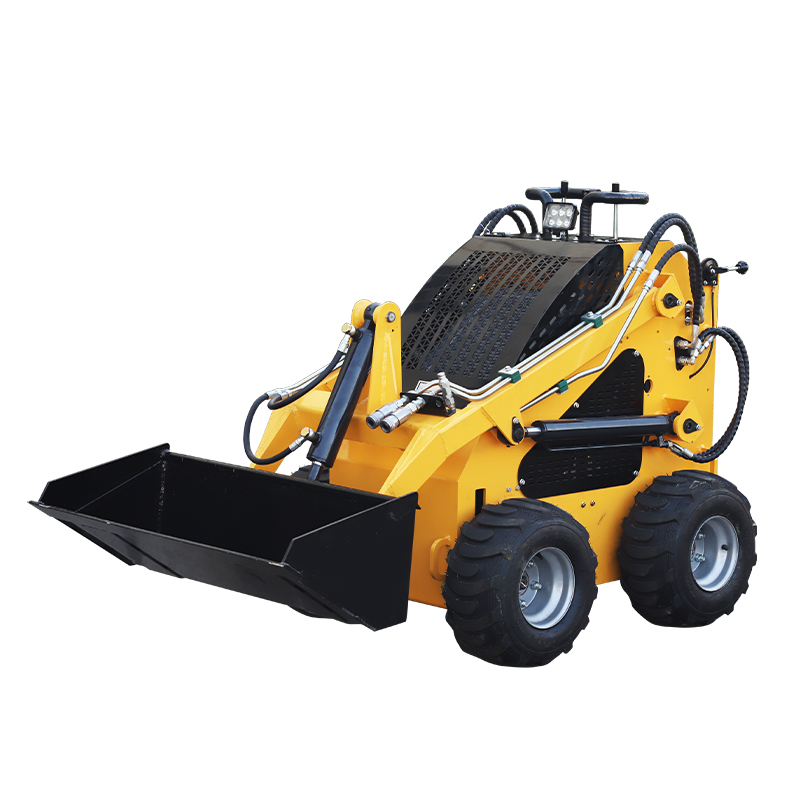
The core causes of rapid tire wear in loaders are improper operating habits, harsh working environments, incorrect tire selection, or lack of maintenance. These four types of factors, acting alone or in combination, can significantly shorten the normal service life of tires. Under normal working conditions, the tire service life is approximately 1,500-2,000 hours, but it may be less than 800 hours when wear is excessive.
To solve this problem, it is necessary to identify the causes in a targeted manner and take measures from four dimensions: "standardizing operations, optimizing the environment, selecting the right type, and strengthening maintenance" to effectively slow down wear.
This is the most common cause, as many operators' habits directly accelerate tire wear:
Frequent Sudden Acceleration and Hard Braking: When the loader is under heavy load (especially when carrying gravel or ore), sudden acceleration causes severe friction between the tires and the ground, leading to rapid heating and wear of the tread rubber. Hard braking, on the other hand, results in "skidding" of the tires, causing severe local wear on the tread and even "uneven wear" (faster wear on one side of the tread).
In-Place Steering or Full-Lock Steering: When the loader turns, the tires slide laterally. During in-place steering or full-lock steering (steering wheel turned to the maximum), the sliding friction area is the largest, and the tread pattern will be "scrubbed". This is particularly true for the front wheels (steering wheels), which are prone to rapid wear on the tire shoulders.
Overload Operation: Long-term operation exceeding the loader's rated load capacity causes the tires to bear pressure far beyond the design value. The contact area between the tread and the ground increases, accelerating wear. At the same time, it can lead to fatigue fracture of the tire cords, resulting in the risk of "bulging" or tire blowouts.
Uneven Tire Force When Loading with the Bucket: When loading hard materials (such as large rocks), if only one side of the bucket teeth bears force, the center of gravity of the entire machine shifts to one side. The corresponding tire bears additional pressure, leading to "faster wear on one side of the tires".
Hard objects and terrain in the environment directly "abrade" the tires. Common scenarios include:
Sharp Debris on the Ground: If there are gravel, steel bars, scrap iron filings, etc., in the working area, the tires will be scratched when rolling over them. After hard objects get embedded in the tread pattern, "local stress concentration" forms, accelerating pattern wear and even piercing the tire body.
Soft or Uneven Ground: When operating on muddy or potholed ground, the tires sink into the mud. When rotating, they "carry" mud and small stones, causing the tread pattern to be squeezed and rubbed. Potholed ground causes the tires to bear repeated "impact loads", making the joint between the tire sidewall and the tread prone to wear and cracking.
High-Temperature Environment Operation: In high-temperature environments such as mines and steel plants (where the ground temperature exceeds 60°C), the tire rubber accelerates aging, hardens, and loses elasticity. The tread wear resistance decreases, and the pattern is prone to rapid shallowing due to "hard abrasion".
If the tires themselves do not match the working conditions or there are problems during installation, rapid wear will occur even with standardized operations:
Wrong Tire Type Selection: Loader tires are divided into "off-road bias tires" and "radial tires". Bias tires are suitable for low-speed, heavy-load, and rough roads (such as mines), while radial tires are suitable for high-speed and flat roads (such as highway construction). Using radial tires in mines will result in insufficient tread impact resistance and easy wear; conversely, using bias tires on highways will increase driving resistance and also accelerate wear.
Mismatched Tire Size: Using a tire size that does not match the loader's wheel hub (e.g., a too-small hub causing excessive tire stretching) leads to uneven stress on the tread, resulting in "faster wear in the middle or on both sides". At the same time, tire pressure also affects wear—excessive pressure causes faster wear in the middle of the tread, while insufficient pressure causes faster wear on both sides of the tread.
Eccentricity or Looseness During Installation: If the tire is eccentric to the wheel hub (not on the same center) or the bolts are loose during installation, the tire will "swing" when rotating. The contact between the tread and the ground is uneven, leading to "irregular wear" (e.g., wavy wear on the tread).
Long-term lack of maintenance turns minor issues into severe wear. Common deficiencies include:
Failure to Clean Tread Debris in Time: Small stones and gravel embedded in the tread pattern are not cleaned in time, which gradually squeeze the tread grooves, causing pattern deformation and fracture. At the same time, they scratch the tread rubber and accelerate wear.
Failure to Check Tire Pressure: Tire pressure changes with temperature (for every 10°C increase in temperature, the pressure increases by approximately 0.07MPa). Long-term failure to check pressure leads to accelerated wear whether the pressure is too high or too low. In addition, if the tire has a slow leak (e.g., aging valve core) and is not repaired in time, insufficient pressure will also cause wear.
Failure to Replace Severely Worn Tires in Time: When the tread pattern depth is less than 1.6mm (safety limit), or cracks and bulges appear, continuing to use the tire not only accelerates wear but also increases the risk of blowouts. It also affects the stress on other tires, leading to chain wear.
"Step Gently" When Starting and Braking: Accelerate slowly when starting under heavy load, and decelerate in advance when braking to avoid sudden braking and stopping, reducing tire skid wear. Do not turn the steering wheel to full lock; leave a 1-2 turn margin and avoid in-place steering. If direction adjustment is needed, move the vehicle slightly before turning.
Strictly Control Load Capacity: Do not exceed the loader's rated load capacity. Ensure materials are evenly distributed in the bucket when loading to avoid unbalanced loading and prevent excessive stress on one side of the tires.
Avoid Forced Digging When Loading: When encountering hard materials, use a breaker to crush them first before loading. Do not use the bucket to hit hard, reducing the impact load on the tires.
Clean Site Debris: Clear sharp debris (such as steel bars and scrap iron) from the site before operation. When working on muddy or potholed ground, level the ground as much as possible or lay steel plates and gravel to reduce tire sinking and impact.
Cool Down in High-Temperature Environments: When operating in high-temperature sites, stop the equipment for 10-15 minutes every 2 hours of work to cool the tires. At the same time, avoid prolonged exposure of the tires to the sun and park the equipment in a cool place when not in use.
Choose Tires Based on Working Conditions: Select the tire type according to the working scenario—use off-road bias tires for mines and rough roads, and radial tires for highways and flat roads. At the same time, select the matching tire size according to the loader model and rated load capacity (refer to the recommended model in the equipment manual).
Standardize Installation and Inspection: Ensure the tire is concentric with the wheel hub during installation, and tighten the bolts to the specified torque (refer to the tire manual, generally 300-500N·m). Check the tire pressure after installation to ensure it meets the standard (the pressure of bias tires is generally 0.4-0.6MPa, and that of radial tires is 0.35-0.5MPa).
Regular Cleaning and Inspection: Clean debris from the tread pattern before and after each operation (using a screwdriver or special cleaning tool). Check the tire pressure once a week, adjust it in time if there is an abnormality. If there is a slow leak, check whether the valve core or tire body is damaged and repair it promptly.
Replace Worn Tires in Time: Immediately replace tires when the tread pattern depth is less than 1.6mm, or when cracks, bulges, or tire body damage occur. At the same time, regularly "rotate" the front and rear tires (e.g., swap front and rear tires every 500 hours of work) to ensure more even tire wear.



 Chinese