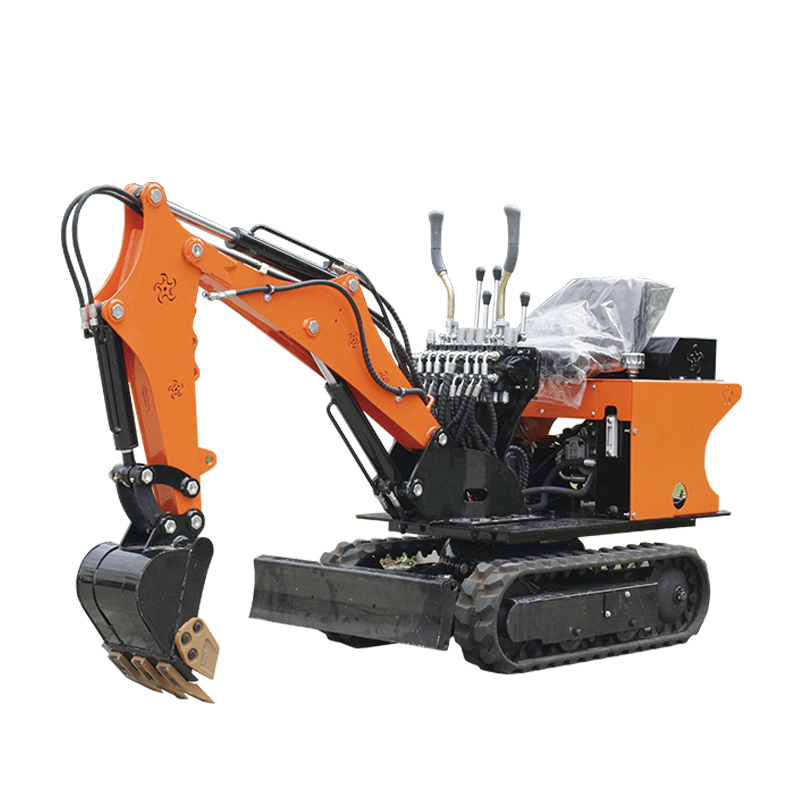
When operating in muddy areas, excavators face a high risk of getting stuck. Preventive measures need to be taken from multiple aspects, including site assessment, operating skills, and equipment protection. The specific methods are as follows:
Survey the terrain and plan the route
First, observe the hardness of the muddy area. Judge the bearing capacity of the ground by tentative walking (such as gently stepping on the crawler/tire and observing the sinking situation). Avoid obvious mud pits, waterlogged areas, or regions with thick humus layers.
When planning the operation route, try to drive along the edge of the site or existing compacted tracks. Avoid repeated rolling in the same position (repeated rolling will make the ground softer).
Clear obstacles and carry out paving reinforcement
Clean up debris such as stones and tree roots in the site to prevent them from getting stuck in the crawler/tire and causing slipping or getting stuck.
For areas with insufficient expected bearing capacity, pave gravel, steel plates, wooden boards, or woven fabrics in advance:
Steel plates/wooden boards can disperse the ground pressure and are suitable for locally soft areas.
Woven fabrics (such as geotextiles) can enhance the integrity of the soil and reduce the cutting of the ground surface by the crawler.
Adjust equipment parameters
For crawler excavators, the crawler tension can be adjusted to a moderate level (too loose is easy to get stuck with mud, too tight is easy to break), and the mud between the crawlers should be cleaned to avoid increasing driving resistance.
For wheeled excavators, the tire pressure can be reduced (within a safe range) to increase the ground contact area and reduce the ground pressure.
Control the driving and steering methods
Drive at a low and uniform speed: Avoid sudden acceleration or braking to prevent the crawler/tire from slipping, which will "dig up" the soil and cause deeper sinking.
Prioritize straight driving: When steering, try to use "large-radius steering" to reduce the lateral cutting of the ground by the crawler/tire (especially for crawler-type excavators, in-place steering will seriously damage the ground structure).
Maintain the balance of the body: When driving, keep the bucket slightly lower than the ground (about 20-30cm). If slight sinking is encountered, the bucket can quickly support the ground to prevent further sinking.
Choose a reasonable working posture
During operation, try to keep the crawler/tire in maximum contact with the ground: For crawler-type excavators, place the crawlers on both sides parallel to the solid area; for wheeled excavators, ensure the tires are evenly stressed.
Avoid having one side of the crawler/tire pressing on a soft area (such as one side in mud and the other on hard ground) to prevent the body from tilting, which will cause the center of gravity to shift and lead to skidding or getting stuck.
Control the operation range and load
Overload operation is prohibited in muddy areas. Avoid digging too deep (especially vertical digging) to prevent the reaction force of the bucket from causing the body to sink.
If moving operation is required, the moving distance each time should not be too long. Before moving, check whether the front ground is solid. If necessary, move forward while paving.
Reserve an "escape route"
During operation, avoid completely getting the body stuck in the center of the muddy area. Try to back against a solid ground (such as a soil slope, hardened edge) so that you can move to the solid area when sinking starts.
Monitor the body status in real-time
During operation, pay attention to signs of tilting or sinking of the body (such as the crawler/tire gradually sinking into the soil, or the engine load suddenly increasing). Once an abnormality is found, stop the operation immediately and try to evacuate to a solid area.
Equipment auxiliary protection
Crawler excavators can be equipped with widened crawler plates (to increase the ground contact area) or anti-skid chains (to enhance grip); wheeled excavators can be replaced with off-road pattern tires to reduce the risk of slipping.
Through the above measures, the probability of excavators getting stuck in muddy areas can be significantly reduced. The core principles are: assess the ground bearing capacity in advance, reduce damage to the ground, maintain the stability of the body, and promptly respond to signs of initial sinking. If the excavator gets stuck accidentally, do not operate it forcibly (to avoid sinking deeper), and use external equipment (such as loaders, cranes) for auxiliary rescue.



 Chinese