
 Chinese
- HOME >> NEWS >> Company news
NEWS
Latest Product
Contact Us
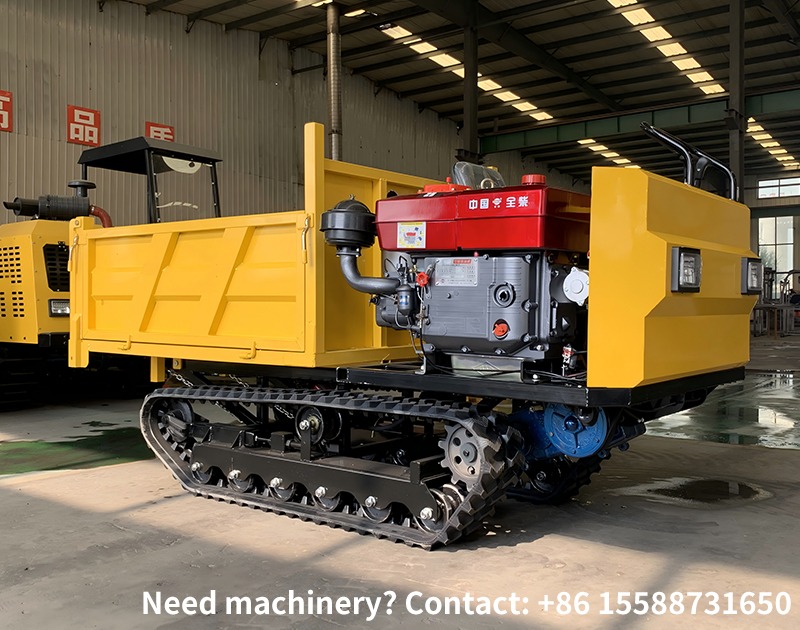
Turning Radius and Maneuverability Parameters of Tracked Carriers
2026-02-05I. Core Turning Radius Parameters
Tracked carriers primarily use differential steering / pivot steering, and do not have the fixed turning radius concept of wheeled carriers. Key indicators:
Minimum Turning Radius
Pivot steering (center-point turning): Radius ≈ 0, capable of 360° in-situ U-turn – a core advantage of tracked chassis.
Models with width restrictions / body protection: Minimum radius ≈ 0.3–0.8 m.
Recommended Safe Turning Radius
For heavy-duty / high-speed driving, to prevent rollover and track derailment, a safe turning radius of 1.5–3 m is recommended.
II. Key Maneuverability Parameters
Steering Modes
Civil engineering models: Bilateral track differential steering (forward/reverse rotation enables pivot turning).
Large heavy-duty models: Some equipped with hydraulic power steering for smoother control.
Maneuverability vs. Body Dimensions
Small walk-behind / mini models (0.5–1.5 t): Body length 1.8–2.8 m, flexible passage in confined spaces, field ridges, and sheds.
Medium models (2–5 t): Body length 3–4.5 m, suitable for construction sites and mountain forest access roads.
Large models (6–12 t): Body length 4.5–6 m, reduced steering flexibility – recommended for open sites only.
Auxiliary Maneuverability & Passability Indicators
Minimum ground clearance: 180–400 mm, avoids bottoming out when overcoming obstacles.
Track contact length: Shorter length = easier pivot turning; longer length = better driving stability.
Body width: Standard 0.8–1.8 m; narrow-body models can access orchards and narrow lanes.
III. Maneuverability Limiting Conditions
Heavy-load state: Sharp pivot steering is prohibited, as it may damage tracks and cause rollovers; use a larger turning radius.
Soft / muddy ground: Pivot steering easily digs ruts and causes sinking; gentle small-radius turning is recommended.
Sloped terrain: Lateral steering is strictly forbidden; only straight driving + gentle small-radius turning along the slope is permitted.
Track tension: Excessively loose tracks reduce steering response; overly tight tracks increase wear and steering resistance.
IV. Comparison with Wheeled Carriers (Summary)
Tracked carriers have far superior maneuverability to equivalent wheeled carriers:Wheeled models typically have a minimum turning radius of 3–6 m, while tracked models can perform 0-radius in-situ U-turns.They are better suited to confined scenarios such as narrow construction sites, mountain forests, and agricultural sheds.