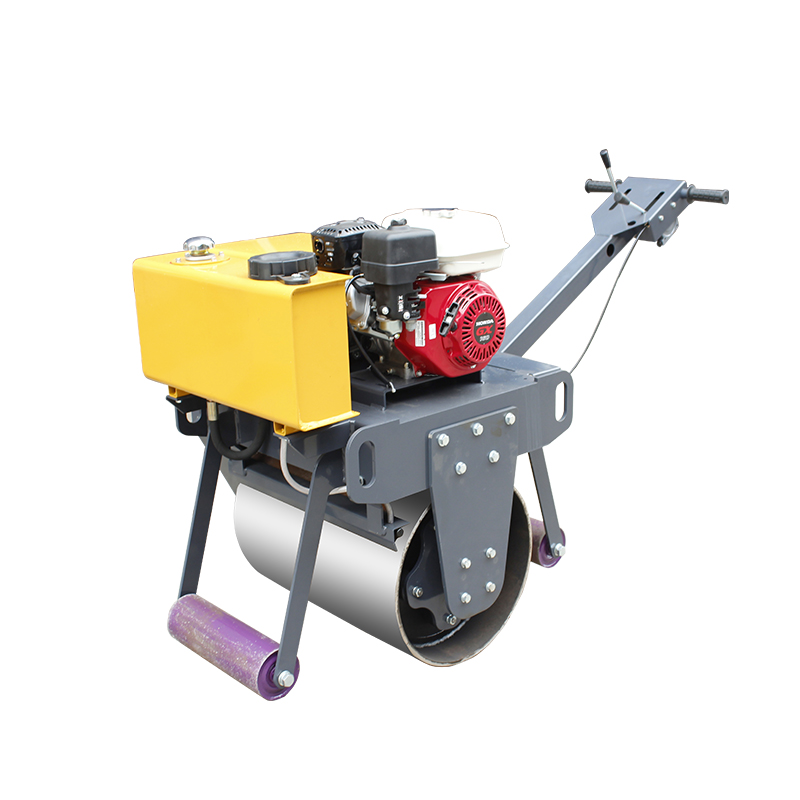
When large rollers operate on narrow sections or curves, the core operating principles are "low-speed stable driving, small-radius steering, and avoidance of sudden braking or sharp turns". Meanwhile, strict safety protection measures must be implemented. The specific operating skills and safety precautions are as follows:
Maintain low-speed driving throughout the operation, with the speed controlled within 1–2 km/h; exceeding 3 km/h is strictly prohibited. Low speed enhances the maneuverability of the machine, preventing compaction drum slippage or machine rollover caused by excessive inertia.
Adopt small-angle and multiple steering when working on curves, avoiding full-lock steering in one go. Single-drum rollers have a large turning radius, so it is necessary to plan the driving path in advance and slowly cut into the curve along the inner side. Double-drum rollers use articulated steering; the articulation angle can be adjusted slightly to ensure the trajectories of the two drums overlap, preventing the compaction drums from gnawing at the road edges or shoving the pavement.
Decelerate first before steering; after completing the turn, straighten the steering wheel before resuming uniform speed. Sudden steering during compaction is prohibited, especially in asphalt surface construction, to avoid pavement swelling or cracking.
When compacting narrow sections, adopt forward-reverse compaction instead of the conventional back-and-forth compaction to reduce the number of U-turns. The overlap width of adjacent compaction strips can be appropriately increased to 1/2 of the wheel width to avoid missed compaction in blind spots.
Follow the principle of "low-amplitude vibration on the inner curve, stable compaction on the outer curve" when compacting curves. The inner side of the curve has a small radius, which may cause the roller's center of gravity to shift. It is necessary to turn off the high-amplitude vibration mode (switch to static rolling or low-amplitude vibration mode) and reduce the excitation force to prevent machine rollover. Maintain a uniform speed when compacting the outer side to ensure uniform compaction degree.
For extremely narrow sections where the width is only slightly larger than the roller wheel width, the oblique compaction method can be adopted. Conduct oblique paving and compaction in two passes, covering half of the wheel width each time, to prevent the collapse of the mixture at the edges.
Prioritize the use of the roller's low-speed gear and steering assist function. Some large-tonnage rollers are equipped with a "narrow road mode", which can limit the steering angle and driving speed to improve operational safety.
During curve construction of asphalt pavements, continuously spray atomized water on the steel drums for cooling to prevent the mixture from adhering to the wheel surface. If adhesion occurs, stop the machine immediately for cleaning to avoid scratching the pavement by rolling with adhered materials.
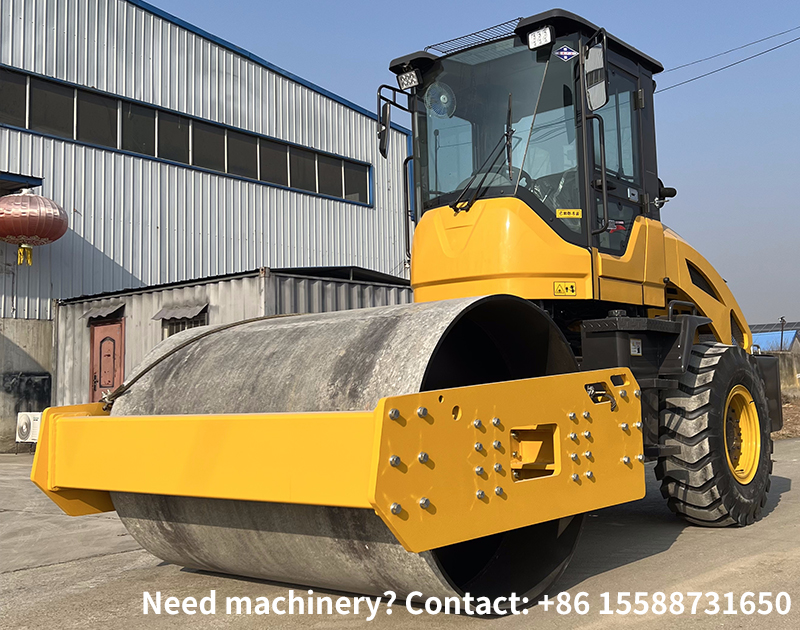
When a single-drum roller operates on narrow sections, keep the steel drum side close to the curb as much as possible, with the rubber tire side following behind. Utilize the flexible adhesion of the rubber tires to reduce compaction damage to the subgrade edges.
Survey the site in advance, remove obstacles (such as stones, steel bars, and construction waste) in narrow sections, mark vulnerable structures like curbs and pipeline manholes, and set up obvious warning signs.
Reinforce the slopes or trenches on the inner side of curves to prevent the collapse of edge soil during roller compaction. Set up construction warning zones at both ends of narrow sections to prohibit the entry of non-construction personnel and equipment.
Inspect the roller's steering system, braking system, and vibration reduction system to ensure they are in good working condition. For articulated rollers, focus on checking the tightness of the articulation points to prevent loosening during steering.
Strictly prohibit sudden braking or U-turns on curves. Predict braking in advance and press the brake pedal slowly. If a U-turn is necessary, drive to an open area before performing the maneuver.
The roller operator must observe the rearview mirrors and side conditions throughout the operation. Assign a dedicated person to direct the work when operating on narrow sections, using hand signals or walkie-talkies for communication to avoid collisions caused by blind spots.
Avoid leaving the roller parked on the inner side of curves for a long time. When parking, straighten the machine, engage the handbrake, and place triangular blocks under the wheels for skid prevention if necessary. Parking on sloped curves is strictly prohibited.
For narrow curves in subgrade construction, if the moisture content of the filler is too high, first perform static rolling for stabilization, then switch to low-amplitude vibration compaction to prevent "springy soil" that may cause roller slippage.
During curve compaction of asphalt surfaces, do not keep the roller stationary on high-temperature mixtures for a long time to avoid machine deviation caused by asphalt adhering to the wheel surface. If slippage occurs, turn off the vibration immediately and slowly reverse to exit the area.
For night construction, turn on all the roller's lighting equipment and add temporary lighting at narrow sections and curves to ensure clear visibility.
If the roller slips slightly on a narrow section, turn off the vibration function immediately and slowly reverse to firm pavement; do not force continued compaction.
If the machine tilts, the operator should remain calm and is strictly prohibited from jumping off the machine. Reduce the speed slowly and drive the machine to a flat area.
If the roller collides with a structure, stop the machine immediately for inspection, assess the damage to the pavement or structure, and resume operation only after completing rectification and passing inspection.


 英文
英文