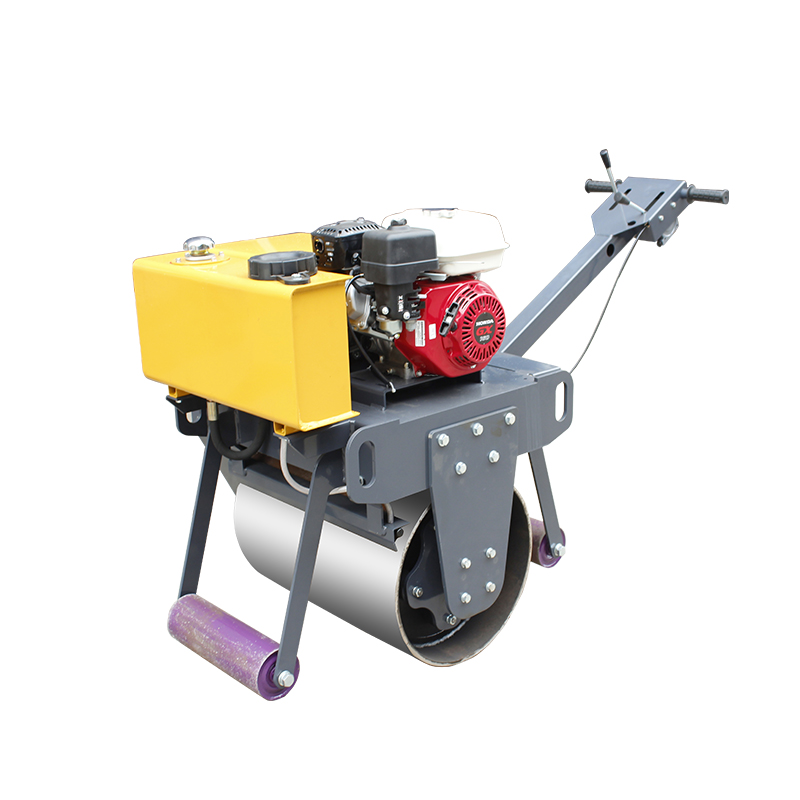
The testing of compaction degree after road roller operation is a key link in evaluating the compaction quality of pavements or foundations. The method should be selected according to the material type (soil, sandstone, asphalt mixture, etc.) and engineering requirements. The following are common compaction degree testing methods, classified and explained by their applicability:
Ring Knife Method (the most commonly used traditional method)
Principle: A ring knife of a certain volume (usually 200cm³) is used to cut an undisturbed soil sample. The mass of the soil sample is weighed to calculate its wet density, which is then converted to dry density in combination with water content. The compaction degree is obtained by comparing it with the maximum dry density derived from indoor compaction tests (compaction degree = on-site dry density / maximum dry density × 100%).
Applicable scope: Suitable for fine-grained soils (cohesive soil, silt) and sandy soil with a particle size ≤ 20mm. Not applicable to soils containing boulders or loose materials (e.g., sandy soils are prone to errors due to disturbance during sampling with a ring knife).
Operation points:
Select representative points on the rolled soil layer, dig a test pit 30cm deep, and insert the ring knife vertically into the soil to avoid disturbing the soil sample.
Seal the soil sample immediately after sampling to prevent water evaporation, and determine the water content in a timely manner (using the oven-drying method or alcohol combustion method).
Sand Replacement Method (suitable for sandy materials)
Principle: A test pit of a certain volume is dug at the test point, the mass of the excavated soil sample is weighed, and then the test pit is filled with standard sand (with known density). The volume of the test pit is determined according to the volume of the sand, and the density of the soil sample is calculated to further convert the compaction degree.
Applicable scope: Suitable for coarse-grained soils such as sand, gravel, and graded crushed stone, as well as compaction degree testing of base courses and subbase courses. Not applicable to soft clay (test pits are prone to collapse) or materials with large particle sizes (> 50mm).
Advantage: Causes little disturbance to the soil sample, has high accuracy, and is one of the commonly used methods on construction sites.
Water Filling Method (a convenient alternative to the sand replacement method)
Principle: A test pit of fixed volume (e.g., defined by an iron ring) is used, and water is poured into the pit until it is flush with the top of the ring. The volume of the test pit is determined according to the amount of water poured, and the density is calculated in combination with the mass of the soil sample.
Applicable scope: Similar to the sand replacement method, especially suitable for scenarios where on-site sand sources are insufficient or it is inconvenient to carry sand. However, it is greatly affected by the shape of the test pit (the pit wall must be vertical).
Nuclear Density Gauge Method (rapid testing)
Principle: Radiation emitted by radioactive elements (e.g., cesium-137) penetrates the soil sample. By detecting the intensity of scattered radiation, the wet density and water content of the soil are quickly calculated, and then the dry density and compaction degree are converted.
Applicable scope: Suitable for various soils and asphalt mixtures, allowing on-site instant reading with high efficiency.
Notes:
It is an indirect method and needs to be calibrated with the ring knife method or sand replacement method (at least 3 calibrations for each batch of materials).
Operators must hold a radiation safety license to avoid prolonged exposure.
Core Drilling Method (the most authoritative method)
Principle: A core drilling machine is used to drill a cylindrical core sample (usually with a diameter of 100mm or 150mm) from the pavement. The height and mass of the core sample are measured to calculate its density. The compaction degree is obtained by comparing it with the indoor standard Marshall density or maximum theoretical density (compaction degree of asphalt pavement = core sample density / standard density × 100%).
Applicable scope: All asphalt mixture pavements (hot-mix asphalt, emulsified asphalt, etc.), and it is a mandatory method for completion acceptance.
Operation points:
Avoid damaging the core sample during drilling. After taking it out, seal it with wax or wrap it with plastic wrap to prevent water loss.
Take at least 3 core samples for each test point and take the average value as the result.
Nuclear Density Gauge Method (auxiliary rapid testing)
The principle is similar to that for soil testing, but it needs to be switched to "asphalt mode" to directly measure the density of the asphalt mixture (no need to measure water content).
Advantage: Can quickly test large-area pavements and is used for quality monitoring during construction, but it needs to be calibrated with the core drilling method (especially for different types of asphalt mixtures, re-calibration is required).
Sand-gravel cushion / graded crushed stone: In addition to the sand replacement method, the water filling method or surface vibration compaction instrument method can be used (by simulating on-site vibration conditions, the maximum dry density is measured indoors, and then the compaction degree is calculated in combination with the on-site density).
Cement concrete base course: Its compressive strength is usually tested (core samples are taken for compressive tests) to indirectly reflect the compaction quality; for unhardened concrete, the rebound hammer method can be used for rapid evaluation.
Priority to accuracy: Direct methods (ring knife, sand replacement, core drilling) must be used for completion acceptance, while indirect methods such as nuclear gauges are only used for process monitoring.
Material adaptability: Use the ring knife method for fine-grained soils, the sand replacement method for coarse-grained soils, and the core drilling method for asphalt pavements.
Efficiency and cost: In large-area construction, indirect methods can be used for rapid screening, and direct methods can be used for rechecking if abnormalities are found.
By scientifically selecting testing methods, it is possible to effectively judge whether the compaction effect of the road roller meets the design requirements, and avoid quality problems such as pavement settlement and cracking caused by insufficient compaction degree.



 英文
英文