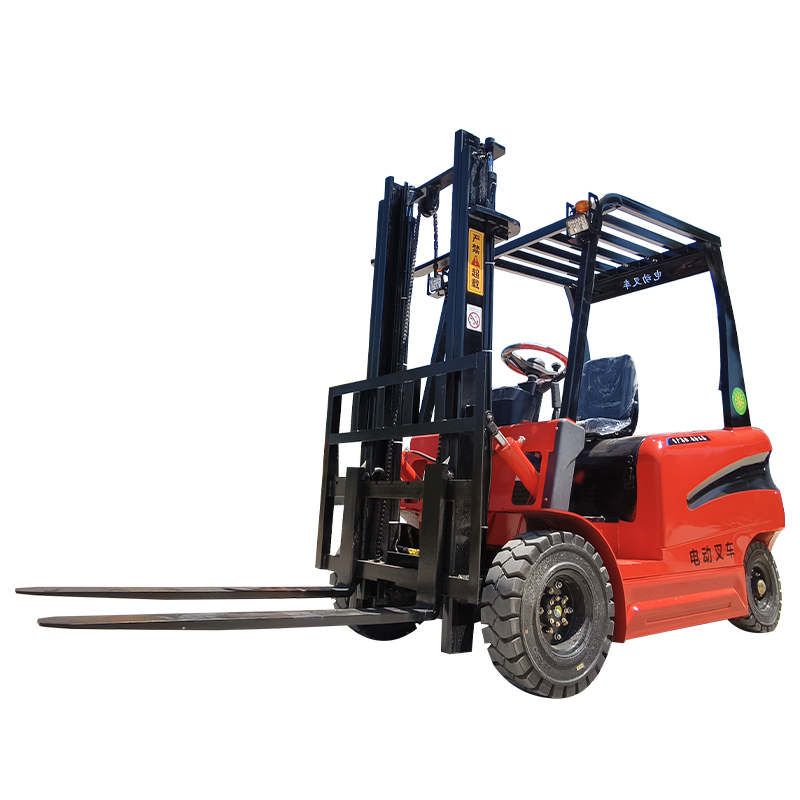
The common battery types for electric forklifts are mainly lead-acid batteries and lithium-ion batteries. Other types such as nickel-metal hydride batteries are only used in very few special scenarios due to performance or cost issues, and the mainstream choices are focused on the first two.
Low Initial Cost: The purchase price is usually 1/2 to 2/3 of that of lithium-ion batteries, making it more friendly for users with limited budgets.
Strong Short-Term Overload Capacity: It supports high-current discharge and performs more stably in scenarios that require instantaneous high power, such as handling heavy goods and climbing slopes.
Mature Technology and Long-Term Verified Safety: It has a long application history. In case of abnormal situations such as short circuits, violent reactions are less likely to occur, and the safety risk is relatively controllable.
Low Energy Density: It has a large volume and weight, which will occupy more space of the forklift and may affect the load capacity or overall flexibility of the forklift.
Poor Charge-Discharge Performance: Charging is slow, and it usually takes 8-10 hours to fully charge; it has a "memory effect" and requires regular deep-discharge maintenance, otherwise its capacity will decrease; the battery life attenuates significantly at low temperatures, and the battery life in an environment of -10°C may only be half of that at room temperature.
Short Service Life and Frequent Maintenance: The cycle life is about 800-1200 times, and it generally needs to be replaced after 2-3 years; conventional lead-acid batteries require regular addition of distilled water, and even maintenance-free ones need regular inspection, resulting in high maintenance costs.
Poor Environmental Friendliness: It contains lead and sulfuric acid. Leakage will pollute the environment, and professional institutions are required for recycling and disposal after scrapping, leading to high subsequent environmental protection costs.
High Energy Density: Small in size and light in weight, it can save space on the forklift. With the same installation space, it can provide longer battery life, or allow for more flexible forklift design.
Excellent Charge-Discharge Performance: Supports fast charging, which can be fully charged within 1-3 hours; no "memory effect", so charging at any time without affecting the capacity; its low-temperature performance is better than that of lead-acid batteries, and it can still maintain a certain battery life in an environment of -20°C.
Long Service Life and Simple Maintenance: The cycle life is about 2000-3000 times, and the service life can reach 5-8 years, with low replacement frequency; basically no maintenance is required, only regular inspection of connecting wires and voltage is needed, resulting in lower long-term use costs.
Good Environmental Friendliness: It does not contain heavy metal pollutants such as lead and sulfuric acid. Compared with lead-acid batteries, the difficulty of recycling and disposal after scrapping and the environmental risks are lower.
High Initial Purchase Cost: The upfront investment is much higher than that of lead-acid batteries, which brings greater pressure on short-term budgets.
Safety of Some Types Requires Attention: Although lithium iron phosphate batteries have good thermal stability, if they are low-quality products or the protection circuit fails, there is still a risk of overheating and fire. Therefore, compliant products must be selected.
Stability of High-Current Discharge Needs Attention: Compared with lead-acid batteries, some lithium-ion batteries have slightly lower stability in scenarios of continuous high-current discharge. It is necessary to select a matching battery model according to the operation requirements.
Lead-Acid Batteries Are Suitable For: Scenarios with low operation frequency (less than 4 hours per day), limited budget, and low sensitivity to charging time, such as intermittent handling tasks in small warehouses.
Lithium-Ion Batteries Are Suitable For: Scenarios with high operation frequency (more than 8 hours per day), need for fast charging or battery swapping, operation in low-temperature environments (such as cold chain warehouses), or requirements for battery life and flexibility, such as large logistics parks and high-frequency production workshops.



 Chinese