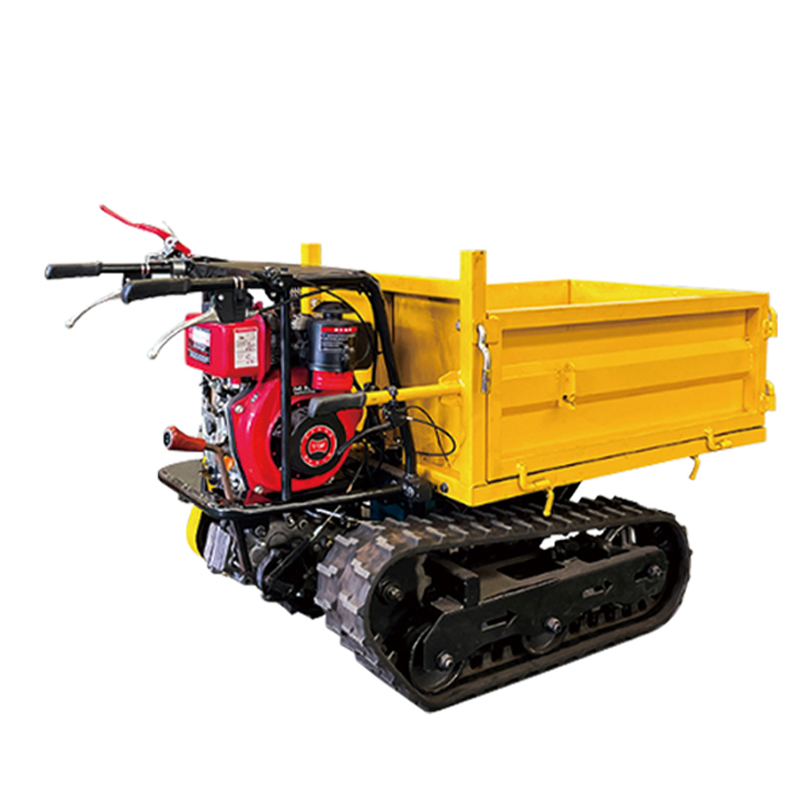
When operating in narrow spaces (such as indoor workshops, around pipelines, wall corners, small foundation pits, etc.), road rollers need to adopt targeted operating strategies based on space constraints, equipment characteristics, and construction requirements, while focusing on safety and compaction quality. The following are specific operating methods and precautions:
The core of working in narrow spaces is matching the "size" of the equipment with the space. Priority should be given to small, highly flexible specialized equipment:
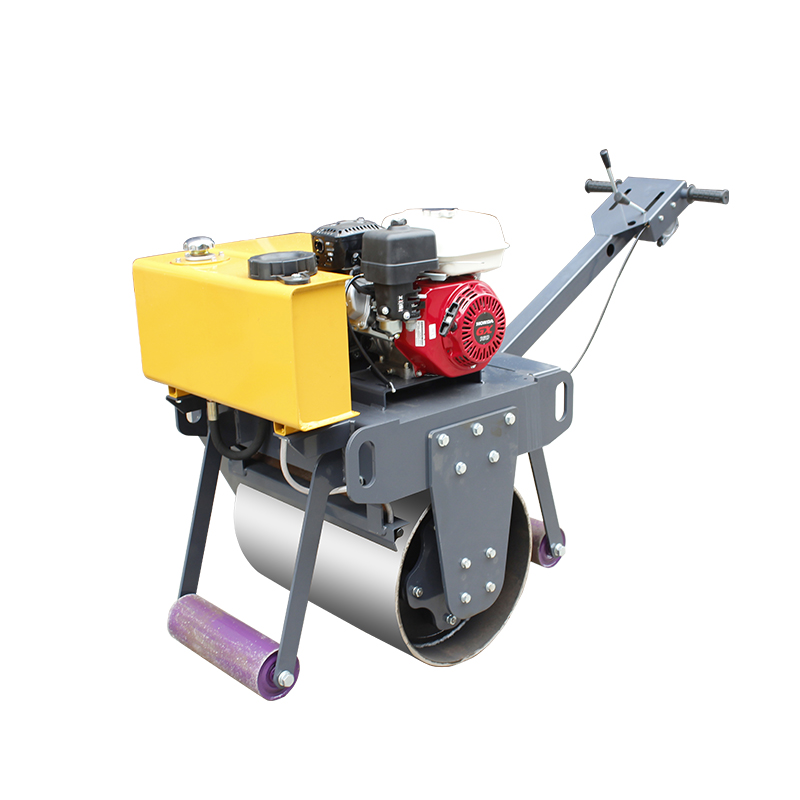
Small hand-held road rollers
They usually weigh 0.5-3 tons, with a body width of 0.8-1.2 meters, and can be steered through handrails. They are suitable for compacting narrow passages (such as areas 1-2 meters wide) and indoor floors (such as warehouses and factories).
Advantages: Flexible steering, able to work close to wall corners and columns, suitable for compacting thin-layer materials such as asphalt, sandstone, and concrete bases.
Remote-controlled micro road rollers
Without a cab, the body width can be as narrow as 0.6 meters, and they are operated via a remote control. They are suitable for small spaces that are difficult for humans to enter (such as under pipelines, at the edge of foundation pits).
Advantages: Avoid operators entering dangerous areas, suitable for toxic and low-height (e.g., height < 1.5 meters) environments.
Vibratory plate compactors / impact rammers
For narrower corners (such as wall corners, around equipment foundations), they can be used in conjunction with road rollers: plate compactors are suitable for plane compaction, and impact rammers are suitable for vertical compaction of trenches and edges.
Advantages: Compact size (width 0.3-0.5 meters), able to fill the "blind areas" that road rollers cannot cover.
Articulated small road rollers
Adopting an articulated steering design, they have a small turning radius (usually < 3 meters) and a body width of 1.2-1.5 meters. They are suitable for moderately narrow spaces (such as community roads, small squares), balancing compaction efficiency and flexibility.
Site survey and planning
Measure the site dimensions (width, length, height, position of obstacles) in advance, mark areas that cannot be rolled (such as pipelines, equipment foundations, inspection wells), and plan the rolling route (to avoid dead ends).
Clean up debris (stones, steel bars, etc.) in the site to ensure there are no protrusions on the ground, preventing equipment jamming or damage.
Layered rolling and thickness control
The paving thickness in narrow spaces is usually thin (generally ≤ 20cm), and the thickness of each layer must be strictly controlled: excessive thickness will lead to uneven compaction, and small equipment will have difficulty compacting deep materials.
Adopt the principle of "thin layers and multiple passes", compacting each layer 3-5 times, and adjust the number of rolling passes according to the material type (such as sand, cohesive soil).
Rolling route design
Linear back-and-forth method: In long and narrow passages (such as corridors), roll back and forth along the length direction, overlapping 1/3 of the wheel width each time to avoid missing compaction.
Circular progressive method: In closed small areas (such as small foundation pits), roll spirally from the edge to the center, gradually reducing the radius to ensure the edges are compacted in place.
Corner treatment: For wall corners and around equipment that cannot be directly rolled by the road roller, first pre-compact with an impact rammer or plate compactor, then use the road roller to make up compaction close to the edge (reserve a 5-10cm distance to avoid collision).
Speed and parameter control
The operating speed is controlled at 1-3km/h (50% slower than in conventional sites) to avoid failure to steer in time, collision with obstacles, or insufficient compaction energy due to excessive speed.
Vibratory road rollers need to reduce the amplitude (the amplitude of small equipment is usually ≤ 1mm) to prevent excessive vibration from causing cracks in surrounding equipment and walls (especially during indoor operations).
Safety protection
Due to limited visibility in narrow spaces, special personnel should be arranged to direct, and operators should always observe the surrounding environment (such as walls, pipelines, other construction personnel).
Equipment should be equipped with anti-collision devices (such as rubber buffer strips) to avoid damage to the equipment or site structure due to collision with hard objects.
Ensure good ventilation during indoor operations (especially for diesel-powered equipment) to prevent exhaust gas accumulation.
Quality inspection
Use methods such as the ring knife method and sand replacement method to test the compaction degree, focusing on checking corners and areas close to obstacles (where insufficient compaction is prone to occur).
Observe whether there are cracks, shift,looseness, etc., on the surface, and adjust rolling parameters in time (such as increasing the number of passes, reducing speed).
The core of operating in narrow spaces is "equipment adaptation + precise operation". By selecting small and flexible compaction equipment, planning rolling routes according to site characteristics, controlling speed and compaction parameters, and strengthening safety and quality inspections, efficient and qualified compaction effects can be achieved in limited spaces. In actual operations, the plan needs to be flexibly adjusted according to the specific size of the site, material type, and surrounding environment.



 Chinese