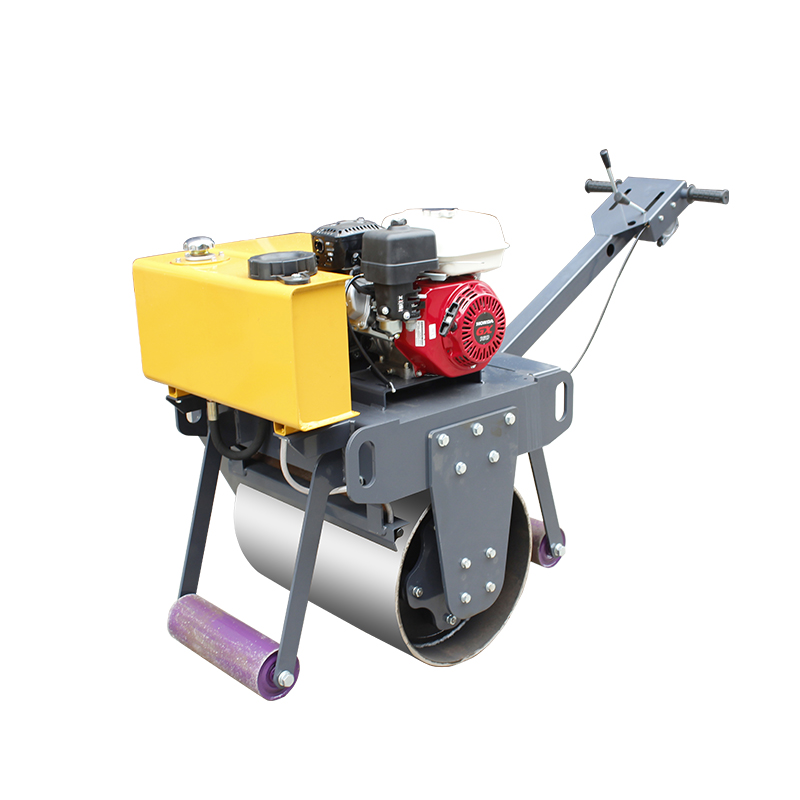
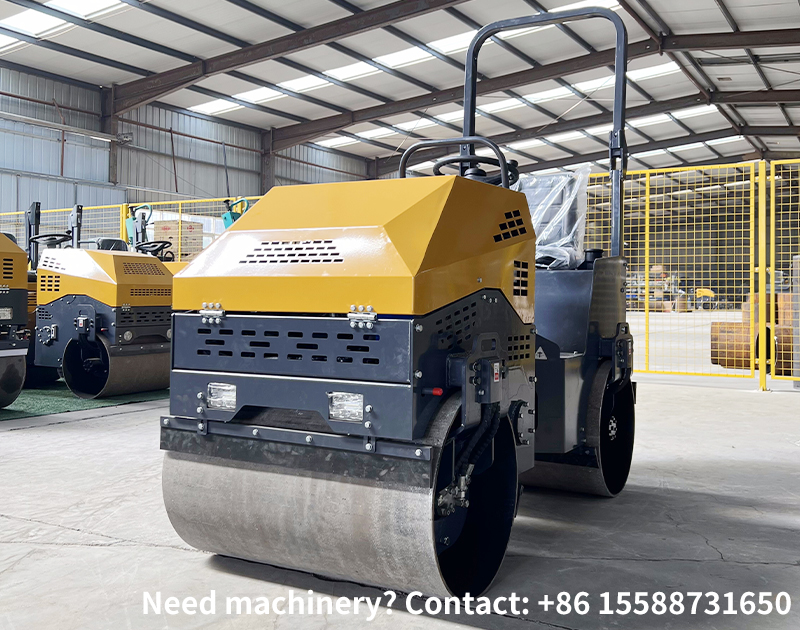
The core difference between full hydraulic drive and mechanical drive road rollers lies in their power transmission methods, which directly determine their significant differences in performance and application scenarios.
Power is transmitted to the drive wheels through a series of rigid mechanical components such as a clutch/torque converter, gearbox, drive shaft, and differential.
Its power transmission path is fixed and rigid.
The engine drives a hydraulic pump to generate high-pressure oil, which is delivered through hydraulic pipelines to a hydraulic motor on the drive wheels. The hydraulic motor directly drives the wheels to rotate.
Its power transmission is achieved through the pressure energy of hydraulic oil, offering flexibility and adjustability.
Mechanical Drive: Relatively high starting impact, noticeable gear shifting jolts during acceleration, and discontinuous speed changes.
Full Hydraulic Drive: Extremely smooth starting, linear and shock-free acceleration, enabling stepless speed change with smooth speed adjustment.
Mechanical Drive: Traction and torque are limited by gearbox gears and engine speed, with average performance under low-speed, high-torque conditions, potentially struggling with heavy loads or climbing.
Full Hydraulic Drive: Excellent low-speed, high-torque characteristics, providing large and constant traction. It delivers powerful performance even at low crawling speeds or during climbing, adapting well to heavy-duty conditions.
Mechanical Drive: Relatively complex operation requiring frequent gear shifting, resulting in higher labor intensity.
Full Hydraulic Drive: Simple operation, typically controlling speed and direction with just one lever or pedal, reducing labor intensity and improving comfort.
Mechanical Drive: Relatively fixed power matching, making dynamic optimization based on real-time conditions (e.g., load changes) difficult.
Full Hydraulic Drive: Highly flexible power matching, automatically adjusting hydraulic pump and motor displacement according to load changes to maintain optimal power output and fuel economy, with strong adaptability to complex conditions.
Mechanical Drive: Relatively simple structure with lower manufacturing costs. However, mechanical transmission components (e.g., clutch, gearbox gears) experience faster wear, resulting in moderate maintenance costs.
Full Hydraulic Drive: Hydraulic components (pumps, motors, valve groups) have high technical content, typically with higher manufacturing costs. While structural wear is minimal, the hydraulic system has strict requirements for oil cleanliness, potentially leading to higher initial maintenance costs, though long-term maintenance costs may be more favorable.
Small and Medium-Sized Earthwork Projects: Such as rural roads, small-scale site leveling, and initial subgrade compaction, where performance requirements are not extreme.
Cost-Sensitive Projects: Its lower purchase cost is attractive for projects with limited budgets.
Relatively Fixed Working Conditions: Suitable for environments with stable operating conditions and low requirements for operational comfort.
Advantageous Scenarios:Limitations: Performance and efficiency become insufficient for large-scale projects, complex conditions (e.g., muddy or soft ground), frequent start-stop operations, or applications requiring high climbing capability.
Large-Scale Earthwork and Subgrade Projects: Such as highways, railway subgrades, dams, and airport runways—core projects with extremely high requirements for compaction quality, efficiency, and traction.
Complex Working Conditions: Such as muddy or soft ground, steep slope operations, or precision compaction requiring frequent steering and speed changes.
High Operational Comfort and Efficiency Requirements: Its smooth operation and efficient power transmission significantly enhance work efficiency and operator satisfaction.
Advantageous Scenarios:Limitations: Higher initial investment may restrict its popularity in some small-scale projects with very limited budgets.
Mechanical Drive Road Roller: A simple, economical, and practical choice suitable for small to medium-sized projects with relatively simple working conditions.
Full Hydraulic Drive Road Roller: Represents higher technical standards with superior performance, operational comfort, and adaptability. It is the preferred choice for large-scale, complex, and high-quality projects.
With the continuous advancement of hydraulic technology and gradual cost reduction, the market share of full hydraulic drive road rollers is steadily growing, especially in the mid-to-high-end compaction equipment sector.


 Chinese