

 Chinese
- HOME >> NEWS >> Company news
NEWS
Latest Product
Contact Us
Differences in Operational Adaptability of Crawler and Wheeled Excavators in Urban Engineering
2026-01-29The operational adaptability of crawler and wheeled excavators in urban engineering centers on the core requirements of urban construction: site flexibility, road surface protection, transshipment efficiency, and operational scenario diversity. Wheeled excavators, leveraging their advantages of high-speed transshipment, low road surface wear, and flexible operation in narrow spaces, have become the main force for conventional urban projects such as municipal administration and road maintenance. Crawler excavators, by virtue of their characteristics of heavy-load excavation and adaptability to complex working conditions, play an irreplaceable role in tough urban infrastructure construction projects. The two types exhibit significant differences in applicable scenarios, operational advantages and operational restrictions. The following is a professional analysis from three dimensions: adaptation to core operational scenarios, comparison of key construction characteristics, and operational restrictions and precautions, which is in line with the actual construction conditions of urban engineering.
I. Differences in Adaptation to Core Operational Scenarios
Wheeled Excavators: Adapted to Conventional Urban Municipal Engineering, Light-Load Operations and Multi-site Mobile Projects
Wheeled excavators are the core adapted models for daily urban municipal engineering, focusing on "rapid transshipment, light-load operation and flexible positioning". Their applicable scenarios are mainly based on the construction needs of urban hardened roads, narrow streets and scattered multi-operation points. The specific core applicable scenarios include:
Urban road maintenance: Pavement breaking, trench excavation (for water supply and drainage/gas/communication pipelines), curb trimming, muck and silt cleaning, etc. They can operate directly on asphalt/cement pavements without additional road surface protection.
Urban street construction: Pipe network transformation, small foundation pit excavation and construction waste cleaning in narrow streets of old urban areas, adapting to the positioning needs of narrow spaces and many corners in streets.
Municipal greening/sanitation: Light-load earthwork operations such as soil arrangement in green belts, tree pit excavation, silt cleaning in river shoals and urban waterlogging drainage.
Scattered construction at multi-operation points: Sporadic maintenance projects in different urban areas (such as community pipe networks and road patching), which can realize self-driven high-speed transshipment without flatbed truck transportation.
Auxiliary operations at urban construction sites: Light-load auxiliary work such as on-site material transshipment, silt cleaning around foundation pits and site leveling at large construction sites, cooperating with large crawler excavators to complete collaborative construction.
Crawler Excavators: Adapted to Tough Urban Infrastructure Construction, Heavy-Load Excavation and Complex Site Projects
Crawler excavators focus on "heavy-load operation, complex working conditions and efficient tackling" in urban engineering. Their applicable scenarios are mainly based on the construction needs of large-scale urban infrastructure, unhardened sites and projects requiring large excavation force, and they are the core models for key urban projects. The specific core applicable scenarios include:
Large-scale urban infrastructure projects: Heavy-load earthwork/rock work such as urban subway foundation pit excavation, viaduct foundation construction, deep foundation pit excavation of commercial buildings and urban tunnel portal construction.
Urban demolition projects: Demolition of old buildings and illegal constructions, which can cooperate with breaking hammers to complete the crushing of concrete and reinforced structures, and the large excavation force can efficiently clean up construction waste from demolition.
Construction on urban unhardened sites: Site leveling in new urban areas, pipe network foundation excavation on unhardened road sections, river widening and silt cleaning in cities, etc., adapting to unhardened ground such as soft ground and mud.
Urban emergency projects: Urban collapse cleaning, road collapse rush repair, large muck accumulation cleaning, etc., which can realize efficient heavy-load operation in emergency sites without flat operation surfaces.
Main operations at large urban construction sites: Main earthwork excavation and foundation pit support cooperative operations at large construction sites such as commercial housing communities and industrial parks, undertaking core heavy-load excavation tasks.
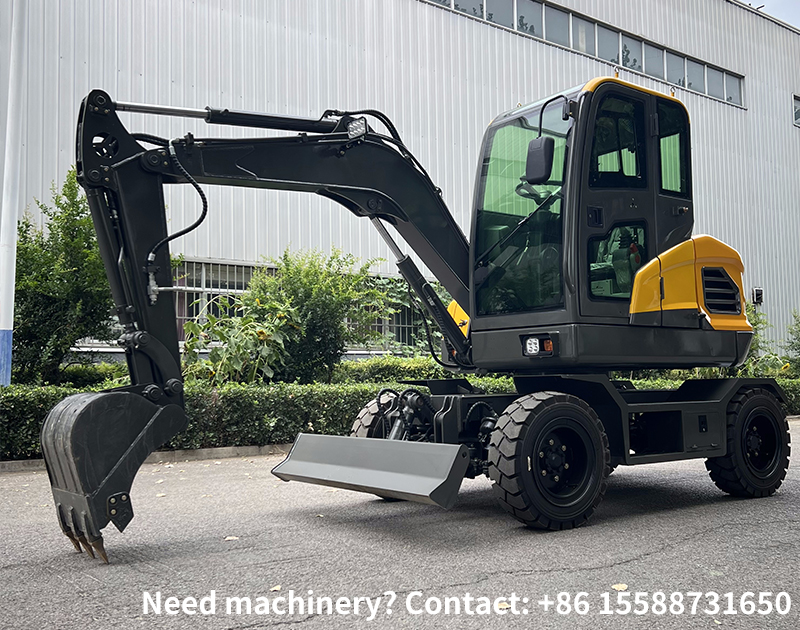
II. Core Comparison of Key Construction Characteristics in Urban Engineering
1. Transshipment Efficiency and Transportation Cost
Wheeled excavators: Self-driven transshipment with extremely high efficiency and no transportation cost. They can self-drive on urban hardened roads at a speed of 30-40km/h for transshipment, adapting to the construction needs of multiple operation points and cross-regional in cities, without flatbed truck transportation, greatly saving transshipment time and transportation costs, and are especially suitable for urban scattered and emergency maintenance projects.Crawler excavators: Requiring flatbed truck transportation with low transshipment efficiency and transportation cost. Their own walking speed is only 3-5km/h, and they cannot self-drive for long distances on urban hardened roads (prone to road damage). Cross-regional transshipment must rely on flatbed truck transportation and require handling urban oversize cargo transportation pass procedures, with long transshipment preparation time. They are suitable for large-scale projects with fixed operation points, not for scattered construction at multiple operation points.
2. Road Surface Protection and Construction Restrictions
Wheeled excavators: Zero wear on road surfaces with no construction road surface restrictions. Adopting rubber tire design, they have no wear in contact with urban asphalt and cement hardened roads. No road surface protection materials such as steel plates and geotextiles are needed during operation, and they can operate directly on urban trunk roads and community roads with no road surface construction restrictions, complying with the requirements of urban appearance management.Crawler excavators: Prone to road damage with strict protection requirements for construction. Metal crawler shoes are in direct contact with hardened roads, which will scratch and roll to damage the road surface. When operating on urban hardened roads, thick steel plates, geotextiles and other protection materials must be laid in walking and operation areas. In addition, some urban trunk roads and core business districts explicitly prohibit the unprotected operation of crawler excavators, with many restrictions on construction sites.
3. Site Flexibility and Adaptability to Narrow Spaces
Wheeled excavators: Flexible body with ultimate adaptation to urban narrow spaces. With short wheelbase, small turning radius and tire steering, they can realize in-situ slewing and small-angle positioning in ultra-narrow spaces such as streets in old urban areas, beside community building corridors and on both sides of pipe network trenches. Their operational flexibility is far superior to crawler excavators, making them the only choice for construction in urban narrow spaces.Crawler excavators: Rigid body with poor adaptability to narrow spaces. Crawler steering relies on bilateral differential speed with a large minimum turning radius, and the body is wider and longer. In urban narrow streets, narrow trenches and other sites, positioning and slewing are severely restricted, and flexible operation cannot be achieved. They can only operate in large urban construction sites and open sites.
4. Operational Capacity and Construction Efficiency
Wheeled excavators: High efficiency in light-load operations with weak heavy-load operational capacity. For light-load earthwork, trench excavation, pavement breaking and other operations in urban engineering, they feature flexible operation and smooth connection with high operational efficiency. However, limited by tire support and body center of gravity, their excavation force is small, unable to complete tough operations such as heavy-load earthwork, rock breaking and building demolition, with an obvious upper limit of operational capacity.Crawler excavators: High efficiency in heavy-load operations with irreplaceable tough operation capacity. Relying on the strong stability of the crawler chassis and large excavation force, they can cooperate with attachments such as breaking hammers and grab buckets to efficiently complete heavy-load operations such as deep foundation pit excavation, concrete crushing and building demolition, with an operational efficiency several times that of wheeled excavators. However, for light-load and scattered operations, the insufficient body flexibility is prone to waste of construction efficiency.
5. Attachment Adaptation and Operational Diversity
Wheeled excavators: Adapting to light-load attachments with refined operation types. The core adapted attachments include small breaking hammers, narrow buckets, silt cleaning buckets, wood clamping forks and other light-load attachments, focusing on refined operations in urban engineering such as narrow trench excavation, small-scale crushing and greening wood clamping. The core of attachment adaptation is "light, refined and small".Crawler excavators: Adapting to all types of attachments with full coverage of operation types. They can adapt to all types of heavy-load attachments such as large breaking hammers, heavy-duty buckets, rock buckets, steel grabbers and pile drivers, not only completing earthwork operations, but also realizing various operations such as rock breaking, steel bar grabbing and pile foundation construction. Their operational diversity is far superior to wheeled excavators, adapting to the multi-process construction needs of large-scale urban infrastructure.
III. Operational Restrictions and Precautions in Urban Engineering
Wheeled Excavators: Focus on Operational Load Control and Avoid Ground Instability
In urban engineering, wheeled excavators are prohibited from heavy-load operations on soft ground, muddy and potholed roads. The operation surface must be leveled in advance, and steel plates must be laid if necessary to prevent tire slipping and subsidence.
Outriggers must be deployed during operation to ensure tires are off the ground. Excavation and crushing operations with load-bearing tires are prohibited to prevent body rollover. Especially when operating beside urban narrow trenches, outriggers must be fully deployed and ground protection must be well done.
When self-driving for transshipment on urban roads, traffic rules must be observed, warning signs must be hung, and high-speed driving is prohibited. Slow down when passing through intersections and communities, and pay attention to pedestrians and vehicles.
Crawler Excavators: Focus on Road Surface Protection and Compliant Construction
When operating on urban hardened roads, protection materials must fully cover the walking and operation areas, and the joints of steel plates must be seamlessly connected to prevent crawlers from scratching the road surface. After operation, muck on the road surface must be cleaned in a timely manner to restore the urban appearance.
When operating in urban core areas and trunk roads, construction permits and pass procedures must be handled in advance. Construction should be carried out in non-peak traffic hours such as nights and early mornings as much as possible to reduce the impact on urban traffic.
When operating at urban construction sites, foundation pit slope protection must be well done. Crawler walking should avoid approaching the slope edge to prevent body rollover caused by slope collapse. Especially in dense urban building areas, the scope of excavation operation must be strictly controlled to prevent impact on the foundation of surrounding buildings.
IV. Summary of Core Adaptation
In urban engineering, wheeled excavators are the "main force of daily urban operation and maintenance", adapted to all light-load, scattered, narrow-space and multi-site municipal engineering, with core advantages of fast transshipment, road surface protection and high flexibility. Crawler excavators are the "core equipment for tough urban infrastructure construction", adapted to all heavy-load, large-scale and complex-site infrastructure engineering, with core advantages of large excavation force, strong tough operation capacity and full coverage of operation types.
In actual urban engineering construction, the two types often form a collaborative operation mode: wheeled excavators are responsible for fine site finishing, pipe network trench excavation and pavement breaking in the early stage, while crawler excavators are responsible for heavy-load earthwork excavation and foundation pit tackling in the later stage. The two complement and adapt to each other, which not only ensures the construction efficiency of urban engineering, but also meets the core requirements of urban construction for road surface protection and site flexibility.