

 Chinese
- HOME >> NEWS >> Company news
NEWS
Latest Product
Contact Us
Comparison of Climbing Capacity and Applicable Terrain Between Crawler and Wheeled Excavators
2026-01-29The climbing capacity and sloped terrain adaptability of crawler and wheeled excavators are fundamentally determined by the ground contact characteristics, adhesion, body center-of-gravity design and power transmission mode of their travel systems. The two types exhibit distinct differences: crawler excavators feature strong climbing capacity and wide terrain adaptability, while wheeled excavators have weak climbing capacity and narrow terrain adaptability. In addition, the actual climbing capacity is affected by no-load and heavy-load working conditions, with the climbing gradient of both dropping significantly under heavy load. The heavy-load climbing gradient of crawler excavators is about 50%-60% of that in the no-load state, and that of wheeled excavators is only 40%-50% of the no-load level. The following is a professional and detailed comparison without tables, covering both design parameters and practical working conditions.
I. Core Differences in Climbing Capacity
Crawler Excavators
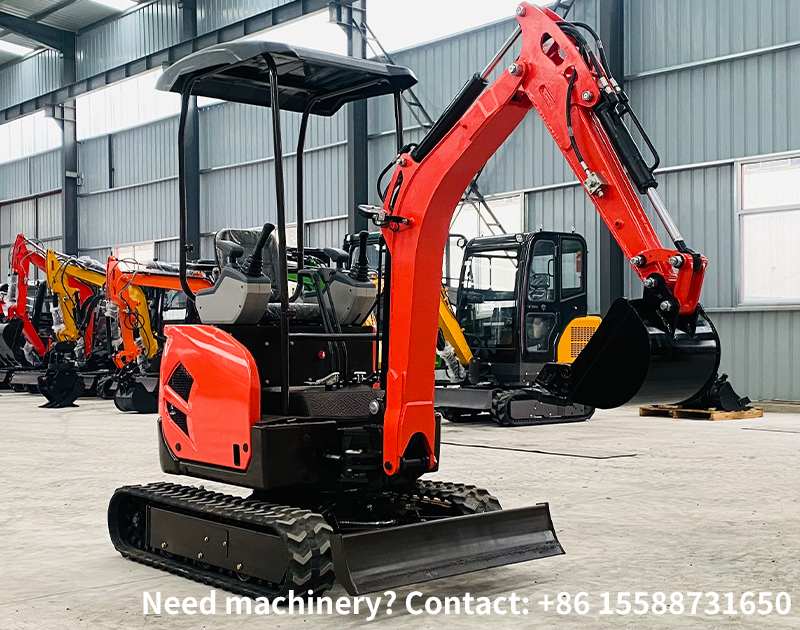
Crawler excavators deliver the best climbing capacity among mainstream industrial excavators. They can climb steep slopes of up to 30°-45° under no-load conditions, and large-tonnage reinforced models are capable of a no-load climbing gradient of 50°. Under heavy-load operation, they can stably climb slopes of 15°-25° in conventional working conditions, and even achieve heavy-load climbing of 10°-15° on special sloped terrain such as soft ground and muddy ground. They also demonstrate excellent continuous climbing capacity. Relying on the high-efficiency heat dissipation and uniform force-bearing design of the crawler travel system, they can move continuously on slopes for extended periods with no risk of excessive overload wear on the travel system, and are not prone to slipping during climbing. Even if one side of the crawler encounters slight slumping, the independent hydraulic drive for the left and right crawlers can adjust the power output separately to ensure continuous climbing.
Wheeled Excavators
The climbing capacity of wheeled excavators is limited by their tire structure and is generally poor. Conventional four-wheel drive models can climb gentle slopes of up to 15°-20° under no-load conditions, and high-configured off-road four-wheel drive models can only reach a maximum no-load climbing gradient of 25°, which is only achievable on hardened pavement. Under heavy-load operation, their climbing capacity is severely restricted—they can only climb extremely gentle slopes of 8°-12° on hardened pavement and almost cannot realize heavy-load climbing on unhardened pavement, with tires slipping and idling on slightly steeper slopes. Meanwhile, their continuous climbing capacity is inadequate: prolonged climbing tends to cause overheating of tires and wheel hubs, and the four-wheel drive transmission system is also prone to overload due to uneven power distribution, allowing only short-distance movement on gentle slopes.
II. Fundamental Core Reasons for the Differences in Climbing Capacity
Divergent Ground Contact and Adhesion
Crawler excavators feature continuous surface contact between the crawlers and the ground, with a ground contact area 8 to 15 times that of wheeled excavators of the same tonnage. The anti-skid patterns on the crawler shoes can tightly engage with soil, gravel and the base layer of sloped terrain to form strong static friction, providing sufficient adhesion during climbing. In contrast, wheeled excavators have four-point contact between tires and the ground with a small ground contact area; tire treads can only generate effective adhesion on hardened pavement. On soft ground, muddy and sandy slopes, the tire treads are easily filled with silt and sand, losing their anti-skid effect instantly and leading to severe slipping during climbing.
Different Ground Contact Pressure and Adaptation to Ground Load-bearing Capacity
Crawler excavators have low ground contact pressure, with conventional models ranging from 0.08 to 0.3 MPa. The machine weight can be evenly distributed on the crawler contact surface, so they will not sink into the ground even on soft ground, muddy or sandy slopes, and can always maintain supporting stability for climbing. Wheeled excavators have high ground contact pressure, up to 0.5 to 1.2 MPa, with large single-point load-bearing on tires, which are prone to sinking into unhardened slopes. This not only fails to provide climbing power but also causes center-of-gravity offset due to machine subsidence, increasing safety risks.
Distinct Body Center of Gravity and Operational Stability
Crawler excavators adopt a rigid track frame chassis with a low and ground-hugging body center of gravity, which always remains within the crawler's ground contact range during climbing. Combined with the uniform support of the support rollers, the risk of machine rollover is extremely low. Due to the design of tires and wheel hubs, wheeled excavators have a relatively high body center of gravity and a four-point support structure with poor stability. When the slope exceeds 20°, slight unevenness of the ground will cause machine imbalance, and the risk of rollover rises exponentially.
Varied Power Transmission and Adaptation to Working Conditions
Crawler excavators are equipped with independent hydraulic drive for the left and right crawlers. During climbing, they can adjust the power output of the two crawler sides separately according to the adhesion differences of the left and right sloped ground. Even if one side of the crawler slips slightly, the other side can still provide sufficient power to ensure continuous climbing. The four-wheel drive system of wheeled excavators is a rigid mechanical transmission, with power evenly distributed to the four tires. Once a single tire slips, the overall power will be greatly lost, making effective climbing impossible. In addition, there is no independent power adjustment capability for individual wheels, resulting in poor adaptability to sloped terrain working conditions.
III. Core Comparison of Applicable Climbing Terrain
Crawler Excavators
Crawler excavators have an extremely wide adaptability to climbing terrain, covering almost all types of engineering sloped terrain. They can stably climb on hardened pavement slopes, plain soil slopes, sandy slopes, as well as muddy soft ground slopes, rock and gravel slopes and uneven mountain slopes. Their advantages are particularly prominent in operations on unhardened field slopes such as foundation pit side slopes, mine waste dumps and water conservancy dams. At the same time, crawler excavators can further enhance their climbing adaptability to extreme sloped terrain such as slippery steep slopes and deep silt slopes by replacing with reinforced anti-skid crawler shoes and wide crawler shoes, making them the primary choice for operations on complex field slopes.
Wheeled Excavators
Wheeled excavators have an extremely narrow adaptability to climbing terrain and can only be used on gentle slopes with hardened pavement, such as asphalt/cement pavement slopes in urban municipal engineering and gentle slope passages in hardened factory areas, with the gradient required to be controlled within 20°. They almost cannot achieve effective climbing on unhardened slopes such as plain soil slopes, sandy slopes, muddy slopes and rock slopes, and are prone to slipping and getting stuck even under no-load conditions. For uneven mountain slopes, their tires cannot adapt to ground height differences, which not only makes climbing difficult but also easily causes equipment failures such as wheel jamming and tire damage, rendering them completely unsuitable for climbing operations on unhardened field slopes.
IV. Supplementary Points on Terrain Adaptation for Climbing Operations
In sloped terrain operations, crawler excavators can not only achieve simple climbing movement but also directly carry out excavation, trimming and other operations on the slope surface after climbing, with a seamless connection between climbing and operation and no need for additional site leveling. Even if wheeled excavators can climb hardened gentle slopes, they can only operate on the flat area at the top of the slope and cannot work directly on the slope surface; otherwise, rollover will occur due to an unstable center of gravity.
When climbing across different terrains, crawler excavators can directly cross small trenches, gravel piles and other obstacles on the slope with strong trafficability. Wheeled excavators have high requirements for the flatness of sloped terrain; when encountering obstacles such as trenches and gravel piles, their tires are prone to being suspended and jammed, making it impossible to continue climbing.
If wheeled excavators need to temporarily climb a small number of unhardened gentle slopes (≤10°), the slope must be pre-paved with materials such as steel plates and gravel to improve ground load-bearing capacity and tire adhesion, otherwise effective movement cannot be achieved. In contrast, crawler excavators can directly climb and operate on such slopes without additional paving, greatly saving construction preparation time.