The rolling speed, rolling passes and compaction degree of rollers have a non-linear collaborative correlation. The core rule is that the compaction degree shows a trend of "rapid increase — slowing growth — tending to stabilize" as the number of rolling passes increases, and decreases inversely as the rolling speed increases. The details are as follows:
In the early stage of rolling, the mixture particles are loose with large gaps. Each additional rolling pass will significantly improve the interlocking degree and compactness of the particles, resulting in a fast growth rate of compaction degree. This stage usually covers the first 3–5 passes.When the number of rolling passes reaches the critical range of 5–8 passes, the mixture particles have basically achieved a stable interlocking state, and the effect of continuing to increase the number of passes on improving compaction degree will slow down sharply.Blind rolling beyond the critical number of passes will enter the over-compaction stage: for subgrade fillers, it is easy to cause aggregate crushing and structural disturbance, which will instead reduce the overall strength of the subgrade; for asphalt mixtures, it will lead to aggregate crushing and asphalt film peeling, triggering early diseases such as pavement raveling and rutting.
Rolling speed directly determines the effective contact time between the roller and the mixture. The longer the contact time, the more fully the compaction energy is transmitted, and the higher the compaction degree.
Low-speed rolling (2–4km/h): The contact time is sufficient, and the compaction energy can fully act on the mixture. The target compaction degree can be achieved with fewer passes, which is suitable for the initial and re-compaction stages with high compaction requirements.
Medium-speed rolling (4–6km/h): The contact time is shortened, so the number of rolling passes needs to be increased to achieve the same compaction degree. It is generally used in the final compaction stage focusing on smoothness.
High-speed rolling (>6km/h): The contact time is too short, so the compaction energy cannot be effectively transmitted, and the phenomenon of "bouncing rolling" is likely to occur. This not only results in insufficient compaction degree, but also causes defects such as wheel tracks and shoving, and is strictly prohibited in core compaction processes.
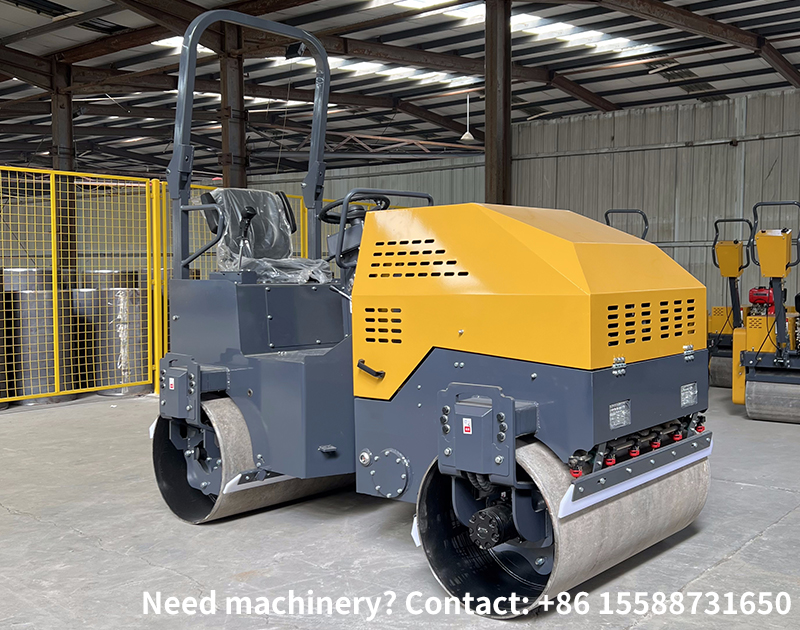
Under the same number of rolling passes, the slower the rolling speed, the more obvious the effect of improving compaction degree; under the same rolling speed, the compaction degree will gradually increase before the number of passes reaches the critical value.For example, during the re-compaction of asphalt mixture, a double-drum roller rolling 4 passes at a speed of 3km/h may achieve the same compaction degree as rolling 6 passes at a speed of 5km/h, but the former has higher construction efficiency and lower energy consumption.
The core of determining the optimal rolling process is to achieve the designed compaction degree with the lowest energy consumption in the shortest time, while ensuring compaction uniformity and surface smoothness. The process should be carried out in the following steps:
Clarify Basic ConditionsFirst, determine the compaction standards of the project, such as the compaction degree of the lower subgrade bed ≥93%, upper subgrade bed ≥96%, and asphalt surface course ≥96%. Then adjust the scheme according to material characteristics: for example, the moisture content of cohesive soil subgrade should be controlled within ±2% of the optimal value, and the rolling temperature of modified asphalt mixture should be increased. At the same time, match the corresponding equipment: use large-tonnage single-drum rollers for subgrade and base course, and adopt the combination of double-drum rollers and pneumatic-tire rollers for asphalt surface course.
Carry Out On-site Rolling Test SectionSelect a test section consistent with the actual construction conditions, divide it into multiple small blocks, and set different combinations of rolling speed and passes for each block. Roll according to the process of initial compaction - re-compaction - final compaction, and test the compaction degree with the sand replacement method (for subgrade) or nuclear density gauge (for surface course) after each pass. Draw the "rolling passes - compaction degree" curve, find the inflection point where the growth rate of compaction degree slows down significantly. The number of passes corresponding to this inflection point is the critical number of passes, and then select the parameter combination with "moderate speed and minimum passes" as the benchmark process.
Optimize Parameters According to Compaction Stages
Initial compaction stage: Aiming at stabilizing the mixture and eliminating paving marks, adopt low-speed rolling (2–3km/h) for 1–2 passes, using the vibration mode of double-drum rollers or static rolling mode of single-drum rollers.
Re-compaction stage: Focusing on achieving the designed compaction degree, adopt medium-low speed rolling (3–4km/h) for 3–5 passes, using the vibration mode of single-drum rollers, vibration mode of double-drum rollers or pneumatic-tire rollers.
Final compaction stage: To eliminate wheel tracks and ensure smoothness, adopt medium-speed rolling (4–6km/h) for 1–2 passes, using the oscillation mode of double-drum rollers or static kneading mode of pneumatic-tire rollers.
Dynamically Adjust Process ParametersAdjust the parameters in real time according to on-site working conditions during construction: when the ambient temperature decreases, the asphalt mixture cools down faster, so it is necessary to appropriately reduce the rolling speed and increase the number of re-compaction passes by 1–2; when the moisture content of subgrade filler is too high, reduce the rolling speed to avoid the occurrence of "springy soil"; if mixture shoving or cracking occurs during rolling, reduce the speed or decrease the number of passes immediately, and check whether the material temperature or moisture content exceeds the standard.


 Chinese