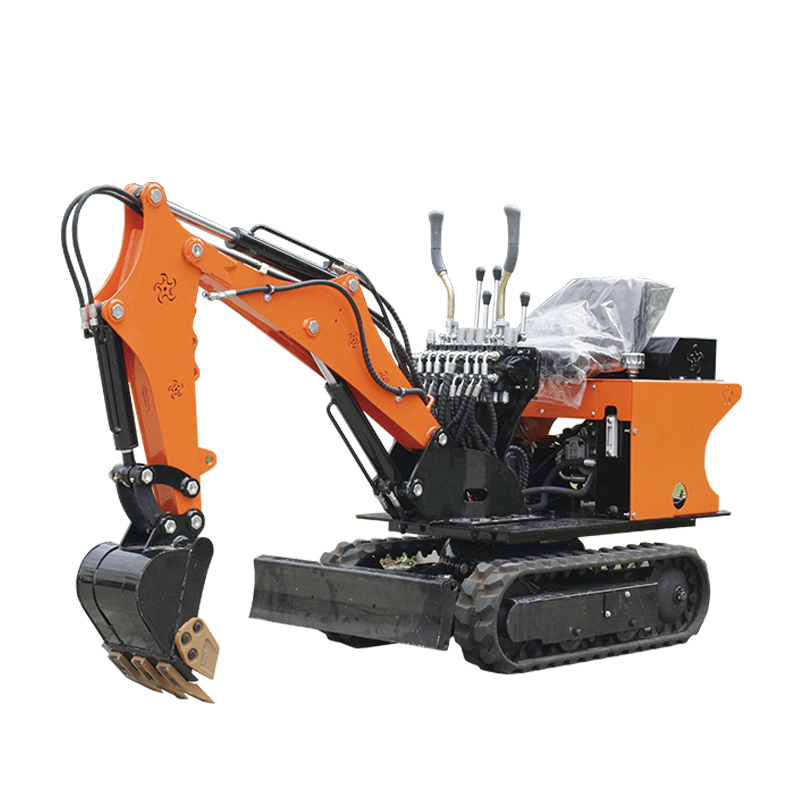
When a tracked excavator operates on steep slopes, unbalanced track force and out-of-control machine posture are the main risks leading to rollovers. The core control logic is "uniform track force bearing, centered machine center of gravity, and dynamic fine-tuning to adapt to slope gradient". Targeted operation plans must be formulated for track force control and machine posture adjustment respectively, combining the two scenarios of uphill and downhill operations. Meanwhile, emergency adjustments for unexpected situations should be taken into account. The specific details are as follows:
The machine body must be parallel to the slope direction; transverse uphill movement is strictly prohibited.
Adjust the boom to make the machine body tilt slightly forward, shifting the center of gravity toward the front of the tracks to enhance the grip of the front tracks and prevent the machine from sliding backward.
Use the cab level to monitor and ensure the left-right tilt angle of the machine body does not exceed 3°.
Keep the boom slightly bent, the arm fully extended, and the bucket teeth facing downward, 20-30cm above the ground, forming a "forward protection" posture.
If there are protrusions on the slope, make small adjustments by slightly lifting the boom to avoid center-of-gravity shift caused by machine jolting.
During uphill travel, track force is concentrated on the rear drive wheels and middle support rollers. Steadily supply fuel to ensure the drive wheels exert force evenly; avoid sudden heavy acceleration that may cause drive wheel idling. This not only reduces track wear but also prevents side slipping due to unbalanced driving force.
Ensure both tracks operate synchronously; excessive force on one side of the tracks is strictly prohibited to prevent the machine from tilting toward the side with less force.
Keep the bucket teeth lightly touching the ground, using the bucket's supporting force to bear 10%-20% of the load that would otherwise be on the tracks, reducing track ground contact pressure.
The bucket must bear force gently and evenly to avoid local track sinking caused by excessive force at a single point.
Clear sharp gravel and protruding obstacles on the slope in advance to prevent track plate deformation or support roller damage due to excessive local pressure on the tracks.
It is strictly prohibited to let the tracks press against the slope edge to avoid track sinking and force imbalance caused by loose edge soil.
Similarly, keep the machine body parallel to the slope. Adjust the boom to make the machine body tilt slightly backward, shifting the center of gravity toward the rear of the tracks to counteract the forward-tilting tendency during downhill travel and prevent the machine from tipping forward.
The left-right tilt angle of the machine body must be strictly controlled within 3°; stop and adjust immediately if the angle is exceeded.
Extend the bucket forward with the teeth facing downward and close to the ground. Use the friction between the bucket and the ground for auxiliary deceleration, forming a buffered protection.
Keep the boom and arm slightly bent; in case of emergency, the bucket can be quickly lowered to the ground for support to stabilize the machine body.
During downhill travel, track force is concentrated on the front idler wheels and middle support rollers. Rely on engine idle speed restriction and light brake application to control the vehicle speed, ensuring the idler wheels bear the machine's inertial force stably and avoiding sharp increases in track force caused by high-speed sliding.
Maintain equal braking force on both tracks to prevent the machine from deviating sideways due to excessive braking force on one side.
Neutral sliding is strictly prohibited. In neutral, the tracks lose engine restriction and will accelerate downward due to the machine's weight, subjecting the tracks and braking system to huge impact.
When passing through potholes, drive slowly to ensure the tracks bear force evenly and avoid damage to support rollers and track plates caused by instantaneous impact force.
Stop operation immediately, quickly lower the bucket to the ground for support. Restore the machine to a horizontal position by making small adjustments to the boom height. Only continue operation slowly after the tracks bear force evenly; continuing to move or excavate in a tilted state is strictly prohibited.
Reduce the throttle quickly to avoid track idling. At the same time, insert the bucket into solid ground, use the bucket's grip for assistance, and slowly adjust the track speed to move out of the slipping area. If one side slips, reduce the speed of the slipping track and allow the other track to exert force stably.
Stop all actions immediately and observe the collapse range. If the collapse is small, clean the soil in the collapsed area with the bucket, lay gravel or steel plates, and then drive out slowly. If the collapse is large, call for external traction to rescue the machine; blind movement to expand risks is strictly prohibited.


 Chinese