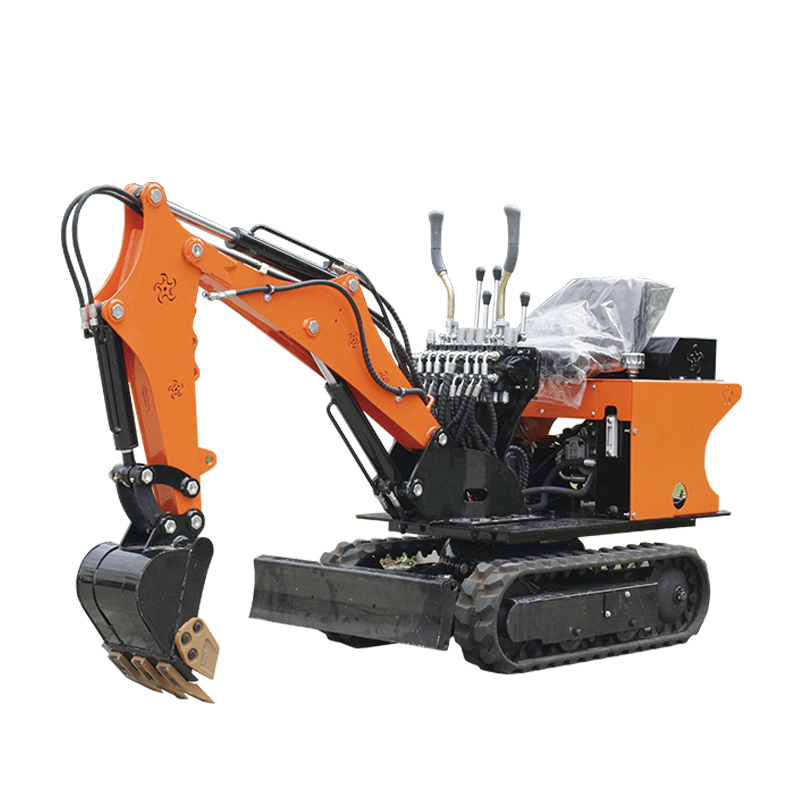
When a tracked excavator operates on muddy ground, the core causes of slipping and getting stuck are excessive track ground contact pressure, insufficient ground adhesion, and excessive entanglement of the track with mud. Protection must follow the full-process logic of "reducing pressure in advance, enhancing adhesion, precise operation, and emergency rescue". Combined with pre-operation preparation, in-operation control, equipment protection, and emergency response, a practical and implementable plan is formulated. The details are as follows:
For areas with shallow mud, lay steel plates, subgrade plates, gravel, or hay mats. The coverage area must be larger than the track contact area. By increasing the contact area, the machine's weight is distributed, and the ground contact pressure is reduced (wide subgrade plates can reduce the ground contact pressure by more than 30%).
For areas with deep mud, temporary operation platforms can be built. The bearing capacity of the platform must be no less than 1.5 times the excavator's own weight.
In advance, find out the mud thickness in the operation area and the location of the underground hard layer, and avoid low-lying waterlogged areas and humus accumulation areas.
Plan fixed excavation and movement routes to avoid frequent rolling over the same area, which would further soften the ground. At the same time, reserve an emergency evacuation channel.
Adjust the track tension to a slightly loose state (press the middle of the track, with a sag of 20-30mm) to avoid excessive tightness increasing ground contact pressure.
Clean residual mud and gravel in the gaps of the track plates to ensure the grip of the track patterns.
Check that the support rollers and drive wheels do not jam, to prevent uneven local force during operation.
Use low gear throughout driving and operation, supply fuel steadily, and strictly prohibit sudden acceleration, sudden braking, and frequent steering.
When steering, adopt small-angle segmented steering, completed through the method of "forward - stop steadily - fine adjustment". This avoids the track exerting shear force on the muddy ground, which leads to slipping and sinking.
Keep the machine body horizontal during excavation to ensure even force on both tracks and avoid excessive load on one side of the track.
When operating the bucket, follow the principle of "digging from far to near and in layers". Do not dig deeply at close range directly below the machine body, to prevent the reaction force from bucket excavation causing the machine body to sink.
Do not overfill the bucket to reduce the instantaneous weight of the machine body.
When driving, keep the bucket teeth facing down and lightly touching the ground. If slight slipping occurs, the force of slightly lifting the boom can assist the machine body in moving forward. At the same time, the bucket can clean the mud in front of the track to reduce driving resistance.
During operation intervals, regularly use the bucket to clean the mud entangled on the track and chassis to prevent the track from losing grip.
Replace with mine-specific wide track plates or track plates with anti-slip teeth. Wide tracks can increase the ground contact area, and anti-slip teeth can enhance the bite force on muddy ground.
Anti-slip nails can also be installed on the original track plates to further improve grip.
For excavators operating in muddy environments for a long time, hydraulic auxiliary outriggers can be installed. During operation, the outriggers are deployed to support the machine body, transferring part of the weight to the outriggers and reducing the pressure of the track on the ground.
The bottom of the outriggers must be equipped with anti-slip pads to prevent the outriggers from sinking into the mud.
When slight track slipping is detected, stop refueling immediately. Insert the bucket into the solid ground ahead, and through the coordinated action of lifting the boom and slowly moving the track forward, drive out of the slipping area slowly.
If one side of the track slips, reduce the rotation speed of the slipping track and let the other track exert force to avoid one-sided idling deepening the sinking.
If the track has sunk but not covered the support rollers, call a loader or trailer for traction. During traction, use a dedicated traction rope and fix it to the designated traction point of the machine body. Keep the traction speed slow and uniform to avoid damaging the chassis components.
At the same time, use the bucket to clean the mud around the track to reduce traction resistance.
If the machine body sinks significantly, first lay hard materials such as steel plates and gravel in front of and below the track to form a support surface. Then rescue by combining bucket support and external traction.
Forcibly stepping on the accelerator is strictly prohibited, as this will cause the track to sink deeper and even damage the hydraulic system.


 Chinese