In asphalt pavement construction, the operation of rollers directly determines the pavement's flatness, compactness, durability, and appearance quality. The core of the operation should focus on the four key dimensions of "temperature control, parameter determination, strict operation, and damage prevention". The specific operation points can be broken down into the following 6 categories of core content:
Asphalt pavement compaction has extremely high requirements for "timing" and "equipment condition". Sufficient preparations must be made before construction to avoid compaction failure due to inadequate preparation:
Steel Wheels: Clean the debris adhered to the surface and check the flatness of the steel wheels (deformation of steel wheels will cause wavy patterns on the pavement).
Rubber Wheels: Check that the tire pressure is uniform (usually 0.6-0.8MPa) and that there is no oil or debris on the tire surface (oil will contaminate the asphalt pavement).
Water Spraying System: Debug the atomized water spraying function (a small amount of water needs to be sprayed during asphalt construction to prevent the mixture from sticking to the rollers, but excessive water is strictly prohibited as it will reduce the asphalt temperature).
A combination of "static roller + vibratory roller + rubber-tired roller" is required, with clear division of labor:
| Roller Type | Core Function | Applicable Stage |
|---|
| Double Steel Wheel Vibratory Roller | Achieves deep compaction of asphalt mixture by vibration | Initial compaction (static pressure), re-compaction (vibration) |
| Rubber-Tired Roller | Eliminates steel wheel marks through the kneading effect of rubber tires and improves surface compactness | Re-compaction, final compaction |
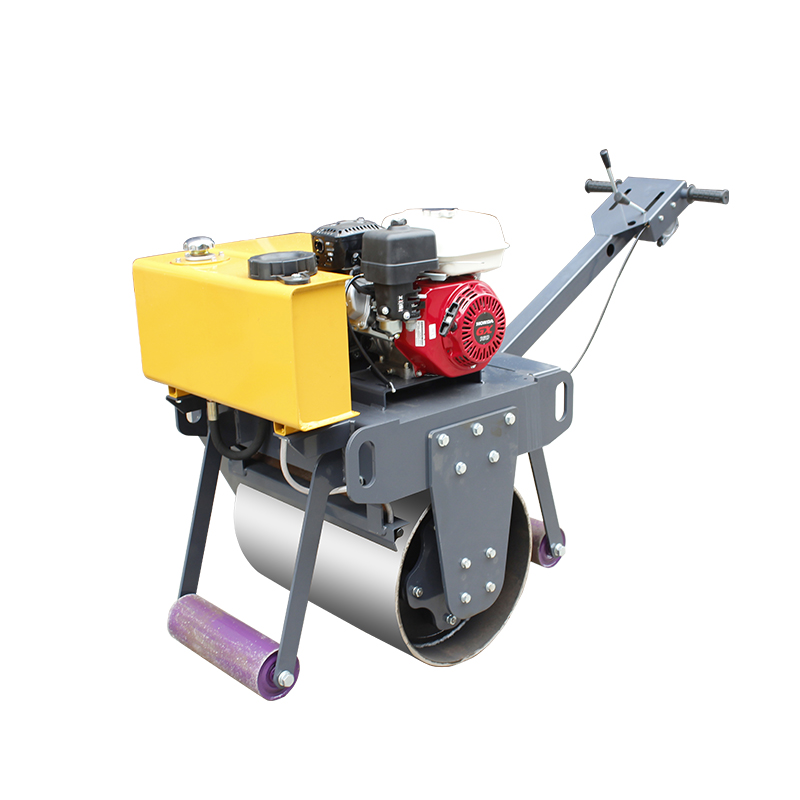
| Light Static Roller | Avoids damage caused by vibration and is used for supplementary compaction at pavement edges and around inspection wells | Final compaction or special areas |
The compaction effect of asphalt mixture completely depends on "temperature" — only within a specific temperature range does the mixture have plasticity and can be compacted. Once the temperature is lower than the "final compaction temperature" (ordinary asphalt ≤80℃, modified asphalt ≤100℃), further rolling cannot improve the compactness. Therefore, it is necessary to strictly control the "three key temperature points":
Timing: Follow the paver immediately after paving (with an interval of no more than 5m). At this time, the mixture temperature is the highest, and static pressure should be used quickly to fix the shape and avoid pushing.
Requirements: The temperature should be ≥120℃ for ordinary asphalt and ≥140℃ for modified asphalt. If the temperature is too high (e.g., >160℃), wait for a while to let it cool down before compaction to prevent the steel wheel from adhering to the mixture.
Timing: Conduct immediately after the initial compaction. At this time, the temperature drops to "100-130℃ (ordinary asphalt)" and "120-150℃ (modified asphalt)". The mixture has the best plasticity, which is a key stage to improve compactness.
Requirements: Re-compaction must be completed before the temperature drops to the final compaction temperature. Usually, the re-compaction time should be controlled within 15-20 minutes (adjusted according to the ambient temperature; it can be appropriately extended in summer and accelerated in winter).
Timing: Conduct when the temperature drops to "80-100℃ for ordinary asphalt and 100-120℃ for modified asphalt" after re-compaction. The purpose is to eliminate wheel marks and level the pavement.
Requirements: Final compaction must be completed before the temperature is lower than "80℃ for ordinary asphalt and 100℃ for modified asphalt"; otherwise, "hard wheel marks" will appear on the pavement and cannot be eliminated.
Different asphalt types (ordinary asphalt, modified asphalt) and different pavement layer positions (lower layer, middle layer, upper layer) have different compaction requirements, so it is necessary to adjust the roller parameters accordingly:
Lower Layer (5-8cm thick, focusing on deep compaction): Select medium amplitude and medium frequency (amplitude 0.8-1.2mm, frequency 30-35Hz) to ensure that the deep mixture is compacted.
Middle Layer (4-6cm thick, considering both deep and shallow compaction): Select small amplitude and high frequency (amplitude 0.5-0.8mm, frequency 35-40Hz) to avoid the surface layer being pushed due to excessive amplitude.
Upper Layer (3-4cm thick, focusing on surface flatness): Static pressure or extremely low-frequency vibration (frequency ≤25Hz) is usually used to prevent the vibration from damaging the surface fine aggregates and causing the pavement to become sandy.
Rolling Speed: Control at 2-4km/h (approximately walking speed) throughout the process. Excessively fast speed will lead to insufficient contact time between the roller and the mixture, resulting in insufficient compactness; excessively slow speed will prolong the compaction time, leading to too low temperature during subsequent rolling.
Number of Rolling Passes: Determine through the "test paving section". The conventional combination is "1-2 passes of initial compaction (static pressure) + 2-3 passes of re-compaction (vibration/rubber tire) + 1-2 passes of final compaction (static pressure/rubber tire)", with a total of 5-7 passes. The standard is "meeting the compactness requirement (usually ≥96%) and no wheel marks on the surface".
The operation of the roller should follow the principles of "orderly, uniform speed, and no sudden stop", and focus on avoiding defects such as pushing, wheel marks, and cracks:
From Low to High: Roll from the low side of the pavement (e.g., the side of the curb) to the high side to avoid the mixture being pushed to the low place.
From Edge to Center: First compact the pavement edge (5-10cm away from the curb), then gradually move to the center to prevent insufficient compaction at the edge.
Overlap of Adjacent Rolling Zones: The double steel wheel roller overlaps by 1/3-1/2 of the steel wheel width (about 20-30cm), and the rubber-tired roller overlaps by 1/2 of the wheel width to avoid missing compaction.
Follow the order of "from low to high, from edge to center, from slow to fast".
During the rolling process, sudden steering and sudden braking are strictly prohibited. Steering should be completed in the "compacted area" (e.g., driving out of the pavement width or reaching the rolling starting point) to prevent the uncompacted mixture from being squeezed to form "wavy patterns".
Pavement Edges/Curbs: Use a small double steel wheel roller (1-3t) for edge compaction, or reserve a 5-10cm space inside the curb before rolling, and fill it with asphalt sand after rolling to avoid the roller colliding with the curb.
Around Inspection Wells/Manhole Covers: When paving with the paver, reserve the "area around the wellbore" and use a hand-held small vibratory rammer (or micro roller) for layered compaction (each layer thickness ≤5cm) to prevent "vehicle jumping" caused by settlement around the inspection well.
Longitudinal Joints (Joints between Two Paving Sections): After paving the first section, reserve a 10-15cm wide "hot joint" (without rolling). When paving the second section, overlap it with the first section by 5-10cm, then roll from the second section to the original section with a roller to eliminate joint marks.
The compaction of asphalt pavement is greatly affected by the environment, so the operation should be dynamically adjusted according to the weather and temperature:
High-Temperature Weather (≥30℃): Asphalt cools down slowly, so the rolling rhythm can be appropriately slowed down, but the roller should be prevented from staying in the same position for a long time (to avoid the asphalt softening and sticking to the roller).
Low-Temperature/Windy Weather (≤15℃ or wind speed ≥5m/s): Asphalt cools down quickly, so the distance between the roller and the paver should be shortened (controlled within 3-5m), the number of re-compaction passes should be increased, and if necessary, a "heat preservation shed" should be set up in front of the paver to slow down the cooling.
Mixture Sticking to Roller: If asphalt adheres to the steel wheel, turn on the water spraying system (spray a small amount of atomized water); directly washing with a water pipe is strictly prohibited (as it will significantly reduce the temperature). If the sticking is severe, stop the machine to clean the steel wheel and continue rolling after the pavement temperature rises.
Surface Pushing: If the mixture is pushed (forming a bulge) during rolling, stop rolling immediately. After the temperature drops slightly (by 5-10℃), use static pressure to roll in the reverse direction to eliminate the pushing. If the pushing is severe, shovel off the affected part and repave.
Insufficient Temperature: If the pavement temperature is already lower than the final compaction temperature, continue rolling is strictly prohibited; otherwise, "cracks" or "hard wheel marks" will appear on the pavement. The area should be recorded and handled through "local supplementary compaction" (e.g., re-compaction after heating) later.
During the compaction process, dynamic quality monitoring is required to ensure that the final indicators meet the standards:
Compactness: Sample 1 point every 500㎡ and test using the "core drilling method" (measure the density after drilling the core sample). The compactness of ordinary asphalt pavement should be ≥96%, and that of modified asphalt pavement should be ≥97%.
Flatness: Test with a 3m straightedge, measuring 3 points every 100m, with a maximum gap ≤3mm; or test with a flatness meter, requiring the International Roughness Index (IRI) ≤2.0m/km.
Appearance: Visually inspect that the pavement surface has no wheel marks, no pushing, no cracks, no oil stains, and the joints are smooth.
Surface Layer Thickness: Test the thickness simultaneously with the core drilling method, which should meet the design requirements (allowable deviation ±5mm).
Anti-Skid Performance: Test the texture depth of the upper layer (using the sand spreading method), usually ≥0.5mm (to ensure driving anti-skid performance).
In summary, the core of roller operation in asphalt pavement construction is to "seize the temperature window period, and achieve a balance between compactness and flatness through matching parameters and standardized operations". Finally, it is necessary to meet the requirements of the Technical Specifications for Construction of Highway Asphalt Pavements (JTG F40-2004) to provide a guarantee for the long-term use of the pavement.



 Chinese