

 Chinese
- HOME >> NEWS >> Company news
NEWS
Latest Product





Contact Us
What Are the Core Differences Between Vibratory Rollers and Static Rollers?
2026-01-22The core differences between vibratory rollers and static rollers are reflected in three key dimensions: compaction principle, operational performance, and applicable working conditions. The specific differences are as follows:
Compaction Principle and Force Application Mode
Vibratory rollers: Adopt a dual-pressure mechanism of gravity + high-frequency excitation force. The machine's dead weight provides the basic pressure, and the eccentric block inside the vibrating wheel rotates at high speed to generate alternating excitation force. This forces the particles of the compacted material to vibrate, reduces friction between them, and allows the particles to quickly fill gaps to achieve compaction. The applied force is dynamic and periodic impact pressure.
Static rollers: Only rely on the machine's dead weight to exert constant static pressure. Compaction is accomplished through the extrusion, displacement, and rearrangement of material particles. The applied force is static and continuous, with no additional auxiliary power.
Operational Performance and Efficiency
Compaction Depth and Effect
Vibratory rollers: Offer deep compaction depth, up to tens of centimeters below the surface layer. They can achieve deep densification of materials, effectively reducing post-construction settlement of subgrades. The overall strength and stability of compacted materials are higher.Static rollers: Have shallow compaction depth, acting only on the 5–10 cm surface layer of materials. The deep-layer compactness is insufficient, so they are mostly used for surface leveling rather than deep compaction.
Operational Efficiency
Vibratory rollers: Feature high compaction efficiency. Generally, 1–2 passes of rolling can meet the designed compactness requirements, making them suitable for large-area, high-intensity construction projects.Static rollers: Have low compaction efficiency. Multiple repeated passes of rolling are required to meet the standards, resulting in a long operation cycle.
Energy Consumption and Equipment Parameters
Vibratory rollers: Consume relatively more energy due to the equipped vibration system. Core parameters include excitation force, vibration frequency, and amplitude, which can be adjusted according to material types.Static rollers: Have a simple structure with no vibration system, leading to lower energy consumption. The only core parameter is the machine's operating weight, with no additional adjustable parameters.
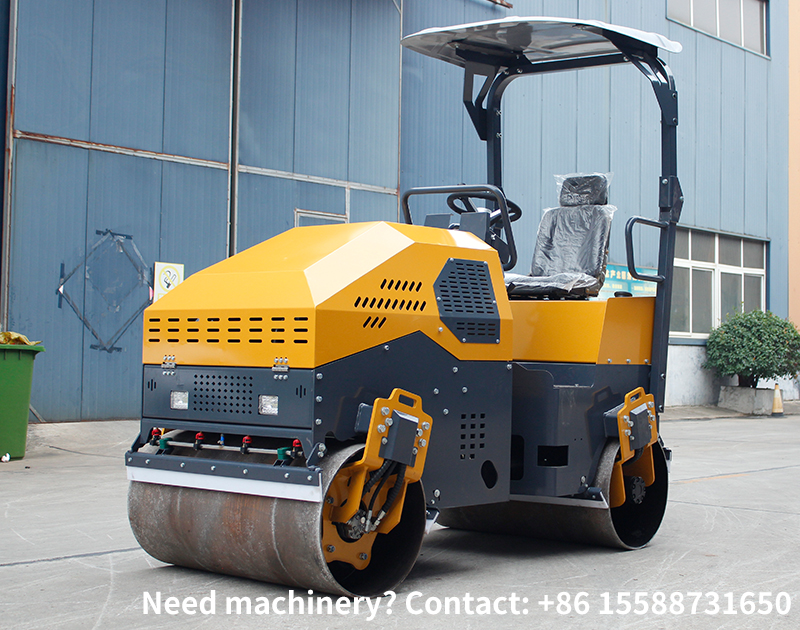
Applicable Working Conditions and Operation Scenarios
Suitable Scenarios for Vibratory Rollers
Most subgrade and base course compaction works, such as the compaction of gravel subgrades, cement-stabilized soil bases, and graded crushed stone layers. Some models can be used for the initial and intermediate compaction of asphalt pavements.Unsuitable Scenarios: Cohesive soil with excessively high moisture content (prone to spring soil formation), and final compaction of asphalt pavements sensitive to impact.
Suitable Scenarios for Static Rollers
Final compaction and leveling of asphalt pavements (to avoid aggregate structure damage caused by vibration), compaction of cohesive soil with high moisture content (to prevent soil liquefaction induced by vibration), and surface compaction and repair of small-scale sites.Unsuitable Scenarios: High-fill subgrades and large-scale projects requiring deep compaction.
Differences in Operation and Maintenance
Vibratory rollers: Operators need to adjust vibration parameters according to materials, which requires a relatively high level of proficiency. Maintenance focuses on inspecting the vibration system (eccentric blocks, bearings, hydraulic pipelines), and the failure rate is slightly higher than that of static rollers.
Static rollers: Simple to operate with no need to adjust vibration parameters, making them easy for beginners to master. Their simple structure only requires maintenance of the traveling system and braking system, resulting in low maintenance costs and difficulty.