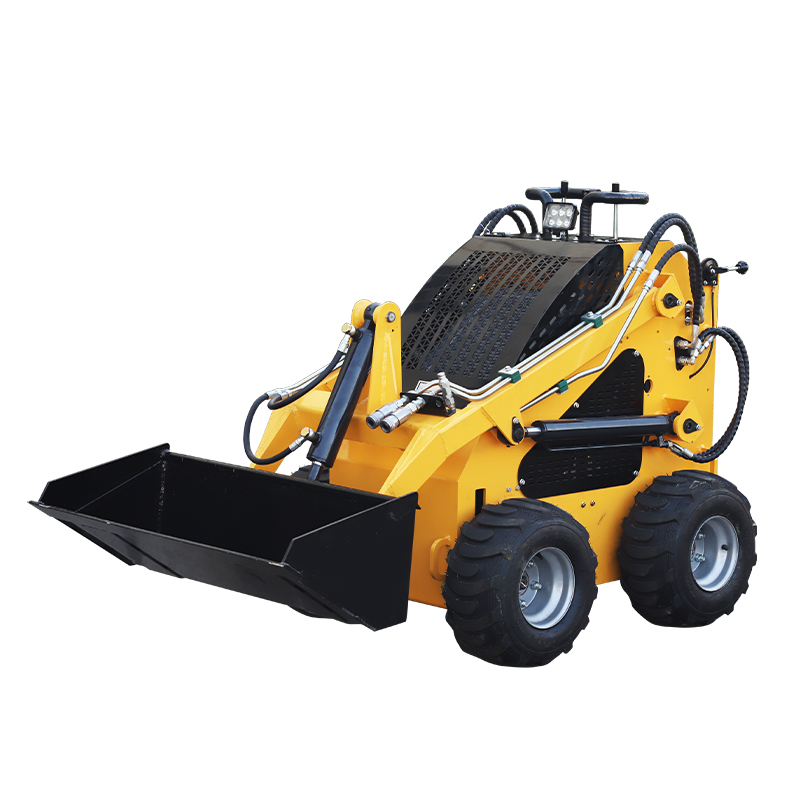
The "quick replacement" of skid steer loader attachments (such as buckets, breakers, log grapples, etc.) mainly relies on standardized quick-change devices (mechanical quick-change or hydraulic quick-change). The process has achieved a high level of automation, and a single person can complete the operation in 1-2 minutes. However, the replacement process involves key steps such as mechanical locking and hydraulic pipeline connection, so safe operation is a core prerequisite. The following details are provided from two aspects: "quick replacement process" and "safety precautions":
The quick-change devices of skid steer loaders are divided into mechanical quick-change (entry-level, relying on manual operation) and hydraulic quick-change (mainstream, fully automatic control). The processes of the two are slightly different, but the core logic is "unlock - separate the old attachment - connect the new attachment - lock". The specific steps are as follows:
Before starting the replacement, external risks must be eliminated first to create safe conditions for the replacement:
Park the Equipment: Park the skid steer loader on a level, hard, and non-sloped ground (to prevent attachments from falling due to the machine tilting). Turn off the engine, pull the handbrake, and remove the key (some models require shifting to neutral);
Clear the Site: Remove personnel and debris (such as tools, gravel) from the operation area to ensure no obstacles interfere with the replacement;
Inspect the Attachments: Confirm that the new attachment to be replaced is undamaged (e.g., no cracks in the bucket, no bending of the breaker chisel), and that the connection parts (pin holes, hydraulic interfaces) are free of oil stains, rust, or foreign objects (clean with a rag if necessary).
Hydraulic quick-change is a standard configuration for most skid steer loaders currently. Locking/unlocking can be completed through the operating lever in the cab, with the highest efficiency. The process is as follows:
Start the engine, and use the operating lever to lower the quick-change device to a height aligned with the connecting pin of the old attachment (e.g., bucket). The bottom of the quick-change device has a positioning groove that needs to be clamped into the connecting lug plate of the attachment;
Operate the "unlock lever" (inside the cab, usually red or yellow). The hydraulic system drives the locking hooks of the quick-change device to open, ensuring they can be smoothly fitted over the connecting pins of the old attachment.
Slowly operate the lifting lever to completely separate the quick-change device from the connecting pins of the old attachment (the old attachment will fall to the ground at this time; ensure the ground is level to prevent the attachment from tipping over);
If the attachment is equipped with hydraulic pipelines (e.g., breaker, grab bucket), first close the hydraulic shut-off valve (on the side of the quick-change device or the cab control panel), then pull out the hydraulic quick connectors (press the latch when pulling out the connectors to avoid hydraulic oil leakage);
Operate the loader to slowly reverse and completely separate from the old attachment (keep a distance of at least 1 meter to avoid collision).
Drive the loader close to the new attachment, adjust the machine position, and align the locking hooks of the quick-change device with the connecting pins of the new attachment;
Slowly move the loader forward to fit the quick-change device over the connecting pins of the new attachment (ensure the pins fully enter the positioning groove of the quick-change device; confirmation can be done through the cab observation window or auxiliary camera);
If the new attachment is equipped with hydraulic pipelines, first align and insert the hydraulic quick connectors (a "click" sound indicates that the locking is in place), then open the hydraulic shut-off valve (check for no oil leakage at the connectors).
Operate the "locking lever" in the cab. The hydraulic system drives the locking hooks to close, firmly locking the connecting pins of the new attachment (some models are equipped with a "locking indicator light", which turns on when locking is successful);
Slowly lift the new attachment (10-20 cm off the ground), swing the operating lever left and right, and check if the attachment is stable (no shaking, no abnormal noise);
Turn off the engine, and check again whether the locking hooks of the quick-change device are fully closed (if necessary, pull the locking hooks by hand to confirm they cannot be opened). The replacement is completed.
Mechanical quick-change has no hydraulic drive and requires manual insertion and removal of "locking pins" for fixation. The process is slightly more cumbersome, with the following steps:
Connect to the Old Attachment: Start the engine, lower the quick-change device to the connecting lug plate of the old attachment, and align the pin holes of the quick-change device with those of the attachment;
Manual Unlocking: Turn off the engine, get off the machine, and use a wrench or special tool to pull out the manual locking pins on the quick-change device (usually 2 pins, one on each side). At this point, the quick-change device is separated from the old attachment;
Separate and Connect to the New Attachment: The subsequent steps are the same as those for hydraulic quick-change (separate the old attachment and connect to the new attachment). However, after connecting to the new attachment, manually insert the locking pins, ensure the pins fully pass through the pin holes of the quick-change device and the attachment, and finally fix the locking pins with cotter pins or nuts (to prevent falling off);
Test Stability: Start the engine, lift the attachment for testing, and confirm there is no looseness before completing the replacement.
Improper operation during attachment replacement may lead to safety accidents such as "attachment falling, hydraulic oil spraying, and equipment collision". The following safety rules must be strictly followed:
Prohibit Unauthorized Single-Person Operation: When replacing hydraulic pipelines or mechanical locking pins, an auxiliary person must be present to observe (e.g., confirm the connectors are properly connected). Working alone under the equipment is prohibited;
Keep Unauthorized Personnel Away: Set up warning signs (e.g., "Maintenance in Progress, No Entry") in the operation area. Unauthorized personnel (especially children or irrelevant individuals) are prohibited from approaching;
Wear Protective Equipment Correctly: Operators must wear non-slip work shoes, safety helmets, and protective gloves (to prevent oil stains and scratches when pulling out hydraulic connectors, and prevent hand pinching when manually inserting/removing locking pins). If hydraulic oil leaks, wear goggles (to prevent oil from splashing into the eyes).
Prohibit Replacement of Loaded Attachments: Before replacement, the materials in the old attachment must be emptied (e.g., earth in the bucket, wood in the grab bucket). Replacing attachments with loads is prohibited (otherwise, the attachment will be too heavy, increasing the risk of falling);
Confirm Secure Locking: Whether using hydraulic or mechanical quick-change, after replacement, a "test lifting" must be conducted to confirm locking (lift the attachment 10 cm off the ground, let it stand for 30 seconds, and check for sinking or looseness). If the locking indicator light does not turn on or the manual locking pin is not inserted tightly, operation is prohibited;
Hydraulic System Safety:
The hydraulic shut-off valve must be closed before pulling out hydraulic connectors (otherwise, high-pressure hydraulic oil will spray, causing personal injury or oil waste);
If hydraulic connectors cannot be inserted, forced tapping is prohibited (check if the interfaces are aligned or if there is foreign object blockage);
After replacement, start the engine and slowly operate the hydraulic lever (e.g., the striking action of the breaker) to discharge air from the pipelines (to avoid "air resistance" causing sluggish attachment movement).
Ground Must Be Level and Hard: Replacing attachments on ground with a slope >5° or soft ground (e.g., mud, sand) is prohibited (easily causing the loader to tilt and the attachment to slide);
Prohibit Operation in Severe Weather: Replacement must be stopped in rainy, snowy, or strong wind weather (wind force > Level 6) (the ground is slippery and prone to skidding, and strong winds may blow materials);
Avoid Operation in Narrow Spaces: At least a 2m × 2m operation space must be reserved for attachment replacement (to facilitate personnel getting on/off the machine and observation). Replacement in indoor corners or next to walls is prohibited (no escape space if the attachment tips over).
Emergency for Attachment Falling: If an attachment accidentally falls during replacement, immediately turn off the engine. Forcibly moving the attachment is prohibited (use a jack or other equipment to lift the attachment, then check for faults in the quick-change device);
Emergency for Hydraulic Oil Leakage: If hydraulic connectors leak, immediately close the shut-off valve, wipe the leaked oil with a rag (to avoid ground slipping), and replace the damaged connector before continuing operation;
Emergency for Quick-Change Device Jamming: If the locking hooks of the hydraulic quick-change device cannot be unlocked or locked, first turn off the engine and check for blockage in the hydraulic pipelines (e.g., filter blockage). Forcibly operating the lever with brute force is prohibited (which may damage the hydraulic pump).
Core Principles: "Unlock first, then separate; connect first, then lock; no locking, no operation";
Safety Rhyme: "Park level and clear materials; test after secure locking; close the valve before plugging/unplugging hydraulics; keep unauthorized personnel away".
Through standardized processes and strict safety checks, the quick replacement of skid steer loader attachments can not only ensure efficiency but also completely avoid safety risks. Before operation, it is recommended to read the equipment manual again (details of quick-change devices may vary by brand) to ensure each step complies with the manufacturer’s specifications.



 Chinese