

 Chinese
- HOME >> NEWS >> Industry news
NEWS
Latest Product
Contact Us
What Are the Core Differences in Operating Scenarios Between Skid Steer Loaders and Ordinary Loaders?
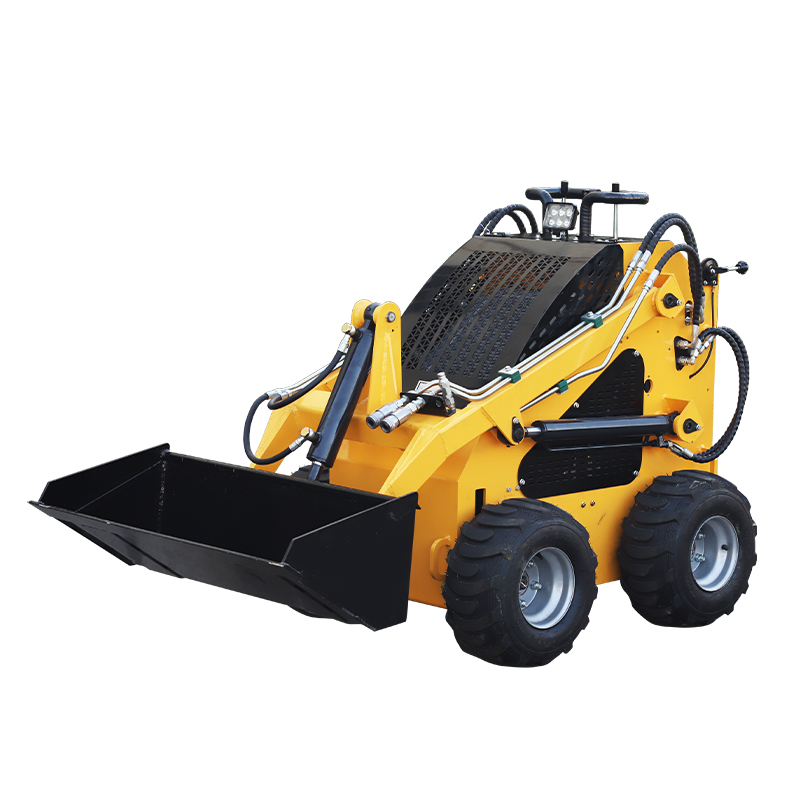
2025-08-28The core differences in operating scenarios between skid steer loaders and ordinary loaders (such as wheel loaders and track loaders) are essentially determined by their core characteristics, including structural design, flexibility, operating efficiency, and applicable space. The following comparison is made from the core dimensions of operating scenarios to clearly present the boundary of differences between the two:
I. Core Difference: Applicable Scenarios from the Perspective of "Operating Space"
Space is the most core dividing line for the scenarios of the two types of loaders. Skid steer loaders focus on "narrow and restricted spaces," while ordinary loaders are designed for "open large spaces." The specific differences are as follows:
| Dimension | Skid Steer Loader | Ordinary Loader (Wheel Loader / Track Loader) |
|---|---|---|
| Operating Space Requirement | Extremely small; can turn flexibly in a closed space of "3m × 3m" (zero-turn radius design) | Relatively large; requires a minimum reserved space of "5m × 8m" for turning/operation (conventional turning radius) |
| Typical Applicable Scenarios | 1. Indoor operations: Factory floor cleaning, warehouse cargo transfer, basement construction 2. Narrow sites: Urban village reconstruction, tunnel maintenance, small courtyard projects 3. Compact scenarios: Municipal sidewalk maintenance, underground auxiliary operations, loading/unloading inside ship holds/vehicle compartments | 1. Open outdoor sites: Construction site earth transfer, mine material loading, farmland leveling 2. Large-scale projects: Infrastructure projects (subgrade filling), bulk cargo loading/unloading at ports/terminals 3. Large-scale scenarios: Aggregate feeding at mixing plants, cargo stacking at large logistics parks |
| Advantage Under Space Restrictions | No additional space for turning required; can perform "edge-close operations" (e.g., cleaning waste along walls) | When space is sufficient, it has a large operating radius and can efficiently connect with large vehicles (e.g., heavy trucks) |
II. Differences in "Flexibility and Versatility" of Operating Scenarios
The core competitiveness of skid steer loaders lies in "fast switching of multiple functions," while ordinary loaders focus on "single heavy-load operating efficiency," leading to completely different scenario adaptation directions:
1. Skid Steer Loader: Scenario Adaptation of "One Machine, Multiple Functions"
Skid steer loaders can quickly switch dozens of operating tools through a quick-change device (tools can be replaced in 1-2 minutes), covering multi-scenario needs of "non-heavy loads." Typical scenarios include:
2. Ordinary Loader: Scenario Focus on "Heavy Load and High Efficiency"
Ordinary loaders take large buckets as the core attachment (some can be replaced with grab buckets, but the switching efficiency is low), focusing on heavy-load operations with "large load and high turnover." Scenarios are concentrated in:
III. Differences in "Efficiency and Load" of Operating Scenarios
The operating efficiency logic of the two is completely different: skid steer loaders "compensate for efficiency with flexibility," while ordinary loaders "improve efficiency with heavy loads." The specific scenario adaptations are as follows:
| Scenario Type | Role of Skid Steer Loader | Role of Ordinary Loader |
|---|---|---|
| Small-load, high-frequency operations | Main equipment: e.g., transfer of small cargo from shelves to trucks in logistics warehouses (single load 0.5-1 ton, frequent turning) | Not applicable: Slow turning, large body, easy to collide with shelves/equipment |
| Large-load, low-frequency operations | Not applicable: Small bucket capacity, requiring dozens of round trips to transfer 100 tons of materials, with extremely low efficiency | Main equipment: Single load 5-10 tons, completing the task in a few round trips |
| Short-distance operations (<50m) | Advantageous scenario: e.g., transporting construction waste from construction points to the door during indoor decoration (no long-distance movement, flexible turning) | Limited advantage: Large body, high turning cost in short distances |
| Long-distance operations (>100m) | Disadvantageous scenario: Slow driving speed (usually <15km/h), time-consuming for long-distance transfer | Advantageous scenario: Fast driving speed (some wheel loaders >30km/h), efficiently completing long-distance heavy-load transfer |
IV. Differences in "Environmental Adaptability" of Operating Scenarios
In addition to space, environmental factors also determine the scenario boundaries of the two:
1. Skid Steer Loader: Adaptation to "Complex Small Environments"
2. Ordinary Loader: Adaptation to "Open Large Environments"
Summary: Core Scenario Difference Comparison Table
| Core Dimension | Skid Steer Loader | Ordinary Loader |
|---|---|---|
| Operating Space | Narrow, closed, low (indoor/tunnel/courtyard) | Open, spacious (construction site/mine/port) |
| Operating Function | Multi-functional (loading, grabbing, breaking, sweeping, etc.), fast attachment switching | Single heavy-load (loading, transferring), low attachment switching efficiency |
| Load and Efficiency | Small load (0.3-1.5m³), short-distance, high-frequency | Large load (5-15m³), long-distance, low-frequency |
| Core Advantageous Scenarios | Indoor operations, narrow-space assistance, multi-functional precision operations | Outdoor heavy loads, large-scale material handling, long-distance transfer |
In short: For "small spaces, multi-scenarios, and light loads," choose a skid steer loader; for "large spaces, single scenarios, and heavy loads," choose an ordinary loader. The two are not substitutes but complementary equipment for different operating scenarios.