
 Chinese
- HOME >> NEWS >> Industry news
NEWS
Latest Product
Contact Us
How Is the Obstacle Avoidance Function of Remote-Controlled Lawn Mowers Implemented?
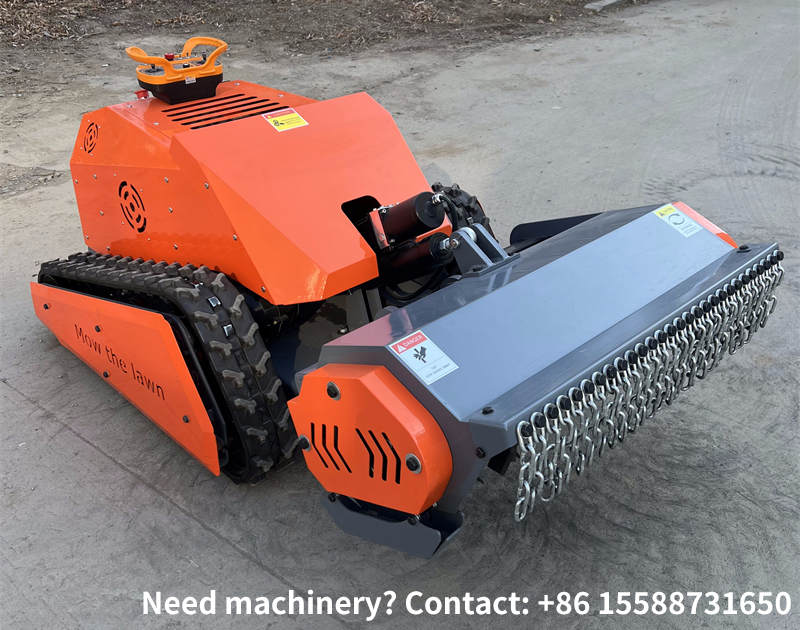
2026-01-15The obstacle avoidance function of remote-controlled lawn mowers is realized by sensors collecting environmental information, the control system analyzing and judging the data, and finally issuing commands such as "stop, detour, turn" to identify and avoid obstacles, thus preventing damage to the mower body or blades.
Common obstacle avoidance technologies are mainly divided into the following categories, each with different technical principles and applicable scenarios:
1. Mechanical Triggered Obstacle Avoidance (Passive Obstacle Avoidance)
This is the lowest-cost and most basic obstacle avoidance method. Elastic collision sensing rods and pressure sensors are installed at the front or sides of the mower. When the mower collides with obstacles such as walls, flower beds, or stones, the sensing rod is pressed to trigger a signal. The control system will immediately instruct the equipment to stop moving forward, reverse backward, and then turn to detour.
Advantages: Simple structure, low failure rate, suitable for small household lawns.
Disadvantages: There is a delay in obstacle avoidance. It can only be triggered by physical contact and cannot predict obstacles in advance.
2. Ultrasonic Obstacle Avoidance (Active Obstacle Avoidance)
Working on the principle similar to reversing radar, the mower is equipped with ultrasonic sensors. It emits high-frequency sound waves and receives the reflected waves to calculate the distance to obstacles. When the detected distance is less than the safety threshold, the equipment will decelerate, turn, or stop in advance.
Advantages: Not affected by light, can work day and night, suitable for identifying medium-distance obstacles such as low shrubs and flower bed edges.
Disadvantages: Weak ability to identify small objects (such as iron wires and thin branches), and easily interfered by environmental noise.
3. Infrared Obstacle Avoidance (Active Obstacle Avoidance)
It relies on infrared transmitting and receiving modules. The transmitting end emits infrared beams. When the beams are blocked and reflected by obstacles, the receiving end captures the signal and calculates the distance. It judges whether obstacle avoidance is needed according to the intensity of the infrared signal and the reflection time.
Advantages: Moderate cost, fast response speed, suitable for short-distance obstacle identification.
Disadvantages: Greatly affected by strong light (such as midday sunlight), prone to misjudgment, and poor identification effect on transparent objects (such as glass).
4. Visual Camera Obstacle Avoidance (Active Intelligent Obstacle Avoidance)
The mower is equipped with a high-definition camera, which cooperates with image recognition algorithms to capture and analyze the surrounding environment in real time. It can identify the shape and category of various obstacles such as stones, trees, pedestrians, and pets, and even distinguish between "stones that need to be avoided" and "weeds that can be cut".
Advantages: High recognition accuracy, wide application range, and can realize more intelligent path planning.
Disadvantages: Limited by light conditions (supplementary lights are needed at night), high requirements for algorithm computing power, and relatively high cost.
5. LiDAR Obstacle Avoidance (Active High-Precision Obstacle Avoidance)
Short for "Light Detection and Ranging", it emits laser beams to scan the surrounding environment, draws a high-precision 3D point cloud map of the environment, and accurately judges the position, size and shape of obstacles. Its obstacle avoidance accuracy and distance far exceed ultrasonic and infrared technologies.
Advantages: Strong anti-interference ability, high precision, can realize long-distance prediction and detour, suitable for commercial/industrial-grade mowers in complex terrain.
Disadvantages: Highest cost, strict requirements for the computing and processing capacity of the equipment.
6. Multi-Sensor Fusion Obstacle Avoidance
This is the mainstream solution for high-end models. It combines two or more technologies from ultrasonic, infrared, visual camera and LiDAR to complement each other's advantages. For example, LiDAR is used for long-distance large-range scanning, ultrasonic for short-distance precise detection, and visual camera for auxiliary identification of obstacle types, which greatly improves the reliability and accuracy of obstacle avoidance.