
 Chinese
- HOME >> NEWS >> Industry news
NEWS
Latest Product
Contact Us
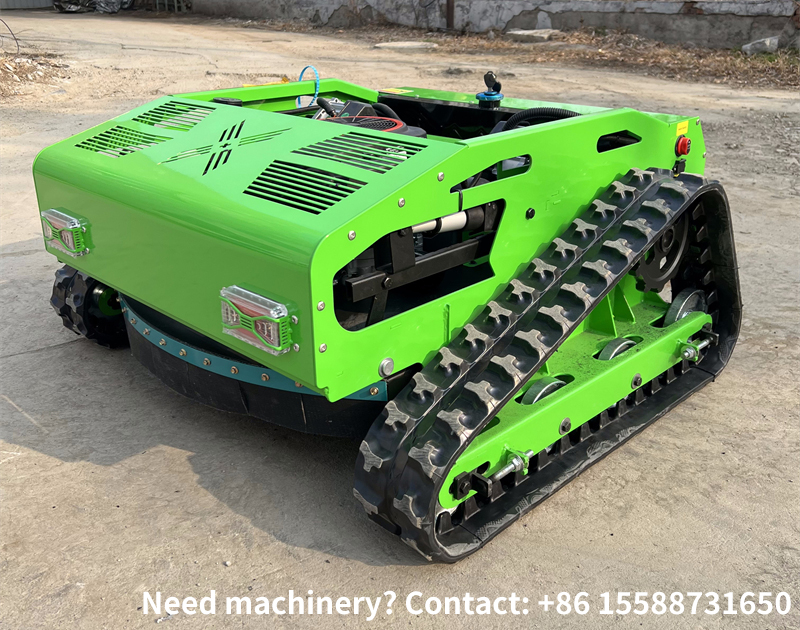
What Is the Typical Remote Control Range of a Remote-Controlled Lawn Mower?
2026-01-15The remote control range of a remote-controlled lawn mower varies significantly depending on the model positioning, with distinct numerical ranges between household-grade and industrial-grade products.
I. Common Remote Control Range Ranges
Household-Grade Remote-Controlled Lawn MowersMainly adopt 2.4GHz wireless RF technology, with a remote control range generally between 50–150 meters. This range is sufficient to cover household scenarios such as villa courtyards and small gardens, meeting the operator’s demand for remote control from a safe area.
Commercial/Industrial-Grade Remote-Controlled Lawn MowersDesigned for scenarios like orchards, river embankments, and large-area lawns. Some models are equipped with enhanced antennas or adopt 433MHz RF technology, with a remote control range of up to 200–500 meters. A few high-end industrial models support long-distance data transmission modules, with a maximum remote control range exceeding 1000 meters.
II. Core Factors Affecting Signal Stability
Obstacle BlockageThis is the most important factor affecting the signal. Solid obstacles such as trees, walls, and large shrubs will block or reflect wireless signals, leading to signal attenuation, delay, or even interruption. Especially in dense orchards or complex terrains with many obstacles, signal stability will decrease significantly.
Electromagnetic InterferenceSurrounding electronic devices generate electromagnetic interference that affects remote control signal transmission. For example, high-voltage lines, base stations, other wireless devices (such as drone remote controls and WiFi routers), as well as metal fences and large metal components, will interfere with the signal frequency band, causing remote control freezes or malfunctions.
Antenna Performance and InstallationThe material, gain, and installation angle of the antennas on both the remote control and the mower directly affect signal strength. High-gain antennas provide longer signal transmission distance and stronger anti-interference capability. Damaged, bent, or poorly connected antennas will directly degrade signal quality.
Environmental and Climatic ConditionsSevere weather disturbs signal stability: water vapor in rainy days absorbs wireless signals; heavy fog and sand dust reduce signal transmission efficiency; extreme high or low temperatures may affect the working status of circuit boards and signal modules, indirectly reducing signal stability.
Battery PowerWhen the battery power of the remote control or the mower is low, the signal transmission power decreases, resulting in shortened remote control range and unstable signals. In particular, when the power is too low, "loss of control" or "signal disconnection" is likely to occur.
Frequency Band CompatibilityDifferent models use different remote control frequency bands (such as 2.4GHz and 433MHz), which have varying anti-interference capabilities. The 2.4GHz frequency band is widely used in devices, making it prone to interference, but it has a high transmission rate. The 433MHz frequency band has fewer interference sources and strong penetration, making it more suitable for long-distance transmission.