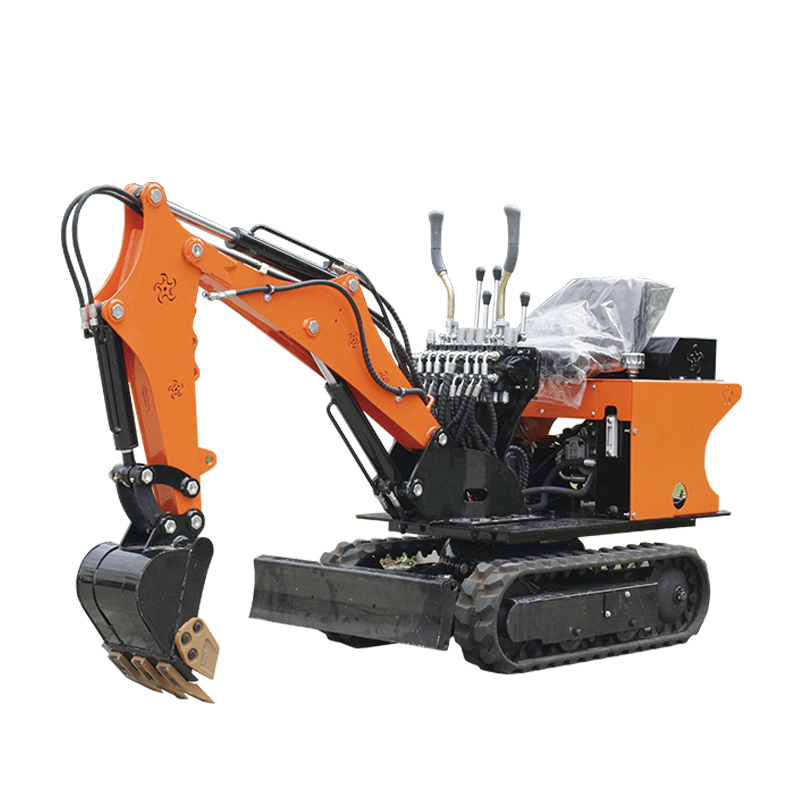
The bucket capacity of an excavator is one of the core parameters that directly determines the earthwork volume. Its size significantly impacts the overall progress of earthwork projects by influencing the single-operation volume, operation cycle efficiency, and adaptability to working conditions. The following analysis is conducted from three aspects: specific mechanisms, practical cases, and limiting factors:
Basic Differences in Single Excavation Volume
Bucket capacity (usually measured in cubic meters (m³) or cubic yards (yd³)) directly determines the amount of earth that can be loaded in a single excavation. Under ideal working conditions (such as loose earth without spillage), a larger capacity means a higher earthwork volume per operation:
For example, a 0.5m³ bucket can hold 500kg of earth at a time (loose soil density is approximately 1.6t/m³), while a 2m³ bucket can hold 3.2t at a time, with a difference of more than 6 times in single loading volume.
If two excavators have the same operation cycle time (e.g., 1 minute per cycle), the hourly operation volume of the 2m³ bucket is theoretically 4 times that of the 0.5m³ bucket (actual filling rate differences need to be considered).
Indirect Improvement in Operation Cycle Efficiency
A "cycle" in earthwork operations refers to the complete process of "excavation → rotation → unloading → return". Although a large bucket may slightly prolong the single cycle time (e.g., slower speed when lifting heavy objects), the total earthwork volume per unit time is still significantly higher due to the greater increase in single loading volume:
Suppose: A 0.5m³ bucket has a cycle time of 30 seconds, 120 cycles per hour, and an actual filling rate of 80%, so the hourly operation volume is 0.5×120×80% = 48m³;
A 2m³ bucket has a cycle time of 40 seconds, 90 cycles per hour, and a filling rate of 70% (large buckets are prone to insufficient filling due to material viscosity), so the hourly operation volume is 2×90×70% = 126m³, with an efficiency increase of 162.5%.
Matching with Transportation Equipment
In earthwork operations, excavators need to unload materials in coordination with transportation equipment such as trucks. The matching degree between bucket capacity and truck bucket capacity directly affects overall efficiency:
If the bucket capacity is too small (e.g., a 0.5m³ bucket matched with a 10m³ truck), it takes 15-20 times to fill a truck, resulting in excessive waiting time for the truck and slowing down the overall progress;
If the capacity is properly matched (e.g., a 2m³ bucket matched with a 10m³ truck), it can be filled in 5-6 times, improving truck utilization and indirectly enhancing the efficiency of earthwork transportation.
The following is a reference for bucket capacity and earthwork volume of common tonnage excavators:
| Excavator Tonnage Class | Standard Bucket Capacity (m³) | Daily Loose Earthwork Volume (m³) | Daily Hard Soil/Gravel Volume (m³) | Core Limiting Factors |
|---|
| 6-ton class | 0.2-0.3 | 200-400 | 100-200 | Small capacity, only suitable for small projects |
| 15-ton class | 0.6-0.8 | 800-1200 | 500-800 | Medium load, suitable for 10-15t trucks |
| 20-ton class | 1.0-1.2 | 1500-2000 | 1000-1500 | Efficient balance, widely used in general earthwork |
| 30-ton class | 1.8-2.5 | 3000-4000 | 2000-3000 | Needs to be matched with heavy trucks over 20t, suitable for large infrastructure |
| Above 50-ton class | 3.0-5.0+ | 5000-8000+ | 4000-6000+ | Only applicable to mines and large filling projects |
It is not true that a larger capacity always leads to a higher operation volume. It needs to match the following conditions; otherwise, efficiency may be reduced:
Excavator power and stability:
A large bucket (e.g., a 2.5m³ bucket installed on a 20-ton excavator) will increase excavation resistance and the overall load of the machine. If the engine power is insufficient, it is prone to "stalling" (flameout during excavation), which will instead prolong the cycle time. At the same time, heavy loads may cause the machine body to shake, increasing operational risks.
Material characteristics:
Loose soil (such as sandy soil): Large buckets have a high filling rate (80%-100%), showing obvious efficiency advantages;
Viscous soil/hard rock: Large buckets are prone to material sticking and difficulty in entering the soil, and the filling rate may drop to 50%-60%. The actual operation volume improvement is limited, and even slower due to high resistance.
Working space:
In narrow sites (such as indoor demolition and tunnel projects), large buckets have a large rotation radius and are prone to colliding with obstacles, so small-capacity buckets must be used for operation.
Bucket capacity directly determines the earthwork volume through single loading volume, cycle efficiency, and equipment matching. On the premise of adapting to the machine power, material characteristics, and working space, a larger capacity leads to a more significant improvement in operation volume. In actual selection, it is necessary to combine the project scale (daily/monthly earthwork demand), transportation equipment capacity, and material hardness to choose a "highly adaptable" bucket instead of blindly pursuing a large capacity.



 Chinese