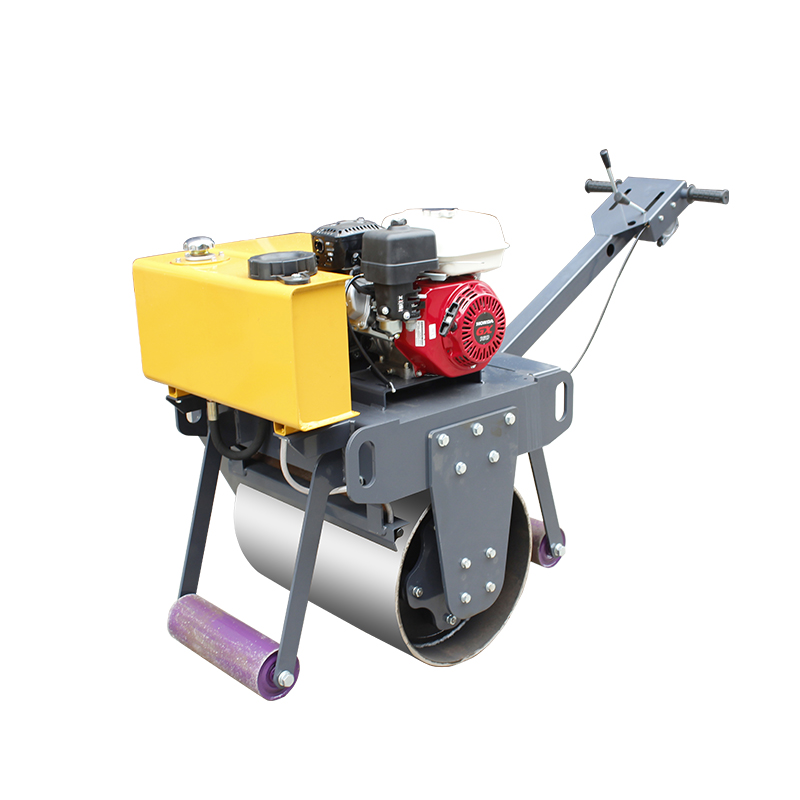
The braking system of a road roller is a core component ensuring construction safety. Its design must adapt to the roller's own working characteristics (such as heavy load, low speed, frequent starts and stops, complex road environments, etc.). Compared with the braking systems of ordinary cars or construction machinery, it has the following significant features:
The braking system of a road roller usually consists of three parts: service brake, parking brake, and auxiliary brake, with clear division of labor and mutual cooperation:
Service Brake: Mainly used for decelerating or stopping during driving.
Air-over-hydraulic brake: Uses air pressure to push the hydraulic pump, transmitting pressure to the brake shoes / calipers. It has a fast braking response and large braking force (suitable for heavy-duty rollers over 10 tons).
Full hydraulic brake: Directly drives the brake piston through hydraulic oil, with a compact structure and simple maintenance (suitable for small rollers under 3 tons).
Core components: Mostly use air-over-hydraulic brakes or full hydraulic brakes (large rollers often use air-over-hydraulic, small rollers mostly use full hydraulic).
Features: Large braking torque (needs to overcome the inertia of the roller's own weight; for example, the braking force of a 20-ton roller must be ≥ 150kN), and can adapt to low-speed and high-frequency braking (during construction, it is often necessary to stop frequently to adjust direction at a speed of 1-5km/h).
Parking Brake: Used to prevent the vehicle from rolling when parked.
Core components: Mostly mechanical drum brakes (pulling the brake shoes through the handbrake cable) or hydraulic locking brakes (using hydraulic valves to lock the brake cylinder).
Features: The parking braking force needs to be lasting and stable, especially during slope construction (such as road slope compaction), it must be able to withstand the downward force generated by the roller's own weight (usually required to keep the vehicle stationary on a 30° slope).
Auxiliary Brake: Reduces wear of the service brake.
Common forms: Engine exhaust brake (reduces engine speed by closing the exhaust passage to generate resistance for deceleration) or hydraulic retarder (consumes kinetic energy using hydraulic oil resistance).
Applicable scenarios: Compaction on long downhill sections (such as mountain road construction). The auxiliary brake can prevent the service brake from failing due to overheating caused by long-term friction (the "heat fade" phenomenon).
Vibration resistance and impact resistance
During operation (especially vibratory rollers), the roller body will generate strong vibrations (amplitude 0.5-2mm, frequency 25-50Hz). The components of the braking system (such as brake pipes, connecting bolts) need to adopt anti-vibration designs:
Pipes use high-pressure vibration-resistant hoses (instead of rigid steel pipes) to avoid loose joints and oil / air leakage caused by vibration;
The gap between the brake shoes and the brake drum needs to be slightly larger than that of ordinary vehicles (usually 0.3-0.5mm) to prevent "virtual contact" wear caused by vibration.
Adapting to harsh environments
Road rollers often work in environments with dust, mud, high temperatures (asphalt road surface temperature can reach 60-80℃ in summer) or low temperatures (below -10℃ in winter). The braking system must have:
Dust and water resistance: The brake disc / drum is equipped with a protective cover to prevent mud from entering and jamming the brake components;
High temperature resistance: Brake pads use ceramic or metal-based composite materials (ordinary cars use resin-based materials), which can withstand high temperatures of 300-500℃, reducing braking force attenuation at high temperatures;
Low temperature adaptability: Hydraulic brake fluid uses low-freezing-point models (such as below -40℃) to avoid brake failure due to freezing in winter.
Linkage with operation modes
When a vibratory roller turns on the vibration function, the braking system will automatically limit the driving speed (usually ≤5km/h) and enhance the braking force (20%-30% higher than in non-vibration mode) to prevent excessive braking distance caused by excessive inertia in the vibration state;
Some intelligent rollers are equipped with "hill-start assist brake": when a slope ≥5° is detected, the system will maintain braking for 3-5 seconds after the brake pedal is released, facilitating the driver to switch the accelerator when starting on a slope and avoiding rolling.
Compared with ordinary cars, the braking performance parameters of road rollers are significantly different, as follows:
| Parameter | Road roller (taking 10-ton class as an example) | Ordinary car (taking 1.5-ton class as an example) | Reason for difference |
|---|
| Braking distance (30km/h) | ≤8 meters | ≤6 meters | Road rollers are heavy with large tire contact area (large rolling resistance but also large inertia) |
| Brake pedal force | 200-300N | 100-150N | Heavy loads require greater braking force, with pedal force amplified by power assist devices (air pump / hydraulic pump) |
| Heat fade recovery time | ≤5 minutes | ≤2 minutes | Brake components are large in size and dissipate heat slowly |
Due to the harsh working environment and high load, the maintenance frequency of the road roller's braking system is higher than that of ordinary vehicles:
Regularly clean the dirt and oil on the brake disc / drum (every 50 working hours) to avoid insufficient braking force caused by reduced friction coefficient;
Vibratory rollers need to additionally check the linkage device between the braking system and the vibration motor (such as sensors, control valves) to ensure that the braking parameters are automatically adjusted normally when vibration is turned on;
The parking brake cable or hydraulic lock needs to be lubricated monthly to prevent rust and jamming (especially in rainy areas).
The braking system of a road roller is a comprehensive system featuring "heavy load adaptation, vibration resistance and weather resistance, and working condition linkage". Its design revolves around safety needs in construction — it must not only overcome the inertia generated by its own weight but also adapt to special environments such as vibration, dust, high and low temperatures. At the same time, it improves operational safety through linkage with operation modes. In daily maintenance, focus should be placed on anti-vibration components, high-temperature resistance, and brake linkage functions to ensure braking reliability in complex construction scenarios.



 Chinese