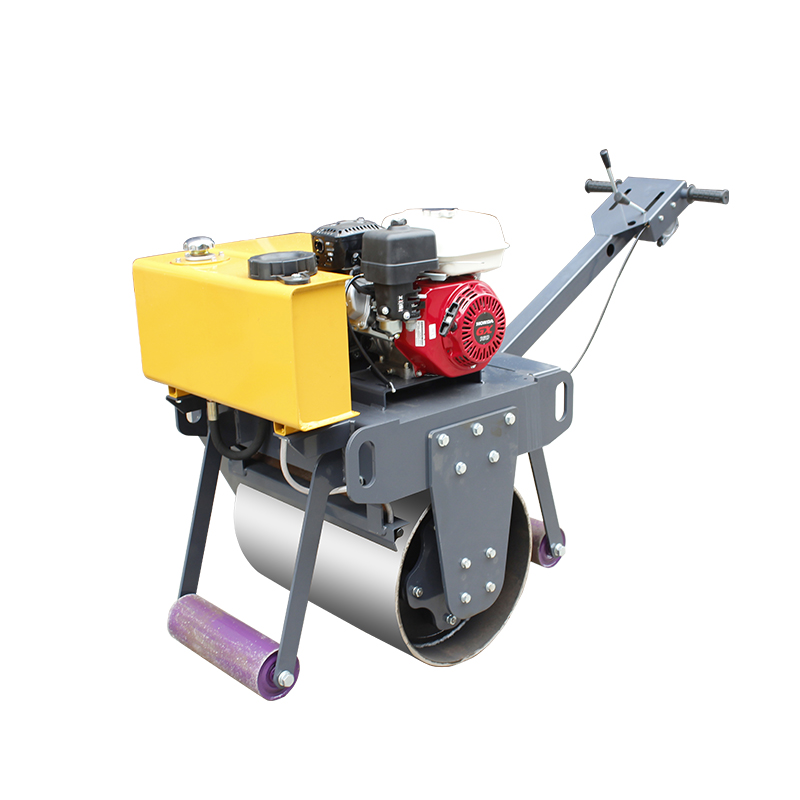
When road rollers work in plateau areas, due to environmental characteristics such as reduced air pressure, thin air, decreased oxygen content, and large temperature differences between day and night caused by increased altitude, their performance will inevitably decline to a certain extent. The specific manifestations and reasons are as follows:
Significant attenuation of power system performance
Decrease in engine power:
In plateau areas (such as above 3000 meters above sea level), the oxygen content is only 70%-80% of that in plain areas, and the combustion efficiency of diesel engines (the mainstream power source for road rollers) will be greatly reduced.
Performance: The power decreases by about 20%-30% (for every 1000 meters increase in altitude, the power decreases by 8%-10%), resulting in weakened climbing ability and reduced operating speed of the road roller (for example, the flat driving speed drops from 5km/h to 3-4km/h). Especially in the vibration compaction mode (which requires an additional 30%-50% power consumption), "insufficient power" or even flameout may occur.
Reasons: Lack of oxygen leads to insufficient fuel combustion, reduced cylinder pressure, and decreased output torque; at the same time, insufficient air intake will cause the engine to overheat (the heat dissipation efficiency of the cooling system also decreases due to low air pressure), further exacerbating power attenuation.
Increased fuel consumption:
To maintain the basic output power, the engine needs to increase fuel injection, but incomplete combustion leads to a 10%-20% increase in fuel consumption (for example, fuel consumption per hour in plain areas is 8L, which may increase to 9-10L in plateau areas).
Reduced efficiency of the hydraulic system
Attenuation of hydraulic pump and motor performance:
The hydraulic system relies on the pressure of hydraulic oil to transmit power, and the low temperature in plateau areas (with a temperature difference of 20-30℃ between day and night) will increase the viscosity of hydraulic oil and deteriorate its fluidity.
Performance: Hydraulic components (such as vibration motors and steering pumps) respond slowly, the vibration start-up time is prolonged (from 2-3 seconds in plain areas to 5-6 seconds), and steering operations become heavy; at the same time, low temperatures may cause hardening of the seals at the joints of hydraulic pipelines, increasing the risk of oil leakage.
Reasons: Low temperature increases the friction between hydraulic oil molecules, reduces the oil absorption efficiency of the pump, and increases system pressure loss; in addition, thin air leads to poor ventilation of the hydraulic oil tank, which may cause cavitation (bubbles mixed in the oil), exacerbating the wear of hydraulic components.

Decreased reliability of the braking system
Insufficient pressure in the air braking system:
For road rollers using air-over-oil braking, the air intake volume of the air compressor decreases with the increase of altitude (for every 10kPa decrease in air pressure, the air intake volume decreases by about 5%).
Performance: The inflation time of the air reservoir is prolonged (from 3-5 minutes in plain areas to 8-10 minutes), the stroke of the brake pedal becomes larger, the braking force is attenuated by about 15%-20%, and the braking distance increases (for example, the braking distance at 30km/h increases from 8 meters to more than 10 meters).
Reasons: The suction pressure of the air compressor is reduced, and the output compressed air volume is insufficient, resulting in the brake pipeline pressure failing to reach the design value (usually 0.7-0.8MPa in plain areas, which may drop to 0.5-0.6MPa in plateau areas).
Insufficient heat dissipation capacity of the cooling system
The engine water temperature is prone to overheating:
In plateau areas, due to low air pressure, the boiling point of water decreases (for example, the boiling point is about 85℃ at an altitude of 4000 meters). After the coolant boils, it is easy to produce air resistance, leading to the interruption of the heat dissipation cycle.
Performance: The engine water temperature gauge alarms frequently, forcing shutdown for cooling, which affects construction efficiency; long-term overheating will also cause wear of piston rings and deformation of the cylinder block.
Reasons: Low air pressure reduces the heat dissipation efficiency of the fan (low air density reduces the air volume flowing through the radiator per unit time), and at the same time, the low boiling point of the coolant leads to inherent insufficient heat dissipation capacity.
To alleviate performance degradation, road rollers adapted to plateau environments usually undergo the following optimizations:
Adjusting the fuel injection advance angle: The ECU (Electronic Control Unit) delays the fuel injection time to adapt to the combustion rhythm in thin air and reduce black smoke emissions (products of incomplete combustion).
Increasing the diameter of the hydraulic oil tank vent or installing an air intake filter to avoid cavitation.
Adopting auxiliary braking (such as exhaust braking) to reduce reliance on service braking and avoid overheating failure.
Using high-pressure coolant (with a higher boiling point, such as adding ethylene glycol antifreeze) to avoid low-temperature boiling.
When road rollers work in plateau areas, the power, hydraulic, braking, and cooling systems will all experience varying degrees of performance degradation. The core reasons are lack of oxygen, low temperature, and reduced air pressure. Through targeted modifications (such as turbocharging, low-viscosity hydraulic oil, and enhanced heat dissipation), performance attenuation can be effectively alleviated, ensuring construction efficiency and safety. In actual operation, it is also necessary to pay attention to reducing the time of heavy-load operations and regularly checking the heat dissipation and braking systems to adapt to the special plateau environment.


 Chinese