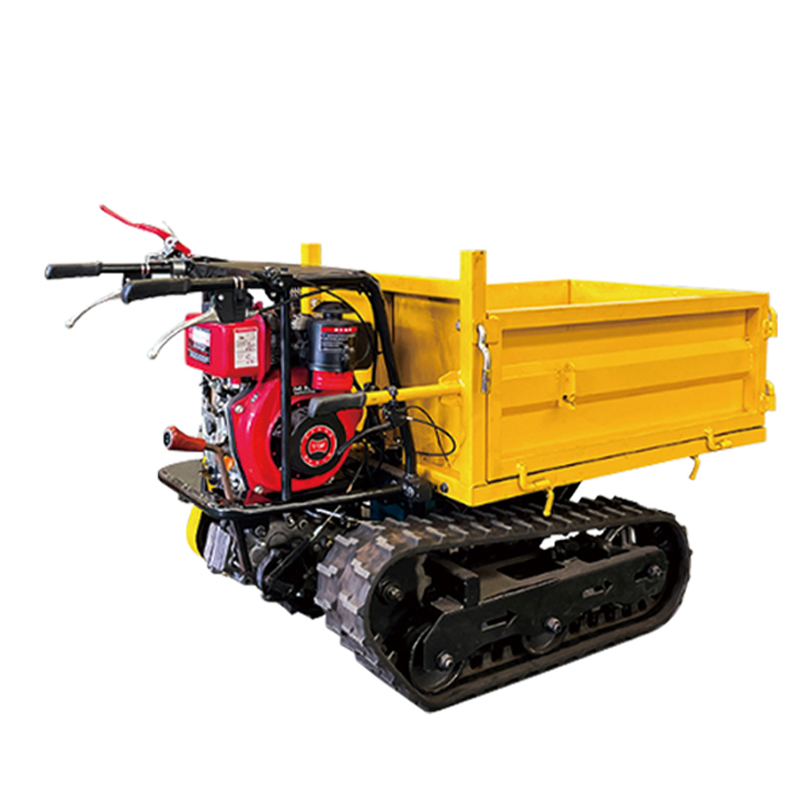
In simple terms, a loader's rated load capacity refers to the maximum weight of materials it can lift and carry as specified in its design, under the premise of safe and stable operation. It is a core indicator for measuring a loader's load-bearing capacity and must never be exceeded for an extended period. Exceeding it can damage the equipment and may even lead to safety accidents.
This value is not arbitrarily set. Instead, it is a "safety upper limit" determined by the manufacturer through rigorous calculations and tests, taking into account key parameters such as the equipment's structural strength, power, and hydraulic capacity. The purpose is to ensure operational efficiency while avoiding risks like equipment damage or rollover.
The rated load capacity is not a "weight that can be achieved anytime and anywhere"; it has clear applicable scenarios, mainly including two points:
Standard Operating Environment: The operation must take place on a flat and solid surface (such as a concrete road or compacted earth road). Additionally, the loader should be moving straight or turning slowly, with materials evenly loaded in the bucket. If operating on a steep slope or muddy ground, the actual safely loadable weight will be lower than the rated value.
No Damage to Equipment Service Life: Operating with loads exceeding the rated capacity for a long time can cause frame deformation, hydraulic cylinder oil leakage, rapid wear of tires (or tracks), and even engine overload. In severe cases, it may lead to bucket breakage or equipment rollover. These are all risks that the rated load capacity is intended to avoid.
When determining this value, manufacturers focus on "safety" and "performance balance", considering 5 key aspects, and finally confirming it through calculations and physical tests:
Evaluate Structural Load-Bearing Capacity: First, calculate the strength of the steel used in the frame, bucket, and boom (main arm). Then, test whether these components will deform or break under different weights. The rated load capacity must be lower than the critical value at which the structure "cannot withstand" the load, as this is the most basic hardware upper limit.
Assess Hydraulic System Lifting Capacity: The hydraulic pump, oil cylinder, and pipelines all have a maximum working pressure. Tests are conducted to check if they can stably lift materials of the corresponding weight. If the hydraulic system cannot lift the load, the rated load capacity must be reduced even if the structure can withstand it.
Check Overall Machine Stability: Simulate various scenarios under heavy loads, such as turning or climbing slopes while lifting materials, and observe whether the center of gravity shifts beyond the support range (the contact area of the tires or tracks). The rated load capacity must ensure that the equipment does not roll over in these scenarios.
Verify Power Sufficiency: Test the engine's torque and speed under heavy loads to ensure the equipment can operate normally, including driving, lifting, and unloading materials, without experiencing a situation where "there is power but it cannot be used". If the power is insufficient, the rated value must be lowered even if other components can withstand the load.
Compliance with Industry Safety Standards: The rated load capacity must comply with national or international industry standards (such as ISO standards and China's GB/T standards) and pass verification by third-party testing institutions. Only after confirming that the value is safe and compliant can it be marked on the equipment.
There is no need to calculate it yourself; you can directly obtain the accurate value through 3 channels:
Check the Machine Nameplate: Each loader has an "ex-factory nameplate" attached to the side of the cab, the front of the frame, or near the bucket. The nameplate clearly indicates the "rated load capacity" (often marked in English as "Rated Load Capacity"), with units typically in tons (t) or kilograms (kg). This is the most direct method.
Refer to the Product Manual: The "Product Operation Manual" or "Technical Parameter Handbook" provided when purchasing the equipment lists all the core parameters of the loader in detail, including the rated load capacity. It also explains the corresponding operating conditions to help you determine the applicable scenarios.
Consult the Manufacturer or Dealer: If the nameplate is lost or the manual cannot be found, you can contact the manufacturer's customer service or the local dealer by providing the loader's model (such as a certain brand's L956F or ZL50GN) and serial number. You will be able to obtain the original rated load capacity data, as the information of each piece of equipment is archived.
Many people mistakenly believe that "a larger bucket capacity means a higher rated load capacity", but this is incorrect. The relationship between the two is "Rated Load Capacity = Bucket Capacity × Material Density". However, the density of different materials varies significantly: for example, the density of dry sand is approximately 1.6 t/m³, and that of gravel is about 2.2 t/m³. For a bucket with a capacity of 3 m³, it can hold approximately 4.8 tons of dry sand but around 6.6 tons of gravel. If your loader's rated load capacity is 5 tons, you must load less gravel to avoid overloading.



 Chinese