

 Chinese
- HOME >> NEWS >> Industry news
NEWS
Latest Product
Contact Us
How Does a Roller's Operating Weight Affect Compaction Results?
2025-06-05The operating weight of a roller is one of the most critical factors influencing compaction effectiveness. Its mechanism and impact are as follows:
1. Compaction Principle & Weight Relationship
Static Compaction: Relies solely on machine weight (e.g., static rollers). Heavier weight increases vertical pressure, improving compaction depth.
Vibratory Compaction: Effective compaction force = static linear pressure + dynamic impact. Weight determines the base static pressure, while vibration frequency/amplitude enhances results.
2. Specific Effects of Operating Weight on Compaction
| Parameter | Effect of Increased Weight | Consequences of Insufficient Weight |
|---|---|---|
| Compaction Depth | Significantly improves deep-layer density (critical for subgrade work) | Only surface compaction; base layers remain loose |
| Uniformity | Wider pressure distribution, reduces uneven settling | Visible wheel marks, poor smoothness |
| Efficiency | Fewer passes needed (e.g., 20-ton roller requires 2-3 fewer passes vs. 10-ton) | More passes, higher time and energy costs |
| Material Suitability | Ideal for coarse soils, gravel, and hard-to-compact materials | Risk of over-compacting clay or asphalt (requires precise weight control) |
3. Weight Selection Guidelines for Different Applications
Subgrade/Base Compaction (earthwork, gravel):
Recommended Weight: 12-20 tons (single-drum vibratory roller).
Reason: High impact force needed to penetrate deep layers; insufficient weight causes "false compaction."
Asphalt Surface Compaction:
Recommended Weight: 8-14 tons (double-drum or pneumatic tire roller).
Reason: Excessive weight crushes aggregates; balance density and material integrity.
Thin-Layer Compaction (e.g., sidewalks):
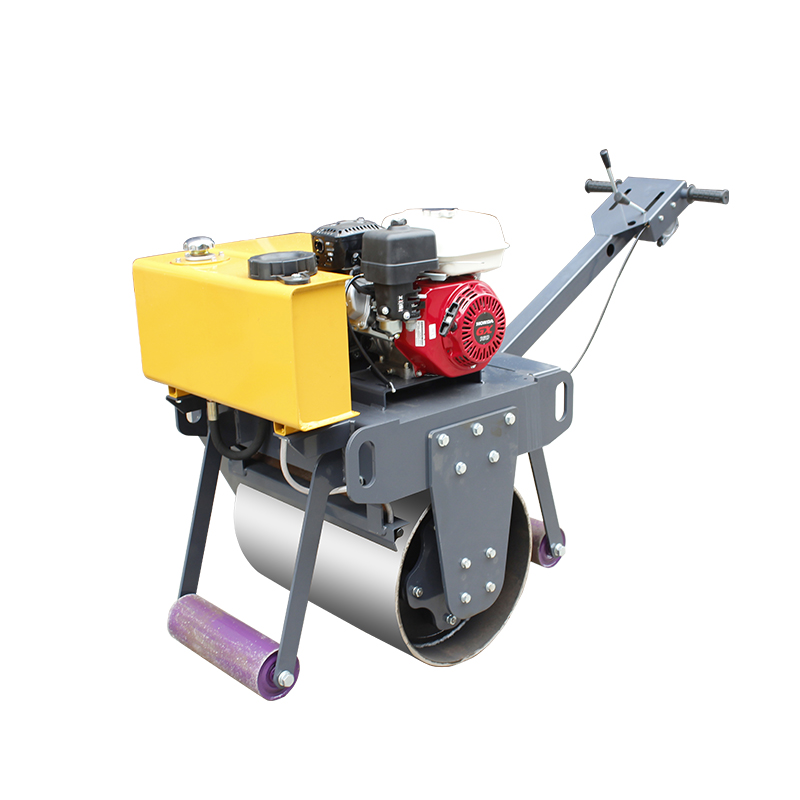
Recommended Weight: 1-5 tons (small rollers).
Reason: Prevents over-settlement or shear failure.
4. Weight Adjustment Techniques
Hollow Drum Filling: Temporarily increase weight by 20%-40% (e.g., 10-ton → 12-14 tons) by adding water/sand.
Counterweights: Some models allow fine-tuning with removable weights.
5. Synergy with Other Parameters
Vibration Frequency/Amplitude: Heavy rollers with high amplitude compact thicker layers (e.g., 30 cm gravel).
Tire Contact Pressure: Pneumatic rollers adjust tire pressure to avoid localized over-compaction.
6. Risks of Excessive Weight
Material Damage: Crushed asphalt aggregates or "spring soil" (elastic deformation in clay).
Terrain Limits: May sink in soft soil or damage bridges; weight reduction is necessary.
Conclusion
Select roller weight based on material type, layer thickness, and construction phase:
Earthwork/Subgrade: Prioritize heavy weights (for penetration force).
Asphalt/Thin Layers: Precise weight control (balances density and smoothness).
Adaptability: Use water/sand filling or counterweights for dynamic adjustments.
Pro Tip: Conduct test sections before full-scale work to determine optimal weight and pass count, ensuring cost-effectiveness and quality.