

 Chinese
- HOME >> NEWS >> Industry news
NEWS
Latest Product
Contact Us
What Is the Typical Climbing Ability of Road Rollers?
2025-06-05The climbing ability of road rollers varies significantly depending on type, drive system, weight, and other factors. General ranges are as follows:
1. Climbing Ability Comparison by Roller Type
| Roller Type | Gradeability (Slope) | Typical Applications | Limiting Factors |
|---|---|---|---|
| Single-drum vibratory | 20%-25% | Earthwork, mining | Rear-wheel drive may slip (vibration assists) |
| Double-drum | 15%-20% | Asphalt paving, municipal work | Lower steel drum traction |
| Pneumatic tire | 25%-30% | Clay compaction, rough terrain | Strong tire grip but higher center of gravity (rollover risk) |
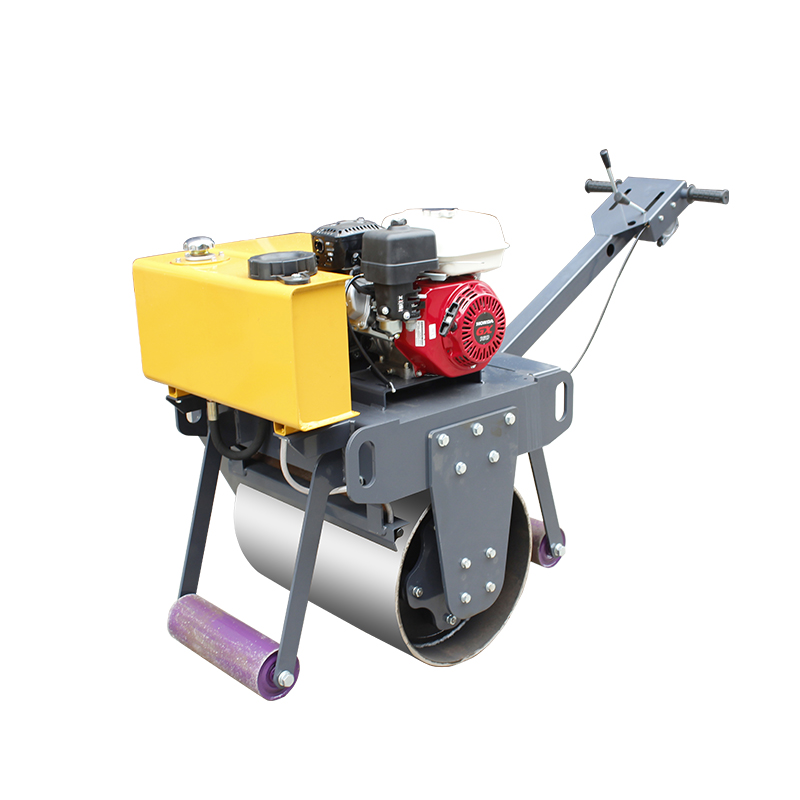
| Small walk-behind | 30%-35% | Narrow slopes, landscaping | Lightweight and agile |
2. Slope Percentage Explanation
Percentage slope (e.g., 20%): For every 100 meters horizontally, the elevation rises 20 meters vertically.
Angle conversion: 20% slope ≈ 11.3° (Formula: Slope angle = arctan(slope percentage)).
Industry standards: Rollers typically require ≥20% gradeability (custom models for extreme slopes).
3. Key Factors Affecting Climbing Performance
Drive system: All-wheel drive (e.g., double-drum) > rear-wheel drive (e.g., single-drum).
Weight distribution: Front-heavy single-drum rollers are more stable uphill but require caution downhill.
Ground conditions: Dry gravel allows max slope; wet clay demands reduced speed or slope angle.
Vibration mode: Engaging vibration uphill improves traction (avoid drum slippage).
4. Slope Operation Guidelines
Longitudinal Climbing:
Maintain steady speed; avoid direction changes or sudden stops (prevents rollback).
For heavy rollers (>18 tons), limit slopes to ≤15%.
Transverse Work:
On slopes >10%, use zigzag patterns to prevent side-slipping.
Safety Measures:
Install slope anti-slip chains (extreme conditions).
Disable vibration downhill; use engine braking.
5. Specialized Models
Articulated rollers: Up to 35% (e.g., Hamm HD+ series for steep mining slopes).
Crawler rollers: 40%-50% (high mobility but low efficiency; rarely used).
Conclusion
Standard projects: Choose rollers with ≥20% gradeability.
Steep/complex terrain: Prioritize pneumatic tire or articulated rollers; conduct slope tests if needed.
Safety first: When exceeding the calibrated slope of the equipment, segmented construction or auxiliary measures must be taken.
Note: Always consult the manufacturer’s specifications for exact limits.