
 Chinese
- HOME >> NEWS >> Industry news
NEWS
Latest Product
Contact Us
What Determines the Climbing Capacity of Remote-Controlled Lawn Mowers? What Is the General Maximum Climbing Angle?
2026-01-15The climbing capacity of a remote-controlled lawn mower is jointly determined by four core factors: the power system, chassis structure, tire grip, and body center-of-gravity design. Its maximum climbing angle varies significantly between household and industrial models due to different positioning.
I. Core Determinants of Climbing Capacity
1. Power System
This is the core driving force for climbing, directly determining whether the equipment can overcome slope resistance.
Electric Models: Depend on motor power and torque—the higher the torque, the stronger the "force" to drive the equipment uphill. The stability of battery output also affects the endurance during steep-slope operations.
Gasoline-Powered Models: The engine displacement and power determine the upper limit of power. Large-displacement models are more suitable for high-load steep-slope operations.
2. Chassis Structure and Ground Clearance
The higher the chassis ground clearance, the less likely the equipment will be scratched or stuck by protruding stones and clods on the slope, ensuring passability during climbing.
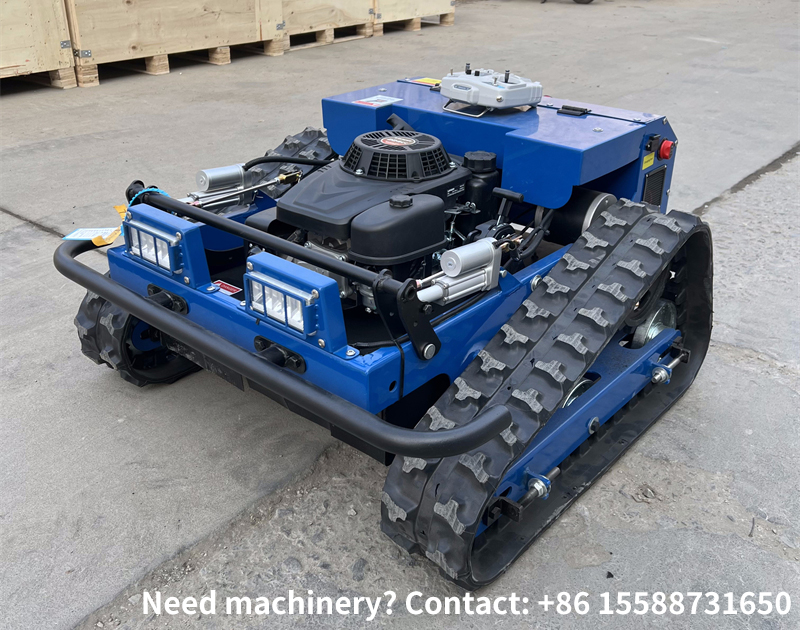
Tracked chassis has stronger climbing capacity than wheeled chassis. The large contact area between tracks and the ground prevents slipping easily, making it suitable for steeper slopes.
3. Tire Grip
The tire material and tread directly affect the friction with the ground:
Rubber tires with deeper anti-slip treads and more wear-resistant materials have stronger grip and are less likely to slip on wet and slippery slopes.
Some industrial-grade models are equipped with anti-slip tracks to further improve adhesion on complex slopes.
4. Body Center-of-Gravity Design
A lower center of gravity, positioned closer to the middle of the body, makes the mower less prone to rollover during climbing.
Household models are lighter with relatively simple center-of-gravity design, making them more sensitive to slopes when climbing.
Industrial-grade models optimize the center of gravity through counterweights to enhance stability during steep-slope operations.
II. Common Range of Maximum Climbing Angles
The marked maximum climbing angle of a remote-controlled lawn mower generally refers to dry, flat lawn slopes. On wet, slippery, or soft slopes, the actual climbing capacity will decrease by 10°–15°.
1. Household-Grade Remote-Controlled Lawn Mowers
Positioned for small courtyards and mild slopes, their maximum climbing angle is generally 15°–25°. Most of these models adopt a wheeled design with lightweight power and chassis configurations, suitable for daily mowing operations on small-slope lawns.
2. Commercial/Industrial-Grade Remote-Controlled Lawn Mowers
Designed for complex scenarios such as orchard slopes and river embankment slopes, their maximum climbing angle can reach 30°–45°. These models mostly use tracked chassis and high-power motors/engines; some high-end models are also equipped with anti-rollover sensors to ensure safety during steep-slope operations.