

 Chinese
- HOME >> NEWS >> Industry news
NEWS
Latest Product
Contact Us
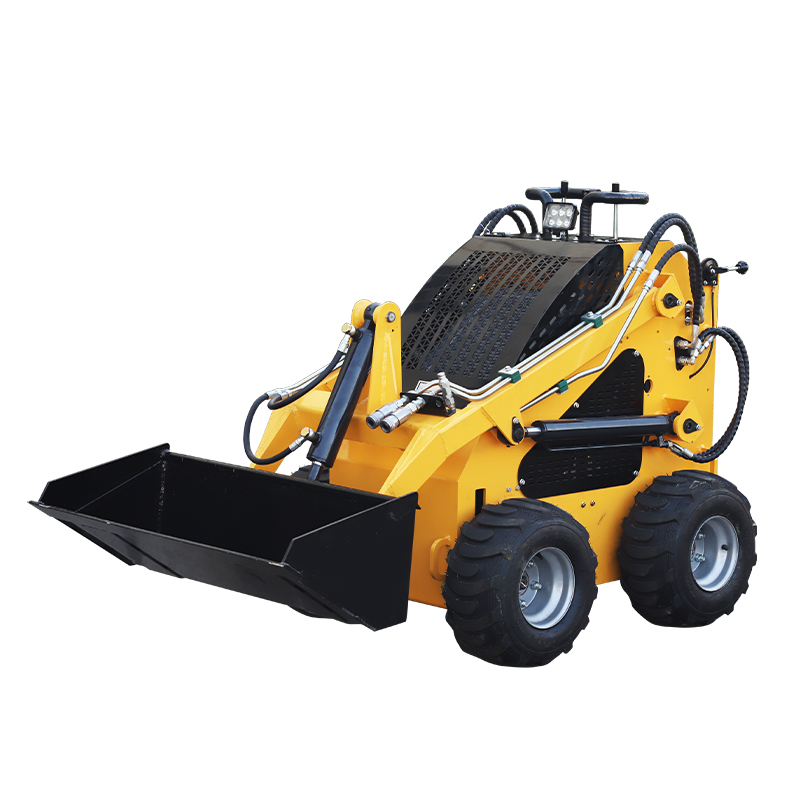
What is the steering mechanism of a skid-steer loader, and what are its characteristics?
2025-06-19A skid-steer loader employs a skid-steer mechanism, which relies on independent drive systems for the left and right wheels (or tracks) to achieve steering, unlike traditional differential or articulated steering in conventional vehicles.
1. How Skid-Steer Steering Works
Independent left/right drive: The left and right wheels (or tracks) are powered by separate hydraulic motors or drive systems.
Steering methods:
Differential steering (different speeds on each side) → Smooth turning.
Single-side braking (one side stops, the other moves) → Tight-radius turn.
Counter-rotation (left side forward, right side reverse) → Zero-turn (pivoting in place).
Straight-line movement: Both sides move at the same speed in the same direction.
Turning: Achieved by adjusting wheel speed or direction, including:
2. Key Features of Skid-Steer Steering
(1) Advantages
✅ Ultra-tight turning radius:
Can pivot in place (zero-turn), ideal for confined spaces (e.g., warehouses, construction sites, orchards).
✅ Exceptional maneuverability:
More agile than traditional loaders in tight areas (e.g., indoors, narrow passages).
✅ Simple structure, easy maintenance:
No differential system, reducing mechanical complexity and failure rates.
✅ Adaptable to various terrains:
Tracked skid-steer loaders perform better on soft ground (e.g., mud, snow).
(2) Disadvantages
❌ High tire/track wear:
Forced scrubbing during turns accelerates wear (especially on hard surfaces).
❌ Risk of ground damage:
May scrape or mark asphalt, concrete, or other hard surfaces.
❌ Requires skill to operate:
Beginners may struggle with the abrupt steering response.
❌ Poor high-speed stability:
Lacks a differential, making steering less stable at higher speeds.
3. Skid-Steer vs. Traditional Steering Comparison
| Steering Type | Skid-Steer (Skid-Steer Loader) | Differential (Wheel Loader) | Articulated (Articulated Loader) |
|---|---|---|---|
| Mechanism | Independent wheel drive, sliding friction | Differential adjusts wheel speeds | Hydraulic cylinders pivot front/rear frames |
| Turning Radius | Minimal (zero-turn possible) | Larger | Moderate |
| Ground Damage | High (may scratch surfaces) | Low | Low |
| Best For | Tight spaces, multi-tasking | Open areas, high-speed work | Rough terrain, heavy loads |
| Ease of Control | Higher skill required | Easier | Moderate |
4. How to Optimize Skid-Steer Operation?
Choose the right tires/tracks:
Pneumatic tires: Smoother on hard surfaces.
Solid tires: Durable for rocky/construction sites.
Tracks: Reduce ground pressure, ideal for soft terrain.
Operating tips:
Avoid sharp turns on hard surfaces to minimize wear.
Use gradual steering inputs instead of sudden turns.
Maintenance:
Check hydraulic systems to ensure balanced motor pressure.
Replace severely worn tires/tracks promptly.
Conclusion
The skid-steer mechanism gives skid-steer loaders unmatched agility in confined spaces and multi-functional tasks, but it also leads to tire wear and potential ground damage. Proper operation and maintenance maximize performance, making these machines ideal for municipal, agricultural, and construction applications.